
Film and Finishes
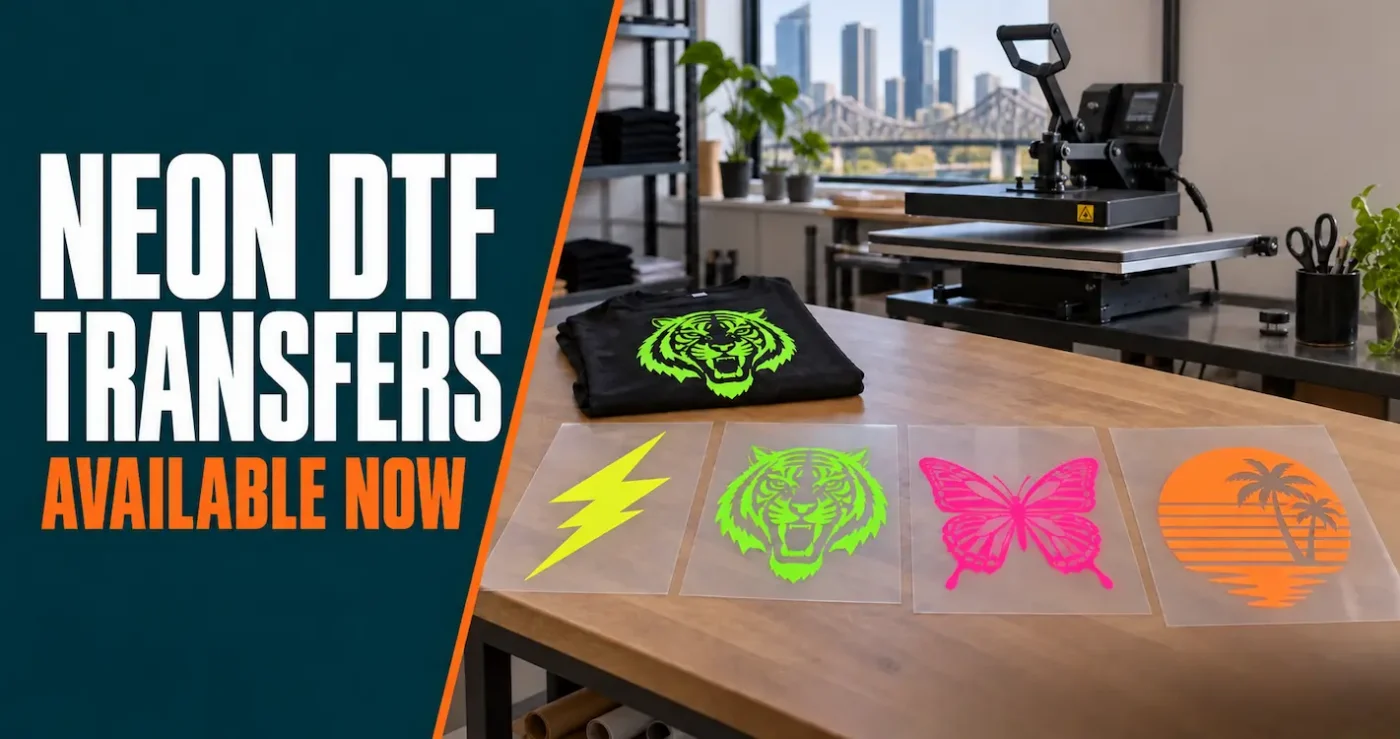
Neon DTF Transfers: Yellow, Green, Pink and Orange
Jun
Originally posted: 25 June 2026. Last updated: 5 October 2026.
Quick summary
Neon DTF is a cold-peel cut sheet in yellow, green, pink, or orange. One colour per 280 × 390 mm sheet. It does not glow and it is not a gang sheet. Cotton and most fabrics: 160°C for 8 seconds, cool, then peel. Polyester: 120°C for 30 seconds, cold peel, then 10 seconds at 120°C. A household iron will not press it.
On this page
What you are ordering
You choose one neon film: yellow, green, pink, or orange. We print your art on a 280 × 390 mm sheet. The colour is the film, not a CMYK mix that happens to look bright. You cannot put yellow and pink on the same sheet.
It is a cut sheet, not a 28 cm or 58 cm gang sheet. It is not glow-in-the-dark and it is not reflective. Those are other films, listed in specialty finishes. We do not sell the raw roll. We sell the printed transfer. Blank shirts are at T Shirts Australia.
Artwork and shirts
Send PNG, JPEG, or WebP. A transparent PNG at about 300 DPI at the size it will be on the shirt is the right file. Crop it. Keep lines at least about 1 mm. Stay under 254 MB. Do not mirror it.
Neon film is loud. It needs a shirt that can take the contrast. Mesh, heavy rib, and a seam under the print all steal contact. Polyester can mark or shift dye. Look at the real fabric in daylight before you approve a club colour from a screen.
How to press
Neon is cold peel. Do not peel it the way you peel a cotton Hot Insta Peel gang sheet.
- Lint-roll and pre-press until there is no steam. See moisture and pre-pressing.
- Lay the adhesive on the fabric. Cover it with your own parchment, baking paper, or Teflon.
- Cotton and most fabrics: 160°C, 8 seconds, firm pressure. Take it off the press and let it cool completely.
- Peel low and slow. If the film takes the design with it, stop, lay it back, and press again.
- Polyester: 120°C, 30 seconds, firm, cold peel, then a 10-second second press at 120°C. Test that garment. DTF on polyester covers dye migration.
A heat press that covers the design is the reliable tool. A Cricut EasyPress is fine when the platen fully covers the design. A household iron is not. Steps for the EasyPress are in how to apply DTF with an EasyPress.
Mistakes
- Peeling while it is hot. The neon layer comes away in patches.
- Using an iron because the design is small. Small does not make it iron-on.
- Promising a glow. This film is bright in the light. It does not store light.
- Judging the colour from a monitor. Press one test on the shirt you will actually sell.
FAQ
Are neon DTF transfers available now?
Yes, as printed cut sheets in yellow, green, pink, and orange. They are not gang sheets by the metre, and we do not sell the blank film roll.
What size is a neon sheet?
280 × 390 mm. You place the art on that sheet. One neon colour per sheet. Yellow and pink cannot share it.
Can I apply neon with a household iron?
No. Neon is a cold-peel specialty sheet. A household iron is only for products labelled iron-on. A Cricut EasyPress is fine when its platen fully covers the design. Otherwise use a heat press that does.
Can neon go on polyester?
Test it. Press at 120°C for 30 seconds, firm pressure, cold peel, then 10 seconds at 120°C. Polyester dye and coatings can still mark or shift. Do not assume every polyester behaves like cotton.
Does neon glow in the dark or reflect light?
No. Neon is a bright film colour under normal light. Glow-in-the-dark and reflective are different sheets. Order those if that is the effect you need.
