
Insta-Peel DTF Film: Now in Production in Australia
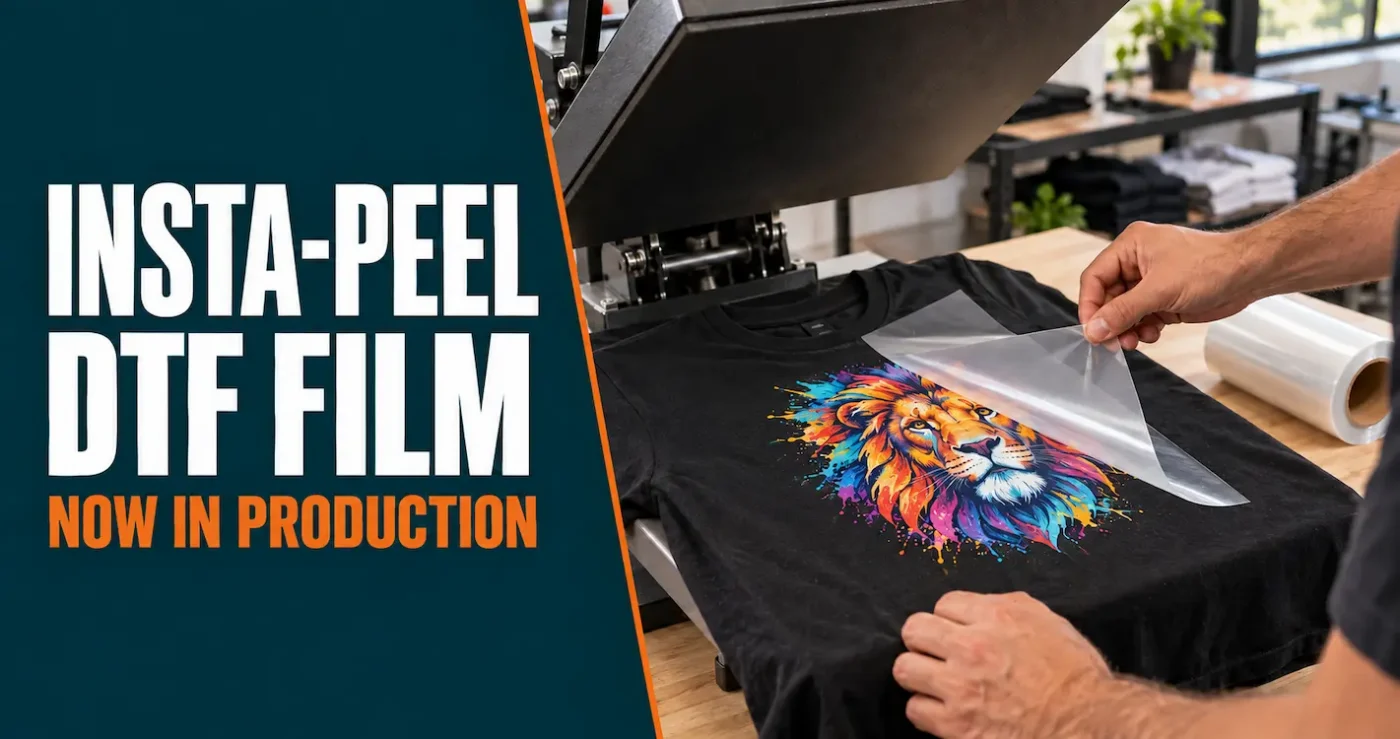
Clear Insta-Peel DTF carrier film being removed from a colourful transfer on a black T-shirt

When we first wrote about Insta-Peel DTF film, a roll had arrived for testing and the planned production change was still ahead of us. That testing is now complete. Insta-Peel is the film we currently use for our standard DTF transfers and gang sheets.

The change is more than a new product name. On cotton and most suitable fabrics, Insta-Peel allows the clear carrier to be removed immediately after the heat press opens: 160°C for 8 seconds at firm pressure. On suitable polyester, cold peel only: 120°C for 30 seconds at firm pressure, then a 10-second second press at 120°C. Immediate peel is not for every fabric.

This article records what changed after our original tests, where Insta-Peel fits within our current range and what customers need to know before pressing it.

Originally published: 26 June 2026
Last updated: 22 September 2026

At a glance

  • It is now in production: Insta-Peel film is used for our standard DTF gang sheets and cut sheets unless the product is labelled otherwise.
  • Peel by fabric: cotton and most suitable fabrics, 160°C for 8 seconds, firm pressure, peel immediately while hot. Suitable polyester, 120°C for 30 seconds, firm pressure, cold peel only. Then a 10-second second press, at 120°C on polyester.
  • A heat press is required: Insta-Peel describes the peeling method; it does not make a standard transfer suitable for a household iron.
  • Iron-On DTF is a separate product: choose transfers specifically labelled Iron-On when using a household iron or suitable craft press.
  • Speciality finishes remain cold peel: metallic, glitter, glow, neon, pearl and reflective sheets use their own instructions.
  • Testing still matters: instant peeling does not remove the need to pre-press, check garment suitability, use even pressure and complete the finishing press.

Insta-Peel DTF film is now in production

The original version of this article announced that Insta-Peel film was being tested ahead of a proposed late-August arrival. That stage has passed. We have run the film through our production equipment, pressed transfers onto a range of suitable garments and moved it into our standard workflow.

If you order one of our standard DTF gang sheets or cut sheets today, it will be produced using our current Insta-Peel system unless the product page or packing information identifies a different transfer type.

This distinction matters because we also offer dedicated Iron-On DTF transfers and cold-peel speciality finishes. The word “DTF” describes the broader process; it does not mean every product uses the same carrier film, peel timing or application equipment.

What is Insta-Peel DTF film?

DTF film is the coated carrier that holds a printed design while the transfer is manufactured and applied. The design, white ink and adhesive are prepared on the film. During application, heat and pressure bond the transfer to the garment, and the clear carrier is then removed.

On cotton and most suitable fabrics, Insta-Peel is peeled immediately while hot: the carrier comes off as soon as the heat press opens, after 160°C for 8 seconds at firm pressure. On suitable polyester, cold peel only: press at 120°C for 30 seconds at firm pressure, let the transfer cool completely before peeling, then do a 10-second second press at 120°C.

That is the main practical difference. “Insta-Peel” does not mean the transfer needs no preparation, uses no adhesive or can be applied with any source of heat. The bond still depends on a suitable garment, a proper heat press, correct settings and even pressure.

For the wider history of the terms, see our guide to cold peel, hot peel and Insta-Peel DTF film. Our DTF hybrid film guide explains how earlier hot-and-cold-peel technology led towards the faster films used today.

Why we changed our standard DTF film

A new film has to work in production, not simply look impressive on a supplier’s sample. Before changing our standard workflow, we needed to see how it behaved through printing, adhesive application, curing, packing and customer-style heat pressing.

The immediate peel was attractive because it could simplify application for decorators. With an older cold-peel workflow, each garment needed somewhere to cool before the carrier could be removed and the print finished. Earlier hot-peel films shortened the wait but could still require a brief pause.

Insta-Peel allows an operator to move directly from the initial press to peeling and then to the finishing press. That is particularly useful for batches, personalised uniforms and orders where similar garments must remain in the correct sequence.

Speed alone was not enough to justify the change. The film also had to release consistently, reproduce detailed artwork and deliver a finish we were willing to supply under the DTF Transfers Australia name.

What we found during workshop testing

We tested the film in our own Brisbane production environment rather than relying only on specifications. The original trials included print appearance, carrier release, hand feel, adhesion and behaviour on materials that can be less forgiving than a standard cotton T-shirt.

Clean immediate release

When the garment, press settings and pressure are correct, the carrier can be peeled immediately after the press opens. The peel should be smooth and controlled rather than rushed or snapped away from the fabric.

If part of the design begins to lift, stop peeling, lower the film back into position and repress according to the fitting instructions. Continuing to pull is likely to damage the transfer.

A slightly softer feel than some earlier films

Our testing found the finished print had a slightly softer hand feel than some older hot-peel films we had used. “Hand feel” means how noticeable the design feels when touched or worn.

The film is only one factor. Artwork coverage, ink, adhesive, curing and the final press also influence the result. A large solid rectangle will still feel more substantial than lettering or a design with open areas.

Promising results on more difficult materials

We also trialled the system on surfaces that need more care than everyday cotton. The results were encouraging, but they did not make every fabric automatically suitable.

Polyester can mark under heat or allow garment dye to migrate into a light print. Stretch fabrics, coatings and textured materials introduce other variables. Test the exact garment style and colour before approving a production run. Our DTF printing on polyester guide explains the additional risks.

Which transfers use Insta-Peel?

Transfer rangeCurrent peel methodApplication equipment
Standard DTF gang sheetsInsta-Peel: hot peel on cotton/most fabrics; cold peel on polyesterProper heat press
Standard DTF cut sheetsInsta-Peel: hot peel on cotton/most fabrics; cold peel on polyesterProper heat press
Dedicated Iron-On DTFFollow the Iron-On product instructions; do not use the standard Insta-Peel methodHousehold iron, suitable craft press or heat press as instructed
Metallic, glitter, glow, neon, pearl and reflective speciality sheetsCold peelProper heat press

Speciality finishes are supplied as sheets rather than speciality gang sheets. They use different films and application instructions, so a successful Insta-Peel test does not establish the settings for a speciality transfer.

Our Iron-On DTF guide explains which transfers suit a household iron and why standard gang sheets still require a heat press.

Film is only one part of the production system

It is easy to focus on the carrier film because peeling is the part customers can see. Transfer quality, however, depends on the complete system: artwork, film coating, ink, adhesive, curing, storage and application all work together.

Our standard ready-to-press DTF transfers use our current powder-adhesive production workflow. Liquid-adhesive transfers have been discontinued. Gang sheets use Coltex inks; cut sheets and iron-on transfers use Brother Innobella inks.

We do not sell these production adhesives to the public. Customers receive a printed, cured and ready-to-press transfer. Our responsibility is to control the manufacturing process; the decorator’s responsibility is to store and apply the finished transfer correctly.

Keep unused sheets dry, flat and protected until use. For more detail, read our guide to storing DTF transfers before pressing.

Current Insta-Peel pressing guidance

The following settings are starting points for DTF Transfers Australia’s current standard Insta-Peel transfers. They are not universal settings for every supplier, film or garment. Always test on a spare garment first — heat presses and fabrics vary.

For cotton and most suitable fabrics, start at 160°C for 8 seconds with firm pressure and peel immediately while hot. For suitable polyester, start at 120°C for 30 seconds with firm pressure and cold peel only. Complete the 10-second final press at the same temperature. Always test first and follow the instructions supplied with your order.

SettingCotton and other suitable fabricsSuitable polyester
Temperature160°C120°C
Initial press8 seconds30 seconds
PressureFirm and evenFirm and even
PeelImmediately while hotCold peel only — cool completely before peeling
Finishing press10 seconds at the same temperature10 seconds at 120°C

Use a clean cover sheet for the finishing press. Pre-press the garment before positioning the transfer, and continue until no visible steam remains. Moisture can interfere with adhesion even when the fabric initially feels dry; our article on moisture and DTF transfers explains why.

Heat presses vary in temperature accuracy and pressure. Garments also differ by fabric, dye, coating and construction. Test the complete process on the actual garment before pressing a customer order or production batch.

Always check our current DTF transfer fitting instructions and the information supplied with your order. Current product instructions take priority over an old screenshot, saved chart or setting used for a previous film.

What changed from the original announcement?

The first version of this article recorded an active test program. Several points have now been resolved:

  • The film has arrived: Insta-Peel is in regular production rather than awaiting a proposed release date.
  • It is our standard system: standard gang sheets and cut sheets now use Insta-Peel unless stated otherwise.
  • The Low Temp adhesive was not adopted: it has been discontinued from our planned adhesive range.
  • Iron-On became a separate product: customers using a household iron must choose sheets specifically labelled Iron-On.
  • Speciality remains separate: specialty films use cold-peel application and their own settings.

Updating an announcement in this way matters. A “coming soon” post becomes misleading once the product is in use, particularly when testing decisions and application instructions have changed.

Troubleshooting Insta-Peel transfers

What happensWhat to check
Part of the design lifts with the carrierStop peeling. Check moisture, heat, dwell time, pressure and whether a seam or raised area prevented contact. Repress before trying again.
One side adheres and the other does notCheck platen alignment, pressure distribution, temperature consistency and the position of the garment.
The carrier is difficult to removeConfirm that the transfer is current Insta-Peel stock and that you are peeling immediately using the correct settings.
The garment shows a press markStop and reassess heat, pressure and fabric suitability. Some polyester and coated fabrics are heat-sensitive.
A white area changes colourCheck for polyester dye migration. Lower-temperature application can reduce risk but does not make every dyed garment suitable.
The print lifts after washingReview the initial bond, finishing press and care process. Test a fresh garment before continuing the batch.

Frequently asked questions

Is Insta-Peel film now available?

Yes. It is used for DTF Transfers Australia’s current standard gang sheets and cut sheets unless the product is identified as a different transfer type.

Do I need to wait before peeling Insta-Peel film?

For cotton and most suitable fabrics, peel immediately while hot after 160°C for 8 seconds at firm pressure. For suitable polyester, cold peel only after 120°C for 30 seconds at firm pressure. Then do a 10-second second press, at 120°C on polyester. Follow the instructions supplied with your order.

Can I peel an Insta-Peel transfer after it cools?

On cotton and most suitable fabrics, peel immediately while hot. On suitable polyester, cold peel only and let it cool completely before peeling. Do not hot-peel polyester. If production is interrupted, test the affected transfer rather than forcing the carrier off.

Can Insta-Peel DTF transfers be applied with a household iron?

No. Our standard Insta-Peel gang sheets and cut sheets require a proper heat press. Choose our dedicated Iron-On DTF range when using a household iron or suitable craft press.

Are speciality DTF transfers Insta-Peel?

No. Our metallic, glitter, glow, neon, pearl and reflective speciality transfers are cold peel and require a heat press. Follow the instructions supplied for the specific finish.

Does Insta-Peel make every print feel soft?

No. We found the film slightly softer than some earlier films, but artwork coverage, ink, adhesive, curing and finishing all influence hand feel. Open designs generally feel less substantial than large solid areas.

Is Insta-Peel suitable for polyester?

Suitable polyester: 120°C for 30 seconds, firm pressure, cold peel only, then a 10-second second press at 120°C. Test the exact garment for heat marks, adhesion and dye migration. Polyester varies between styles and colours.

Is Insta-Peel film sold by the roll?

We supply completed, ready-to-press DTF transfers rather than selling our production film or adhesive materials. Customers order printed gang sheets, cut sheets or other finished transfer products.

Order current Insta-Peel DTF transfers

Insta-Peel has moved from testing into everyday production because it gives our standard transfers a fast, practical application workflow without replacing the fundamentals of good pressing.

Start with a suitable garment, pre-press until dry, use a proper heat press and follow the current instructions. If you are testing our transfers for the first time, request a free DTF sample pack. When you are ready for production, build a custom DTF gang sheet or browse our standard DTF cut sheets.

We print ready-to-press transfers in Coorparoo, Brisbane, with local pickup and Australia-wide delivery.

Call Now Button