
DTF vs Other Methods, Running a Print Business
DTF Transfers for Gym and Activewear Brands
Sep
A gym’s clothing range often starts with a simple idea: a training T-shirt members enjoy wearing. Before long, you might need coach uniforms, personalised challenge shirts, hoodies and a fresh colour for the next release.
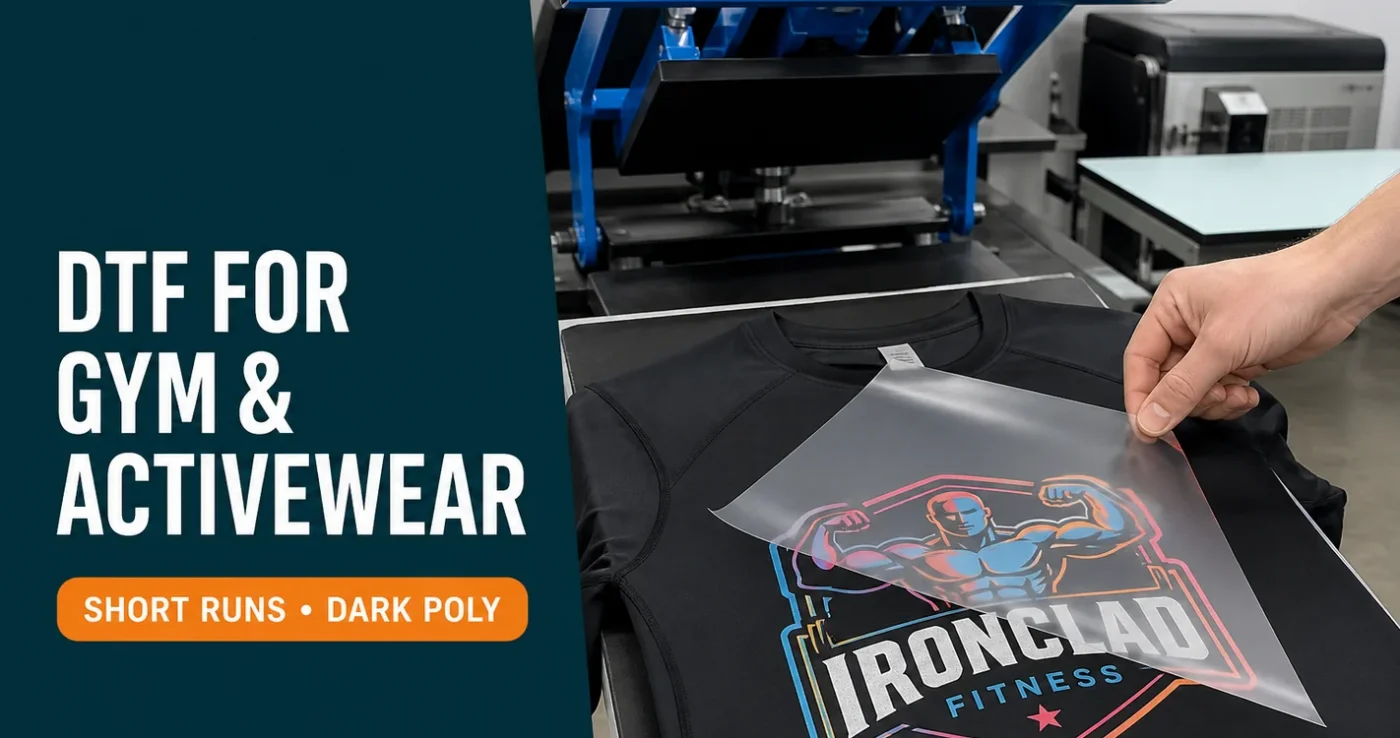
DTF transfers can be a practical option for gym and activewear brands producing logos, names and full-colour designs on suitable garments. They are particularly useful for smaller runs and dark clothing, where an opaque print helps the design stand out.
The best results start with the garment. A cotton gym hoodie, a lightweight polyester training top and a pair of high-stretch leggings place different demands on the print. This guide will help you choose an approach that suits both your brand and the way the clothing will be worn.
At a glance
- Good uses for DTF: Gym logos, coach uniforms, personalised names and small merchandise runs on compatible fabrics.
- Dark garments: A white ink underbase allows light and full-colour designs to show on suitable black and coloured clothing.
- Comfort matters: Smaller logos and open designs can be a better choice than large solid prints on lightweight training tops.
- Test the actual garment: Check adhesion, stretch, heat marks and dye migration before producing a batch.
- Choose the right equipment: Our standard Insta-Peel transfers require a proper heat press.
- Consider sublimation: It may be a better fit for all-over designs on suitable white or light polyester.
Why gym brands use DTF transfers
Ready-to-press DTF transfers let you order the printed designs and apply them with your own heat press, or work with a decorator who can apply them for you. You do not need to operate a DTF printer to create your range.
This can suit a gym that needs a few coach shirts, a fitness brand trialling a new design or a club adding individual names to a team order. You can plan smaller batches and reorder as demand becomes clearer.
Visible colour on dark clothing
Black and navy are common choices for gym apparel. DTF uses a white ink underbase beneath the colour, allowing light lettering and colourful graphics to remain visible on compatible dark fabrics.
That makes it useful for a white chest logo on a black training tee or a full-colour design on a dark hoodie. Polyester still needs testing for dye migration, even when the print initially looks clean.
A range that includes more than training tops
Your customers may want cotton lifestyle tees, warm-up hoodies and performance garments under the same brand. DTF can be used across suitable examples of these fabrics, with the settings and result checked separately for each garment.
If you are new to the process, our guide to how DTF transfer printing works explains how the artwork becomes a ready-to-press transfer.
Choosing garments for your range
Choose the blank garment before finalising the print. Fabric composition is useful information, but the knit, dye, coating and amount of stretch also affect the result.
| Garment | What to consider |
|---|---|
| Cotton gym tees and hoodies | Print size, feel, placement and an even pressing area around seams or pockets. |
| Polyester training tops | Heat sensitivity, dye migration, fabric finish and comfort beneath the printed area. |
| Polyester/elastane activewear | How the garment stretches during wear and whether the print can accommodate that movement. |
| Mesh or textured sportswear | Whether the surface provides enough consistent contact for a clean, secure application. |
| Coated or water-resistant outerwear | Whether the finish tolerates heat and allows the transfer to adhere. |
Two garments labelled “100% polyester” can behave differently under a heat press. Test the exact style and colour you intend to sell, and review the result if the supplier or garment batch changes.
For a closer look at fabric-specific concerns, see our guide to DTF printing on polyester.
Designing gym logos for comfort and movement
A design that looks excellent on a screen can feel quite different on a lightweight training top. DTF adds a layer to the fabric, so the amount of coverage deserves as much thought as the artwork itself.
Use the garment colour as part of the design
Open lettering, separated graphic elements and transparent spaces between details reduce the area covered by the print. On a training garment, this can feel less restrictive than a large solid rectangle.
A small chest logo may suit an everyday workout top, while a larger graphic could work better on a heavier lifestyle tee or hoodie. Check a physical sample before committing to the same print size across the whole range.
Check placement while the garment is being worn
Look at how the print area moves when the wearer reaches, bends or stretches. A transfer on a loose T-shirt experiences different movement from one on fitted leggings or a compression top.
For high-stretch garments, do not assume a transfer suitable for a training tee will perform equally well. Assess the sample through the movement expected in use, then check recovery, adhesion and appearance after washing.
Keep details practical to print
Set the artwork at its intended print size and check small lettering and fine lines before ordering. A logo that works across the back of a hoodie may need simplification when reduced to a small chest mark.
Supply a high-resolution transparent PNG at 300 DPI at the final print size, or another format accepted by your chosen ordering method. Our DTF artwork FAQs explain file preparation and sizing.
DTF or sublimation for activewear?
Both methods have a place in sports clothing. The better choice depends on the garment colour, fabric, coverage and feel you want.
| Your project | Method to consider | Why |
|---|---|---|
| Opaque logo on a dark training tee | DTF, after testing | The white underbase helps the design remain visible on dark fabric. |
| All-over artwork on a suitable light polyester jersey | Sublimation | The colour becomes part of the fabric without adding a transfer layer. |
| Cotton merchandise alongside suitable polyester tops | DTF, tested on each garment | Transfers can support a range of compatible fabric types. |
| Small runs of individual names or logos | DTF | Different designs can be grouped on a standard gang sheet. |
| Large graphics with minimal print feel | Sublimation on suitable polyester | There is no added surface film over the printed area. |
Conventional sublimation does not print opaque white, so it cannot produce a white logo directly on an existing black shirt. For a fuller comparison, read our DTF versus sublimation guide.
Planning logos and names on gang sheets
A gang sheet groups several designs onto one sheet of transfer film. For a gym range, that might include chest logos, larger back prints, coach names and different logo sizes.
Before building the sheet:
- Confirm the garment quantities and the number of prints needed for each item.
- Set every design to its finished print dimensions.
- Check names, spelling and quantities against the order list.
- Leave room between designs so they can be cut apart.
- Keep a record of the artwork version and print sizes for future orders.
Once the layout is ready, use our custom DTF gang sheet builder. Standard designs belong on standard gang sheets; speciality finishes need to be ordered separately as sheets.
Pressing and testing activewear
Use a proper heat press for our standard Insta-Peel transfers. It provides the controlled heat and pressure needed for this process. Household-iron settings are not a substitute.
The following settings are starting points from our application guidance, not a guarantee that every garment will be suitable.
| Setting | Suitable polyester | Cotton and other suitable fabrics |
|---|---|---|
| Temperature | 120°C | 140°C |
| Initial press | 30 seconds | 8–10 seconds |
| Pressure | Firm and even | Firm and even |
| Peel | Cold peel only — cool completely before peeling | Immediately while hot |
| Final press | 10 seconds at the same temperature | 10 seconds at the same temperature |
Prepare a flat, dry print area, keeping raised seams and zips clear of the pressing surface. Remove moisture before applying the transfer while checking that the fabric tolerates the heat. Complete the final press through a suitable clean cover sheet.
Follow our full transfer fitting instructions for the application sequence and the product you ordered. These standard Insta-Peel settings do not apply to speciality transfers. Always test on a spare garment first — heat presses and fabrics vary.
Check for dye migration after the garment cools
Dye migration occurs when colour from the garment moves into the print. A white logo may develop a pink, grey or other unwanted tint, and the change may appear after pressing rather than immediately.
Lower-temperature application can help reduce the risk, but it does not eliminate it on every polyester garment. Include white or light areas in your test design and inspect the sample after cooling and again after 24–48 hours.
That waiting period is a useful early check, not proof of lifetime colour stability. Continue with wash and wear testing before approving a garment for production.
Test the finished garment, not just the transfer
Check how the sample feels during movement, whether the edges remain attached and how the print looks after washing. Record the garment style and colour alongside the temperature, time, pressure and finishing steps used.
If a fabric marks, the print changes colour or adhesion is unreliable, resolve the cause before starting the batch. More heat is not automatically the answer.
Using speciality finishes in a gym range
A speciality accent can give a limited release its own identity. Neon, metallic, glitter, pearl, glow and reflective finishes offer different visual effects, but they need their own garment tests.
Our speciality transfers are supplied as sheets, require a heat press and use a cold-peel process. They are not available as speciality gang sheets. Their application requirements differ from standard Insta-Peel and may not suit heat-sensitive activewear.
Check the intended finish, fabric and application instructions together before planning the range. A successful standard-colour transfer test does not establish that a speciality version will perform the same way.
A practical checklist before launching your range
- Choose the garment: Confirm the supplier, style, fabric composition and colour.
- Plan the artwork: Check print size, placement and comfort for the intended activity.
- Order a test quantity: Use the same transfer type and garment you intend to use in production.
- Apply the complete process: Include preparation, correct peeling and the final press.
- Assess the sample: Check heat marks, colour, adhesion and movement, including another colour check after 24–48 hours.
- Wash and wear it: Evaluate the finished garment before approving the batch.
- Record the settings: Keep a repeatable reference for production and reorders.
- Supply care advice: Give customers instructions that suit both the garment and the print.
Care advice for printed gym clothing
- Wait 24–48 hours after application before the first wash.
- Wash inside out on a cool or cold cycle, following the garment’s care label.
- Avoid bleach.
- Air dry and avoid tumble drying.
- Do not iron directly over the print.
Garments used in frequent training, harsh laundering or heavy abrasion need testing that reflects that use. Avoid promising a particular wash life without evidence from your finished product.
Frequently asked questions
Are DTF transfers suitable for gym clothing?
They can be suitable for logos, names and graphics on compatible cotton, polyester and blended garments. Test the exact garment for heat tolerance, adhesion, colour stability and movement before production.
Can I use DTF on black polyester training tops?
DTF’s white underbase makes opaque designs possible on suitable dark polyester. You still need to test for heat marks and dye migration, including changes that appear after the garment has cooled.
Are DTF prints breathable?
DTF adds a layer over the printed area, so it does not preserve the same airflow as uncovered fabric. Smaller logos and designs with open spaces can be more comfortable than large solid coverage on lightweight training tops.
Can I use DTF on leggings or compression clothing?
Only after checking the transfer and garment together. These garments can experience substantial stretch, and a result that works on a loose training tee may not be suitable for a compression panel or fitted leggings.
Can I mix names and logos on one gang sheet?
Yes. Standard gang sheets can contain different names, logos and print sizes. Check every design’s dimensions and leave space to cut the transfers apart.
Do I need my own DTF printer?
No. We supply printed, ready-to-press transfers. You or your decorator apply them with the appropriate heat press and a tested process.
Can you supply the finished printed garments?
DTF Transfers Australia supplies the transfers for you to apply. For finished custom apparel, visit our sister business, T Shirts Australia.
Plan your next gym clothing release
Start with one garment, one design and a well-tested sample. That gives you something useful to assess: how the print looks, how it feels during training and how it holds up to care.
When you are ready, build your custom DTF gang sheet or browse our transfer range. We supply ready-to-press transfers from our Coorparoo workshop in Brisbane for brands and decorators across Australia.
