
Printing It Yourself, Running a Print Business
Morpho UV Printer for Small Workshops: Why We’re Adding Roll-to-Roll UV DTF Stickers
Sep
First published: | Last updated:
A small print workshop cannot afford to fill valuable floor space with equipment that only looks impressive. Every machine has to solve a real customer problem, fit into the production workflow and deliver repeatable results.
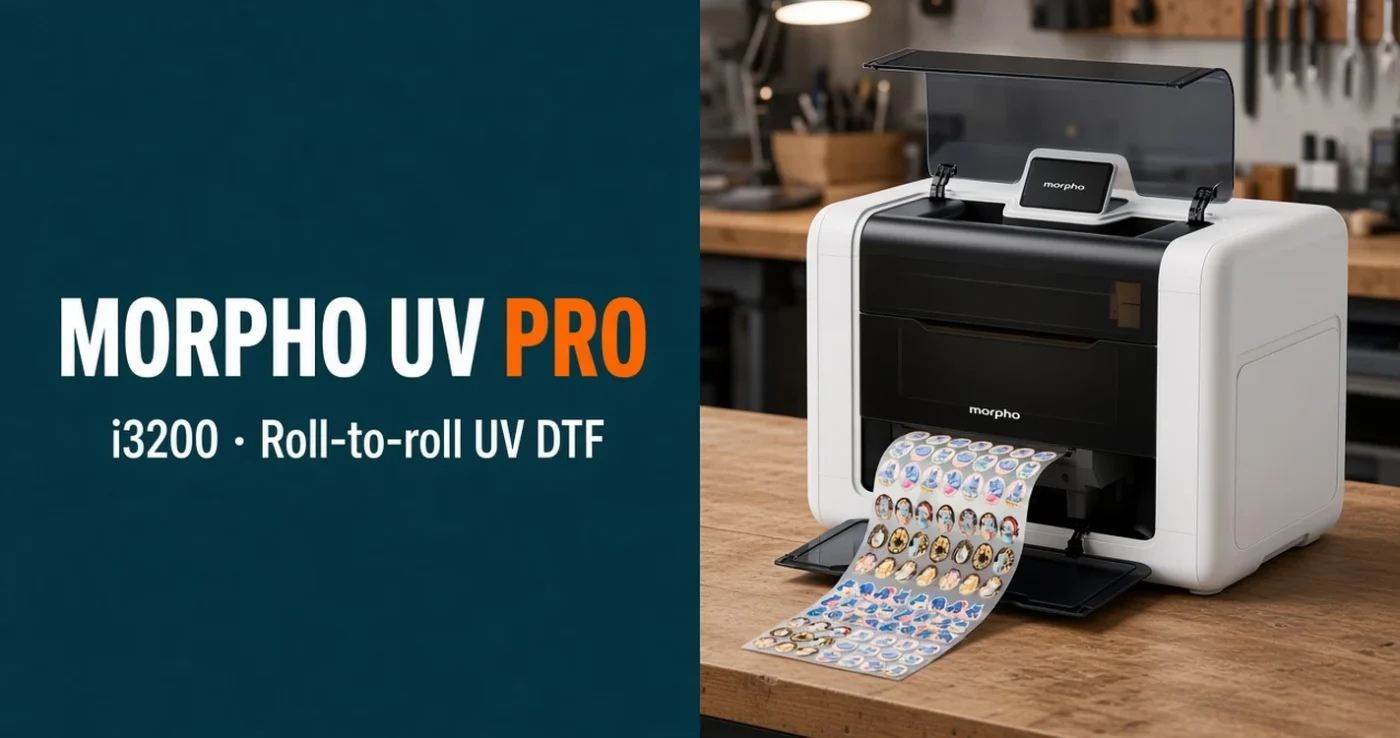
That is why we are preparing to add a Morpho UV Printer Pro with an Epson i3200 printhead and the optional roll-to-roll jig to our Coorparoo workshop. Our first planned use is producing UV DTF stickers for suitable hard surfaces—not garment transfers and not ordinary paper labels.
This is not a hands-on printer review yet. The machine is still in the crowdfunding and fulfilment stage, so the specifications discussed below are manufacturer-published claims. We will not describe the printer as proven in our workshop, or open customer orders, until it has arrived, been commissioned and passed our own production testing.
Current status — 24 September 2026: Morpho’s Kickstarter FAQ says factory shipping is expected to begin between December 2026 and January 2027, subject to production and fulfilment progress. That is a shipping estimate, not a guaranteed Australian delivery or service-launch date.
At a glance
- Planned equipment: Morpho UV Printer Pro with an i3200 printhead and optional roll-to-roll jig.
- First intended product: UV DTF stickers for tested, compatible hard surfaces.
- Why it interests us: Compact dimensions, colour-calibration tools, white and varnish channels, and the ability to support both direct UV and UV DTF workflows.
- What is not confirmed: Our final sticker sizes, pricing, artwork rules, durability claims and launch date.
- What happens before launch: Installation, colour setup, adhesion testing, abrasion and cleaning tests, workflow trials and repeat-production checks.
- For clothing: Continue to use our ready-to-press garment DTF transfers, which use a different film, ink, adhesive and application process.
What is the Morpho UV Printer?
The Morpho is an enclosed desktop UV printer designed for creators, small businesses and compact production spaces. UV ink is cured by ultraviolet light during printing, allowing compatible rigid objects and specialist films to be decorated without the textile heat-press process used for garment DTF transfers.
We have selected the planned Pro configuration with the Epson i3200 printhead. As of this update, Morpho publishes the following specifications for that model:
- Eight ink channels configured as CMYK, two white channels and two varnish channels.
- Print resolutions up to 2400 DPI.
- A built-in spectrophotometer for colour calibration and ICC profiling.
- An enclosed print area of 330 × 220 × 168 mm.
- An optional A3 print bed, rotary jig and roll-to-roll jig.
- White-ink circulation, an enclosed structure and internal filtration.
These are manufacturer specifications, not our test results. Resolution figures, speed comparisons and colour-accuracy claims do not automatically tell us how efficiently the machine will produce sellable work. Media, artwork, print mode, ink limits, curing and operator setup all affect the finished result.
Readers considering crowdfunded print equipment may also find our guide to buying a DTF printer and evaluating Kickstarter equipment useful.
Why does the Morpho UV Printer interest our small workshop?
A compact machine still needs a complete workflow
The printer itself is listed at approximately 660 × 430 × 390 mm, but those figures are not the whole space requirement. A working installation also needs room for the roll-to-roll jig, film handling, ink and consumables, ventilation, maintenance access, finished work and safe operator movement.
The attraction is not simply that the machine is described as “desktop”. It is that the platform may let us develop UV DTF stickers without installing a conventional wide-format UV DTF line. We will only know whether that advantage holds up after using the complete system in daily production.
Colour tools could improve repeatability
Morpho advertises built-in colour measurement, ICC profiling and G7 Master ColorSpace certification. For our customers, the useful question is not whether those phrases sound impressive. It is whether we can reproduce a customer’s approved logo consistently when they reorder weeks or months later.
We will create our own profiles and test files, check neutral greys, gradients, brand colours and repeat runs, and compare results under consistent lighting. That turns a specification into evidence we can use.
White and varnish add useful creative options
UV printing commonly uses white beneath colour so artwork remains visible on clear or dark surfaces. A varnish channel can add selected gloss, texture or raised detail. Those options could be useful for labels and promotional products, but more ink and texture are not always better. Heavy ink builds can change flexibility, edge behaviour and application, so every effect needs testing on the intended product.
Enclosed does not mean installation-free
Morpho promotes an enclosed print area, internal filtration and low-odour inks. Those features are welcome, but low odour is not the same as no exposure. We will follow the manufacturer’s installation information and safety data, assess ventilation and handling requirements, and train the people using the equipment before it enters normal production.
What are UV DTF stickers?
UV DTF stickers are pressure-applied transfers designed for compatible hard surfaces. The artwork is printed onto a specialist film system using UV-curable colour, white and—where required—varnish. A carrier layer helps move the printed design onto the product, then peels away after application.
They are sometimes called UV DTF transfers or crystal labels. Unlike a conventional sticker, the finished design can be transferred without a large surrounding label shape. Unlike garment DTF, UV DTF does not use hot-melt garment adhesive or a heat press.
A typical roll-to-roll workflow is:
- Prepare suitable artwork and set the colour, white and varnish layers.
- Print and UV-cure the design onto the appropriate film.
- Laminate or combine the printed film with its matching carrier system.
- Apply the transfer to a cleaned, compatible hard surface using firm, even pressure, then remove the carrier as instructed.
The exact sequence will depend on the Morpho roll-to-roll jig and the film system we approve after testing. We will publish instructions for the transfers we actually supply rather than copying generic settings from another machine or material.
UV DTF vs direct UV printing vs garment DTF
| Feature | UV DTF stickers | Direct UV printing | Garment DTF transfers |
|---|---|---|---|
| Main purpose | Decorating compatible hard surfaces with a transferable design | Printing directly onto a compatible object placed in the printer | Decorating suitable fabrics and garments |
| Application | Applied using pressure; normally no heat press | No transfer application—the object is printed directly | Applied with controlled heat, time and pressure |
| Best suited to | Curved, irregular or larger items that cannot easily go into the printer | Objects that fit the print area and can be safely positioned | T-shirts, hoodies, tote bags and other compatible textiles |
| Key compatibility checks | Surface energy, texture, coating, cleanliness and intended use | Material, coating, object height, shape and surface preparation | Fabric composition, heat tolerance, dye migration and press settings |
For a deeper explanation of the textile process, see how garment DTF transfer technology works.
What could customers use UV DTF stickers for?
UV DTF is attractive because the same brand artwork can potentially move from clothing to suitable hard-surface merchandise. Possible applications we plan to evaluate include:
- Small-business branding: logos on compatible presentation items, product containers and promotional pieces.
- Giftware: names, decorative artwork and short-run personalised designs.
- Drinkware exteriors: designs on tested outer surfaces, with care instructions based on our results.
- Packaging and display pieces: compatible jars, boxes, signage elements and retail presentation items.
- Prototype merchandise: small runs that allow a business or creator to test a concept before committing to larger quantities.
This is not a universal compatibility list. Two products that both appear to be “plastic” or “metal” can have very different coatings and surface energy. Textured, flexible, oily, silicone-rich, low-energy or frequently heated surfaces can be difficult. We will also avoid unsupported claims about food contact, outdoor life, dishwasher use or permanent industrial marking.
What will we test before offering UV DTF stickers?
A bright sample photographed on the day it was made proves very little. A useful product must print consistently, apply without unnecessary frustration and remain fit for its stated purpose.
Our test program will cover:
- Print detail: fine lines, small text, gradients, transparent areas and complex full-colour artwork.
- White and colour registration: checking for visible white edges, misalignment and unwanted halos.
- Colour consistency: repeat jobs, different print dates and routine calibration.
- Film handling: feeding, lamination, winding, storage and separation of the carrier layers.
- Application: positioning, pressure, release behaviour, bubbles, wrinkles and fine-detail pickup.
- Surface adhesion: glass, coated metal, acrylic and selected plastics with different finishes.
- Edge behaviour: lifting around corners, curves and small isolated details.
- Abrasion and handling: rubbing, scratching and normal day-to-day contact.
- Cleaning resistance: only for products and cleaning methods we can test responsibly.
- Production reliability: maintenance, downtime, waste, consumable use and repeatable output—not just one successful print.
These tests will become the basis of our artwork requirements, application instructions and care guidance. If a material or use has not been tested, we will say so and recommend a sample before a production order.
What does the Kickstarter timeline mean?
The Morpho UV Printer is being introduced through Kickstarter. Crowdfunding can give small workshops earlier access to promising equipment, but a pledge is not the same as buying an established machine from local stock.
As of 24 September 2026, Morpho says factory shipping is expected between December 2026 and January 2027, with timing dependent on production and fulfilment. Freight to Australia, customs processing, accessory availability, installation and commissioning can all add time after a machine leaves the factory.
For that reason, we are not promising a pre-Christmas arrival or advertising a firm customer launch date. We also need to confirm that the production machine, software, inks, roll-to-roll jig and film system work together as expected.
This transparent approach matters. New equipment can be exciting, but customers should not have to carry the risk of our learning curve.
When will our UV DTF stickers be available?
Orders will open only after the printer and roll-to-roll system have arrived, been installed and completed our test program. Based on the manufacturer’s present fulfilment estimate, that is more likely to be in 2027 than before Christmas 2026, but we will publish a date only when we can support it.
When the service is ready, we will add:
- available sheet or roll formats;
- pricing and production times;
- print-ready artwork requirements;
- tested surface guidance;
- step-by-step application instructions; and
- clear care and durability limitations.
Our existing garment DTF production continues as usual. If your project is for clothing, explore our ready-to-press DTF transfer range, read about our current Insta-Peel DTF film, or visit the DTF Transfers Australia FAQ.
Frequently asked questions
Can I order UV DTF stickers from DTF Transfers Australia now?
Not through this planned Morpho production service yet. We will open orders only after installation, testing and publication of the relevant artwork and application instructions.
When will the Morpho UV Printer arrive in Brisbane?
There is no confirmed Australian arrival date. Morpho currently estimates factory shipping between December 2026 and January 2027, subject to production and fulfilment. International delivery and commissioning will occur after that.
Do UV DTF stickers need a heat press?
Generally, no. UV DTF stickers are normally applied to compatible hard surfaces using firm, even pressure. We will provide instructions for our approved film system when the service launches.
Can UV DTF stickers be used on T-shirts?
No. Use garment DTF transfers for T-shirts and other suitable fabrics. UV DTF uses different inks, films and application methods and is intended primarily for compatible hard surfaces.
Will UV DTF stick to every plastic, glass or metal item?
No. Adhesion depends on the material, coating, texture, cleanliness and intended use. Similar-looking products can perform differently, so unfamiliar surfaces should be sampled and tested.
Will your UV DTF stickers be dishwasher-safe or suitable outdoors?
We are not making either claim before testing. Any future dishwasher, cleaning or outdoor guidance will be limited to the materials, products and conditions we have actually evaluated.
Can the Morpho print directly onto objects as well?
The manufacturer promotes the Morpho as a direct-to-object UV printer with optional beds and jigs, as well as a UV DTF workflow using the roll-to-roll jig. Our first planned customer product is UV DTF stickers. Other services would require separate testing and development.
Do you sell Morpho UV printers?
No. We are adding equipment to produce printed products for customers. Printer specifications, backing options and accessory availability should be confirmed directly with Morpho.
Follow our workshop progress
We will update this article when the fulfilment schedule changes, when the printer arrives and when we have meaningful test results to share. That means you will be able to see the difference between an advertised capability and a service we have proven in our own Brisbane workshop.
If you have a future hard-surface project in mind, you are welcome to contact DTF Transfers Australia. We can record the type of product and surface you are interested in, but we will not recommend compatibility or accept an order until our testing supports it.
Source note: Equipment specifications and fulfilment information were checked against Morpho’s official website and Kickstarter FAQ on 24 September 2026. Specifications, accessories and schedules may change before production delivery.
