
Pressing and Care
Moisture and DTF Transfers: Why Pre-Pressing Matters
Jul
Originally posted: 2 July 2026. Last updated: 5 October 2026.
Quick summary
Pre-press every shirt before the transfer goes down. Cotton can feel dry and still throw steam when the platen closes, and that steam fights the adhesive. If you see steam, open the press and dry the fabric again. Moisture is a common reason a print lifts. It is not the only one. Check heat, time, and pressure as well.
On this page
Where the water comes from
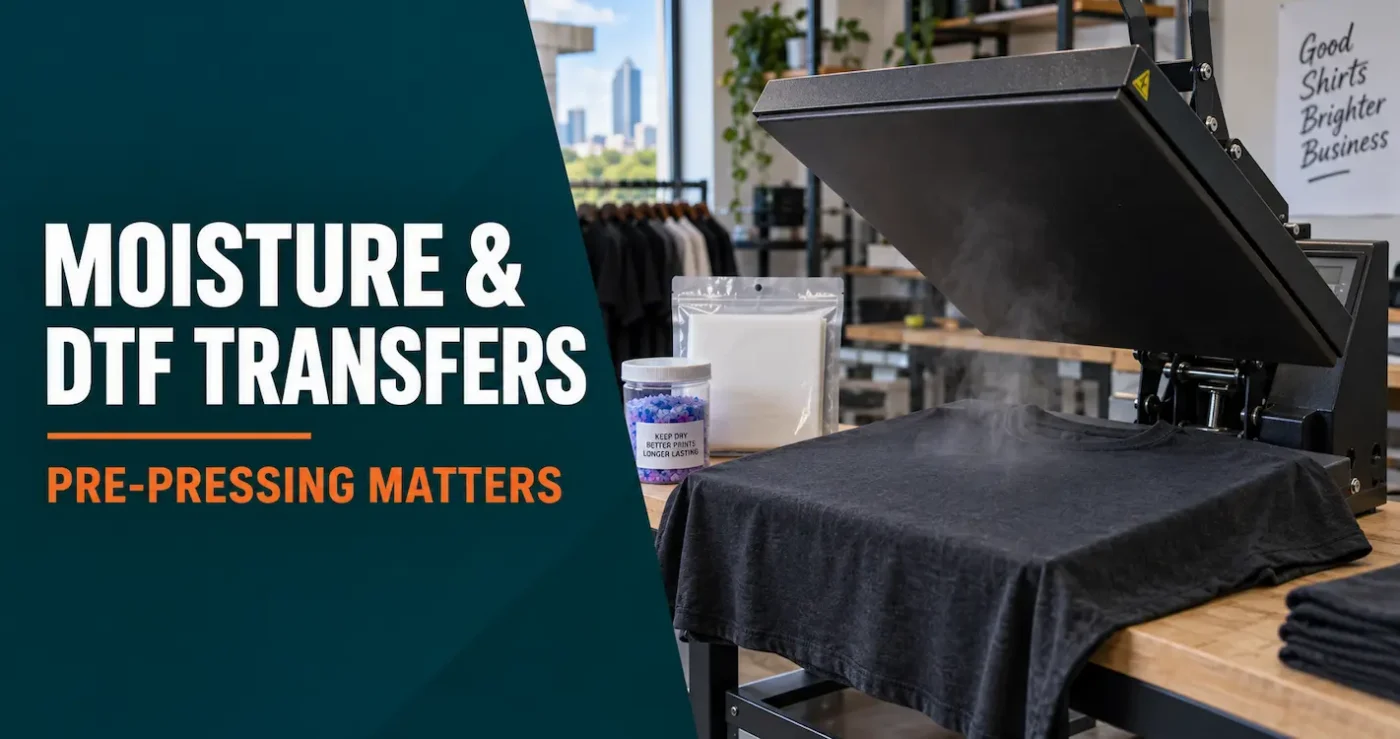
In our Coorparoo workshop, a black tee that sat in a carton overnight can steam like a kettle the first time the press shuts. The shirt felt dry on the bench. The fibres were not.
- The garment. Humid air, a plastic mailer, and a heavy fleece all hold water. Hoodies hold more than a light tee. Two shirts from the same packet can differ if one lived nearer a doorway.
- The transfer, after it leaves us. A hot car, a damp shed, or a bathroom shelf is a bad place for film. Let a cold parcel come back to room temperature in the bag before you open it, so condensation does not sit on the adhesive.
- Adhesive while the transfer is being made. That part is our job. We do not sell powder or liquid adhesive. You receive a finished transfer. Keep it dry. Do not try to “refresh” a damp sheet in a warm room and hope.
Storage after delivery is covered in how to store DTF transfers.
How to pre-press
Pre-press means a short press of the empty shirt, before you place the film. It drives moisture out, knocks the wrinkles down, and shows you a seam that will steal pressure.
- Read the care label. Move zips, buttons, and thick seams off the platen where you can.
- Lint-roll dark fabric and fleece. Loose fibre becomes a bump under the print.
- Press the empty print area. Open it and look for steam.
- If steam appears, let it leave, then press again. Do not lay the transfer on a shirt that is still giving off vapour.
- Place the film only when the area stays quiet when you open the press.
Then use the settings for that product. Cotton and most fabrics, Hot Insta Peel: 140°C, 8–10 seconds, firm pressure, peel immediately while hot, then 10 seconds under your own parchment, baking paper, or Teflon. Polyester: 120°C, 30 seconds, firm pressure, cold peel only, then 10 seconds at 120°C. The pressing sequence is in DTF pressing tips.
A household iron is only for products labelled iron-on. It is the wrong tool for a standard gang sheet, and it is a poor way to drive moisture out of a hoodie. A Cricut EasyPress is fine for Hot Insta Peel when the platen fully covers the design. If it does not, use a larger press. Pre-press with whichever press you are actually using.
When it is not moisture
A lift is not automatic proof the shirt was damp. Change one thing at a time.
- Steam while you press: dry the shirt properly, then start again. Do not press the film through the steam.
- Edges lift as you peel: moisture is possible. So is low pressure, a short press, the wrong peel, or a seam.
- One side sticks and the other does not: look at the platen and the pad, not the weather. A cold corner fails the same way on a dry shirt.
- The next shirt in the pile fails: compare where those shirts were stored, and whether you skipped the second pre-press.
- It fails in the wash: check the second press and the first bond. Moisture may have been involved. So may a weak final press.
- A light print on polyester changes colour: that is usually dye migration, not water. See DTF on polyester.
Turning the temperature up to “make it stick” cooks a damp polyester shirt and still may not fix a cold corner. Dry the garment first. Then test on a spare.
Storing transfers
Keep unused sheets flat, sealed, and indoors. Avoid the car, the garage, and a spot above a kettle. Handle them with dry hands. Do not fold the film. There is no shelf life we can promise for every cupboard in Queensland. If a sheet has been stored badly, press a test before it goes on a shirt you care about.
We pack transfers at 17 Castlemaine Street, Coorparoo. The shop is open Monday to Friday, 9:00am–2:30pm. That does not make a transfer waterproof once it is in your boot on a February afternoon.
FAQ
How can a shirt be wet if it feels dry?
Fabric holds moisture from the air without feeling damp in the hand. You see it as steam when the heat press opens. Heavy cotton and fleece hold more than a thin tee. Humid weather makes it worse.
How long should I pre-press?
Long enough that the print area no longer steams when you open the press. If vapour comes off, let it escape and press again. Do not put the transfer down while the shirt is still releasing steam.
Can I skip the pre-press on a new shirt?
No. A new shirt in a plastic pack can still be holding moisture, especially if it has been in a warm van or a humid room. Pre-press it. The step is short. A failed print is not.
Can I use a household iron on a standard gang sheet?
No. Standard gang sheets and Hot Insta Peel need a heat press. A Cricut EasyPress is fine when its platen fully covers the design. A household iron is only for products labelled iron-on.
Should I raise the temperature if the transfer will not stick?
Not first. Dry the shirt, confirm the time and pressure, and check you used the right peel. Cotton and most fabrics start at 140°C for 8–10 seconds. Polyester starts at 120°C for 30 seconds, cold peel only. Test a spare garment before you turn the heat up.
