Important for polyester: We strongly recommend against using Iron-On DTF transfers on polyester. Polyester is heat-sensitive and dye-prone, and it is very difficult to get a reliable fit and lasting result with a household iron or craft press. If you still want to try, test on a spare garment first — the choice is yours. For polyester, a proper heat press with our standard Hot Peel / Insta-Peel transfers (and careful testing) is the better path.
Short answer: You can apply a DTF transfer with a Cricut EasyPress only when that transfer is made and supplied for iron-on or craft-press use. DTF Transfers Australia’s standard gang sheets and specialty transfers require a proper heat press and should not be treated as EasyPress products. For the dedicated Iron-On DTF range, use a firm heat-resistant surface, pre-press until no steam remains, apply steady two-handed pressure and follow the exact time, temperature and peel instructions supplied with the transfer.
Can a Cricut EasyPress apply DTF transfers?
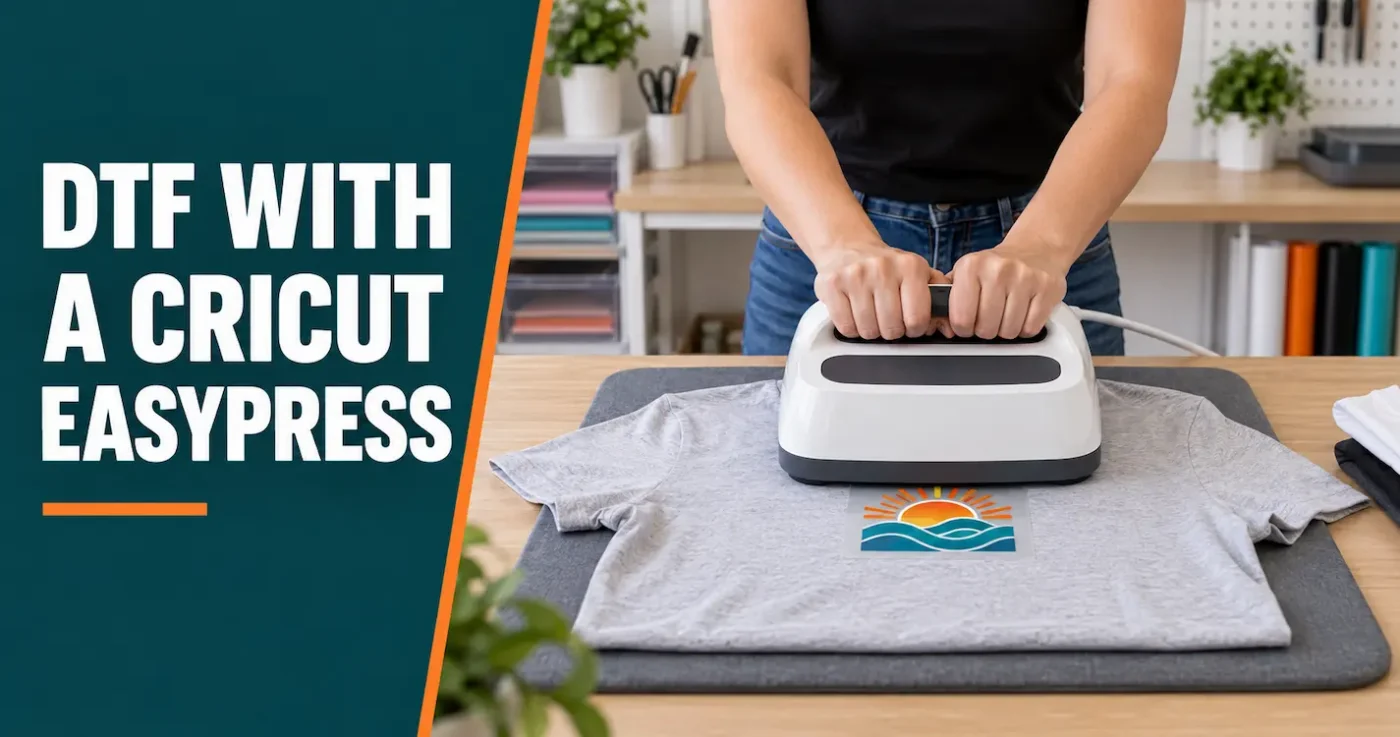
Yes, but the transfer and the application method must be compatible. An EasyPress provides a heated flat plate, while the user supplies pressure manually. That can work for a DTF transfer designed for a craft press or household iron, particularly on small flat designs and suitable garments.
It does not mean that every transfer sold as “DTF” can be fitted this way. Different films and adhesive systems require different combinations of heat, pressure and peel timing. A commercial heat press closes at a repeatable pressure across the whole platen. An EasyPress relies on the operator, the bench, the pressing mat and the size of the design.
Cricut now publishes instructions for using selected DTF transfers with EasyPress models. Its guidance confirms several useful principles: the pressing mat should sit on a firm, steady surface, the fabric must be clean and dry, and constant firm pressure is required. However, Cricut’s Heat Guide is written for the specific transfer products in its system. Do not assume those settings replace the instructions supplied with a DTF Transfers Australia product.
Choose the correct DTF transfer
This is the most important part of the process. Select the product based on the equipment you will actually use.
| Transfer type | Suitable for Cricut EasyPress? | Important point |
|---|---|---|
| Dedicated Iron-On DTF transfers | Yes, with testing | Made for household irons, craft presses and heat presses. Follow the product-specific instructions. |
| Standard Insta-Peel sheet transfers | No | Designed for the controlled pressure of a proper heat press. |
| Standard DTF gang sheets | No | These are professional ready-to-press transfers and require a heat press. |
| Gold, Silver, Glitter, Glow, Neon, Pearl and Reflective | No | Current specialty transfers are sheet-only, cold peel and require a heat press. |
DTF Transfers Australia’s dedicated Iron-On DTF range is available in several sheet widths, including 200, 260, 280 and 300 mm formats. Check the current shop listings and choose an Iron-On DTF product rather than assuming a standard transfer will work.
EasyPress limitations to understand
A Cricut EasyPress can be a useful step between a household iron and a clamshell heat press, but it has practical limits.
- Pressure is manual. The machine does not close at a measured setting, so the result depends on the operator.
- The work surface matters. An ironing board, plastic folding table or soft bed absorbs movement and makes pressure inconsistent.
- Plate size limits the safest artwork size. A design fully covered by one press is easier to apply evenly than a design divided into sections.
- Production speed is lower. Applying firm pressure by hand across many garments becomes tiring and results can vary.
- Garment construction can interrupt contact. Seams, zips, collars, pockets and buttons can hold the heat plate away from the print area.
- High application heat can damage some fabrics. Heat-sensitive polyester, coatings and dye-prone garments need particular caution.
For occasional hobby work and small designs, those limitations may be manageable. For customer orders, larger graphics or repeat production, a reliable commercial heat press gives much better control over pressure and consistency.
What you need
- a DTF transfer clearly supplied for iron-on or EasyPress use;
- a Cricut EasyPress large enough for the design where possible;
- the press’s safety base;
- a Cricut pressing mat or suitable firm heat-pressing mat;
- a sturdy, flat, heat-resistant bench at a comfortable height;
- a new, dry and suitable cotton or other test-approved garment;
- a clean protective sheet such as parchment paper;
- heat-resistant tape when extra positioning security is needed;
- a lint roller; and
- a spare transfer and test garment before any important job.
Do not work on an ironing board. Cricut’s own EasyPress guidance recommends a firm, flat, heat-resistant surface and explains that an ironing board may not provide the support needed for consistent pressure.
Prepare the work area and garment
- Read the transfer instructions first. Confirm the transfer type, approximate temperature, pressing time, pressure and peel method before heating the press.
- Check the garment. Confirm that the fabric and decoration area can tolerate the required heat. Avoid seams, zips, buttons, pockets and thick joins beneath the design.
- Set up a firm bench. Place the pressing mat on a stable, heat-resistant work surface at a height that allows safe two-handed pressure.
- Lint-roll the print area. Remove loose fibres, dust and pet hair that may become trapped under the transfer.
- Pre-press until no steam remains. A garment can hold moisture even when it feels dry. If steam appears, allow it to escape and repeat the pre-press.
- Let the fabric settle briefly. Flatten it without stretching the shirt or trapping creases.
- Position the transfer. Place the adhesive side against the fabric with the clear carrier film facing up. Measure the position rather than relying only on sight.
For more detail on garment moisture, see why pre-pressing matters.
How to apply Iron-On DTF with an EasyPress
The following is a practical starting workflow for DTF Transfers Australia’s current Iron-On DTF range. The instructions supplied with the transfer take priority because films, adhesives and garment types can change.
- Heat the EasyPress. Align Iron-On DTF with the product setting family of approximately 135–145°C; keep steam off and use firm manual pressure on a firm, heat-resistant surface. Do not invent a separate EasyPress-only temperature. See the full household-iron fitting guide.
- Cover the transfer. Place a clean protective sheet over the carrier so the heat plate does not directly contact exposed film or artwork.
- Place the press straight down. Centre the full design beneath the heat plate where possible. Do not slide the hot press across the carrier.
- Apply firm, steady pressure. Use both hands on the handle and press vertically without rocking. Use about 10 seconds per covered section, then cool for approximately 30 seconds before peeling and finish with 10–15 seconds per section through baking paper.
- Lift the press straight up. Return it to its safety base. Avoid dragging the edge across the carrier film.
- Follow the correct peel instruction. Some products need a warm or cool peel. Do not assume that an Iron-On DTF transfer is instant hot peel.
- Watch the design while peeling. Start at one corner and peel slowly. If an edge lifts with the film, lay the carrier back down rather than forcing it away.
- Complete the specified finishing press. Cover the exposed design and follow the final-press instruction supplied with the transfer.
- Allow the garment to cool flat. Inspect the whole edge and surface before moving or folding it.
These are starting instructions, not a guarantee for every EasyPress, garment or transfer. Test before producing a saleable item and change only one variable at a time when refining the process.
What if the design is larger than the heat plate?
A design that fits completely beneath the heat plate is the safest option. It receives one continuous combination of heat, time and pressure. If the artwork extends beyond the plate, each section may receive a different amount of pressure or overlapping heat.
If the dedicated Iron-On DTF product allows sectional pressing:
- secure the carrier with heat-resistant tape so it cannot shift;
- divide the artwork into a simple sequence before starting;
- place the press down and lift it up—never slide it;
- use consistent firm pressure on every section;
- overlap sections only enough to avoid a cold line;
- avoid repeatedly reheating one edge while trying to reach another; and
- check the complete design before peeling.
Large artwork is less forgiving with a handheld press. If it requires several placements, a larger heat press may be more reliable and faster than trying to correct uneven bonding later.
Understanding pressure, time and temperature
DTF adhesive needs the right combination of all three variables. Increasing temperature cannot fully compensate for insufficient pressure, and extending the time can damage a garment that is already receiving too much heat.
Pressure
Pressure is the largest difference between an EasyPress and a commercial heat press. In its EasyPress FAQ, Cricut describes firm pressure as using two hands and approximately 15–20 lb of body weight. Treat this as an explanation of Cricut’s terminology, not a substitute for the instructions and testing required by your transfer. Work at a safe bench height and keep the pressure straight and even.
Temperature
Use the temperature supplied for the specific Iron-On DTF transfer. Use the Iron-On DTF product setting family of approximately 135–145°C with steam off, firm manual pressure and a firm, heat-resistant surface. Do not invent a separate EasyPress-only temperature, and do not apply this guidance to standard gang sheets, specialty transfers or a heat-sensitive garment. See the full household-iron fitting guide.
Time
Time starts when the plate is fully down and steady. If pressure builds gradually or the plate rocks into position, part of the design may not receive the complete cycle. Use the EasyPress timer, lift straight up when it finishes and apply the same method to every section.
Troubleshooting common problems
The transfer does not stick
First confirm that it is an Iron-On DTF product. Other likely causes include insufficient pressure, a soft work surface, too little heat or time, moisture in the garment, a seam beneath the design or a transfer larger than the heat plate. Lay the carrier back in position, cover it and re-press the affected section according to the product guidance.
Only some sections have bonded
This usually points to uneven pressure, an obstruction beneath the garment or incomplete plate coverage. Check the pressing mat and move seams, collars or pockets away from the print area. On the next test, keep the pressure vertical and consistent.
The carrier is difficult to peel
Stop pulling. Check whether the product requires a warm or cool peel and allow it to reach the correct condition. If the artwork lifts, replace the carrier, cover it and re-press rather than stretching the design.
A line appears between pressed sections
The overlap may have been reheated too many times, or the plate edge may have received different pressure from the centre. Reduce the design size, plan fewer sections or use a larger heat press for the production job.
The garment becomes shiny, scorched or discoloured
Stop and reassess the garment. The temperature, pressing time or repeated sectional heating may be too aggressive for the fabric or dye. Do not keep increasing heat to solve an adhesion problem. Test a different garment or use a product and press method with suitable lower-temperature instructions.
The print peels after washing
Possible causes include incomplete bonding, uneven pressure, moisture, incorrect finishing, unsuitable fabric or washing before the adhesive had settled. Review the full process and complete a wash test before producing more garments. See the broader DTF transfer troubleshooting tips.
When to use a commercial heat press
An EasyPress is best treated as craft equipment for compatible products, small designs and modest quantities. Move to a commercial heat press when:
- you are selling garments and need repeatable production;
- the designs are larger than the EasyPress plate;
- you regularly press batches rather than occasional one-off projects;
- manual pressure causes inconsistent edges or operator fatigue;
- you need to use standard Insta-Peel transfers or gang sheets; or
- you want controlled pressure for testing different garments.
A better press will not fix poor artwork or an unsuitable garment, but it removes much of the uncertainty around manual pressure and partial plate coverage.
Frequently asked questions
Can I use a standard DTF gang sheet with a Cricut EasyPress?
No. DTF Transfers Australia’s standard gang sheets are designed for a proper heat press. Choose the dedicated Iron-On DTF product if you need to use an EasyPress or household iron.
Can I apply specialty DTF transfers with an EasyPress?
No. Current Gold, Silver, Glitter, Glow in the Dark, Neon, Pearl and Reflective transfers require a heat press. They are sheet-only, cold-peel products and have a tighter fitting tolerance than the Iron-On DTF range.
What temperature should I use for Iron-On DTF?
Start with the Iron-On DTF product setting family of approximately 135–145°C, steam off and firm manual pressure on a firm surface. Press about 10 seconds per section, cool for approximately 30 seconds before peeling, then finish 10–15 seconds per section through baking paper. See the full household-iron fitting guide. Always use the exact instructions supplied with your transfer and test the garment.
Should I use the Cricut Heat Guide settings?
Use Cricut’s Heat Guide for Cricut materials. For a DTF transfer from another supplier, use that supplier’s instructions. The equipment may be the same, but the film, adhesive and peel behaviour may be different.
Can I use an EasyPress Mini?
A Mini has a very small plate and relies on repeated movement, making even DTF application difficult. It is not recommended for standard gang sheets or specialty transfers. If you are testing a tiny dedicated Iron-On DTF design, follow the product guidance and use a test garment, but a full-size EasyPress provides more consistent coverage.
Do I slide the EasyPress over the transfer?
No. Place it down, apply steady pressure, lift it straight up and reposition if sectional pressing is permitted. Sliding can move the transfer, crease the carrier and create uneven heat and pressure.
Can I use an ironing board?
No. Use a firm, flat, heat-resistant work surface with a suitable pressing mat. An ironing board has too much give for reliable manual pressure.
Why do I need to pre-press the shirt?
Pre-pressing removes moisture and flattens the decoration area. If steam appears, continue pre-pressing until the garment is dry before positioning the transfer.
Use the right transfer for the equipment
A Cricut EasyPress can be a practical way to begin using full-colour DTF artwork at home, provided the transfer is specifically designed for that method. The result depends on firm manual pressure, a stable pressing surface, a dry garment, sensible design size and careful testing.
Do not use EasyPress convenience as a reason to ignore the transfer type. Choose an Iron-On DTF product from the current range, keep standard and specialty transfers for a commercial heat press, and refer to the supplied instructions before every test.