
Printing It Yourself, Running a Print Business
How Workwear Shops Can Add Uniform Printing with a Heat Press and DTF Gang Sheets
Oct
A customer walks into your workwear shop for six polos and a pair of boots. Then comes the question: “Can you put our logo on the shirts?”
With a suitable heat press and professionally printed DTF gang sheets, that question can become an additional service—not a referral to another business. You keep selling the garments you know, while offering approved logo printing on suitable uniforms.
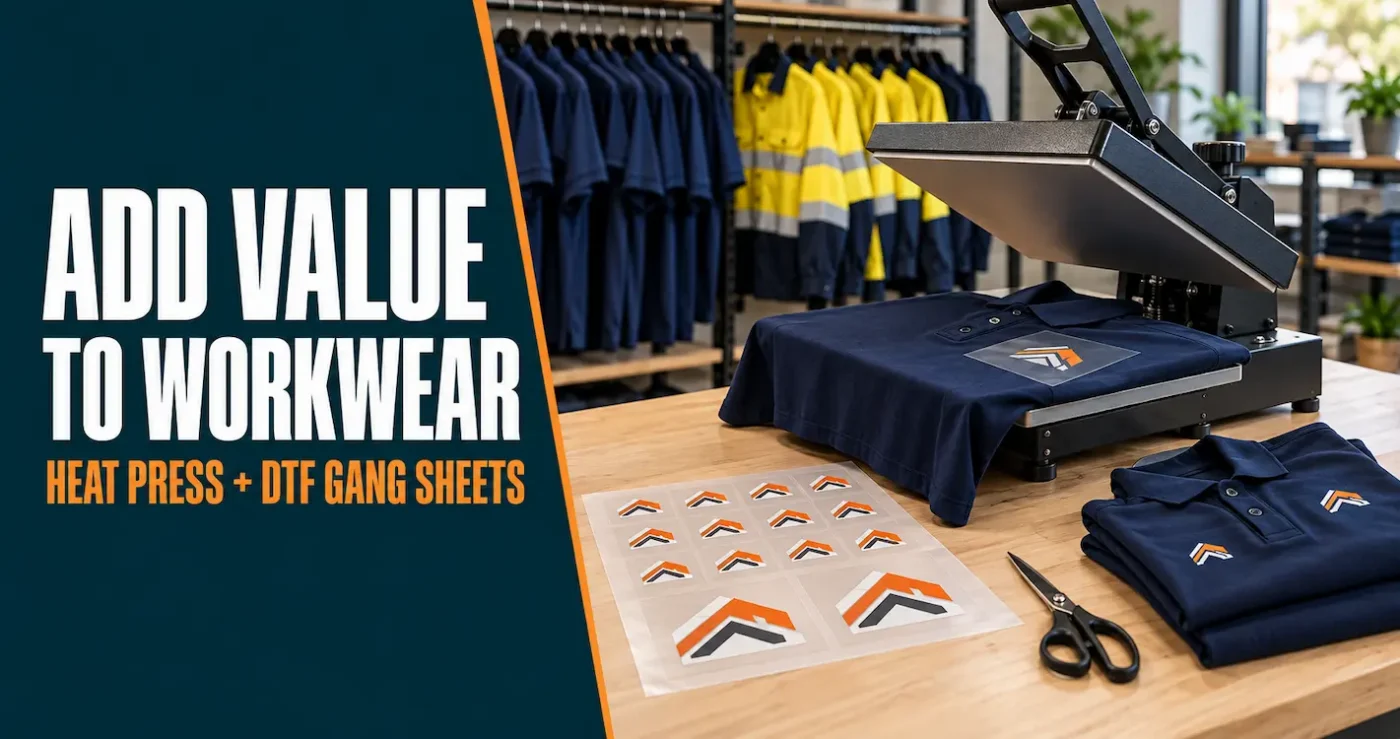
Workwear and safety shops can add custom uniform printing without buying a DTF printer. Order ready-to-press transfers, cut the individual designs from the gang sheet and apply them with a heat press. The opportunity is to make uniform ordering more convenient for customers and earn a properly costed decoration margin. The important conditions are garment suitability, consistent pressing and a clear approval process.
At a glance
- The setup: a reliable heat press, a safe work area, suitable garments and outsourced ready-to-press DTF transfers.
- The service: company logos, staff names and team identification on approved uniform styles.
- The advantage: supply the garment and its branding through one shop, with saved artwork for repeat orders.
- The economics: charge for artwork, application and handling—not just the transfer.
- The safety boundary: a successful print does not prove that decorated hi-vis or protective clothing remains compliant.
- The best starting point: pilot one ordinary uniform style and one logo placement before expanding.
In this guide
- Why uniform printing fits a workwear shop
- What a DTF gang sheet does
- The equipment and workspace you need
- Choosing garments—and protecting safety performance
- How to price the service
- A repeatable uniform-printing workflow
- How to launch a small pilot
- Frequently asked questions
Why uniform printing fits a workwear and safety shop
You already help customers choose sizes, fabrics and garments for their working day. Logo printing adds another part of the uniform order to that conversation.
For a small plumbing business, café, warehouse or maintenance team, buying the garments and arranging their branding separately means another supplier, another delivery and another thing to organise. An in-store decoration service can simplify that process.
It can also give your shop a reason to stay involved after the first sale. New employee? Replacement shirt? A few extra polos before a busy period? A saved, approved logo file makes the next conversation much easier.
That does not mean every job should be printed in-house. Embroidery may better suit a particular garment or premium finish. Other transfer or screen-printing methods may make more sense for large repeat runs. The aim is to add a useful option, not force every uniform through the same process.
Start with a simple, specific offer
“We can add your approved company logo to these polos” is a stronger starting point than “We print on anything”. Choose a small range of tested garments, define the available placements and give staff a clear quoting process. Customers get a service they can understand, and your team gets a job it can repeat.
What is a DTF gang sheet, and how does it help?
A DTF gang sheet is a sheet of transfer film containing multiple printed designs. It can hold repeated company logos, different sizes of the same design, individual names or artwork for several jobs. You cut the transfers apart and heat-press each one onto its intended garment.
With outsourced DTF, the transfer supplier handles printing and adhesive preparation. Your shop handles customer approvals, garment selection and application. You do not need a DTF printer, powder shaker or curing dryer to offer this service.
For example, an order for 20 polos with a chest logo and a back logo needs 20 of each design: 40 transfers, but 20 complete garment sets. That distinction matters when you calculate costs or check that an order is complete.
Mixing small chest logos with larger back designs can use the available sheet space more efficiently. Keep enough room to cut safely, and label individual names carefully. A tightly packed sheet is not a saving if the operator cuts through a paid design or puts the wrong name on a shirt.
See our DTF gang sheet options and builder for current sizes, artwork requirements and ordering details. Plan around the current production and delivery lead times; a heat press in your shop does not make every new artwork order available the same day.
What equipment does a workwear shop need?
The heat press is the centre of the setup, but consistent results depend on more than the machine.
- A dependable heat press: suitable platen size, even pressure, repeatable temperature and an adjustable timer.
- A safe pressing station: a stable bench, suitable power supply, clearance for the machine and a layout that keeps customers away from hot surfaces. Follow the press manufacturer’s installation and operating instructions.
- Application tools: scissors, a positioning ruler or template, lint roller and the cover material specified for the transfer.
- Garment support: appropriate platens or accessories where needed to keep pockets, seams, buttons and zips from disrupting pressure.
- A clean storage area: keep unused transfers dry, flat or correctly rolled, and identified by customer and order.
- A job-record system: even a straightforward spreadsheet can track artwork versions, garment codes, placements, approvals and application settings.
A hobby iron is not an appropriate foundation for a paid uniform-printing service. You need a process staff can repeat—not a result that depends on how hard someone happens to push.
Before buying, consider local servicing, replacement parts, warranty support and how easily the machine accommodates your chosen garments. Our guide to new versus used heat presses can help frame that decision.
Choose suitable garments before you promise the print
DTF compatibility is specific to the garment, transfer and application process. “It is polyester” or “we printed another polo last week” is not enough information.
Check the garment manufacturer’s decoration guidance and test the exact style and colour you intend to sell. Heat-sensitive fabrics, water-repellent finishes, coated outerwear and polyester dye migration all need particular attention. Dark dyes can affect a light-coloured logo after pressing, so inspect the sample again after cooling and over the following days.
Large solid prints can also change how a garment feels and breathes. A tidy chest logo may be more comfortable than a large, solid back panel on a shirt worn all day in the heat. Match the decoration to how the uniform will actually be used.
Hi-vis uniforms: check the decorated garment, not just the blank
A blank hi-vis garment’s certification does not automatically establish that it remains compliant after you add a logo. Decoration can cover required fluorescent material or interfere with reflective components.
Before accepting the job, obtain the manufacturer’s decoration limits and confirm the proposed logo size and location against the garment’s applicable requirements and the customer’s workplace rules. Check the smallest size being supplied as well as larger sizes. Do not print over reflective tape or assume a navy panel is automatically an approved print area.
Flame-resistant and arc-rated clothing: do not treat it as ordinary workwear
Do not apply a standard DTF transfer to flame-resistant, arc-rated or other specialist protective clothing unless the garment manufacturer has confirmed that the proposed decoration system and placement are suitable for its protective use. A logo adhering neatly is not evidence of flame resistance or an arc rating.
Safe Work Australia’s PPE guidance explains the importance of choosing protection suited to the worker, task and hazards, and ensuring it remains effective. For decoration-specific approval, consult the garment manufacturer; for workplace obligations, consult the relevant state or territory regulator. This guide is not a certification assessment.
Ask how the uniforms will be washed
Domestic laundering and commercial or industrial laundering are not interchangeable. Ask about wash temperatures, drying, chemicals and any laundry service before quoting. Do not promise industrial-wash suitability without evidence for the complete decorated garment and intended process.
How to price uniform printing without giving away your time
Your decoration price must cover the usable transfer, artwork handling, labour, consumables and the risk of a remake. The blank garment has its own cost and margin. Keep those two parts visible in your calculations, even if you present one finished-uniform price to the customer.
Count time spent opening files, checking spelling, sending proofs, arranging gang sheets, cutting, positioning, pressing, inspecting and packing. A transfer might be inexpensive; the finished service is not just a piece of film.
A worked example: 20 polos with chest and back logos
The figures below are hypothetical, exclude GST and are not our product prices or a profit forecast. Replace them with your actual costs. The example assumes an approved, print-ready logo and 20 usable chest-and-back sets.
| Item | Calculation | Per polo |
|---|---|---|
| Transfers and allocated delivery | $60 for 20 complete sets | $3.00 |
| Application and handling labour | 6 minutes at a loaded labour cost of $30/hour | $3.00 |
| Consumables | Allocated allowance | $0.50 |
| Remake allowance | Illustrative allowance; adjust for garment value and actual failure rate | $0.50 |
| Total variable decoration cost | Sum of the above | $7.00 |
| Decoration selling price | Illustrative charge | $15.00 |
| Contribution before fixed costs and tax | $15.00 − $7.00 | $8.00 |
At an $8 contribution per garment, a hypothetical $2,000 setup would require 250 paid garments to recover that initial outlay, before additional fixed costs and tax. This is a simple setup-recovery calculation—not a complete business break-even analysis. It assumes the contribution stays the same and does not count the garment’s separate margin.
Artwork preparation, sample garments, staff training, finance costs and ongoing overheads still need to be funded. If the sheet produces fewer usable sets, the transfer cost per garment rises. If the job takes twice as long, the margin changes too.
For small orders, use an artwork/setup charge or minimum decoration charge where appropriate. Confirm your terms for customer-supplied garments and rework before accepting an order. Clear quoting is kinder than a surprise invoice.
A repeatable workflow for custom printed uniforms
- Take a complete brief. Record garment style, colour, size quantities, logo placements, deadline, work environment and laundering requirements. Check whether the clothing has a protective function.
- Check the artwork. Obtain permission to reproduce the logo. Use a suitable transparent-background file at the finished print size; a screenshot or tiny email-signature logo is rarely a good starting point. See our DTF artwork FAQ.
- Approve dimensions, not just appearance. Show the customer the print width and height, placement and every personalised name. Save written approval before ordering. Explain that a screen preview is not a guaranteed exact colour match.
- Confirm the garment and order transfers. Obtain any necessary manufacturer approval, then arrange complete sets on the gang sheet. Order spare transfers where useful, but do not confuse spares with paid yield.
- Produce and assess a sample. Test the actual garment style and colour with the actual transfer. Check adhesion, finish, heat marks, dye migration and the intended care process. A sample wash is a screening check, not proof of a particular lifetime or safety certification.
- Press consistently. Follow the current instructions for the supplied transfer and the garment’s permitted decoration conditions. Use even pressure and keep raised seams or hardware out of the print area. Record the press, settings, peel method and any finishing press.
- Inspect and hand over. Check logo placement, spelling, counts and print quality. Supply appropriate care guidance and keep the approved artwork and job record for reorders.
Use the current transfer-fitting instructions for your order. There is no single temperature, time or peel method that should be applied to every transfer and every workwear fabric. If the transfer’s required application conditions conflict with the garment’s limits, stop and ask rather than improvising.
Send customers the relevant printed-garment care instructions, alongside the garment manufacturer’s care information. If those requirements conflict, resolve suitability before selling the uniform.
Launch with a small pilot—not your entire workwear wall
Choose one ordinary, manufacturer-approved uniform style, one chest-logo position and a few interested existing customers. Make a display sample so customers can see the print and feel the garment rather than guessing from a screen.
During the pilot, record:
- How many customers request branding and how many accept the quote.
- The actual minutes spent on artwork, approvals and production.
- Transfer yield, mistakes and the cost of remakes.
- Feedback after wear and laundering.
- Repeat orders and the contribution earned after variable costs.
Expand only when the numbers and results justify it. A second garment style or back-logo option is an easy next step. Specialist protective garments should remain a separate approval pathway, not the next automatic upsell.
Keep a sample library and a short operating checklist beside the press. The real value of a good pilot is not one attractive shirt—it is knowing another trained staff member can produce the same result.
Frequently asked questions
Do I need a DTF printer to offer custom printed uniforms?
No. You can buy professionally printed, ready-to-press DTF transfers and apply them with a suitable heat press. You still need garment checks, artwork approvals, staff training and quality control.
Can one gang sheet contain different customers’ logos?
Yes, where the supplier’s ordering system allows mixed artwork. Keep quantities and customer identification organised, leave cutting space and avoid delaying an urgent order simply to fill a sheet.
Can DTF transfers be applied to hi-vis workwear?
Some garments may be suitable, but not every hi-vis style or placement is approved. Obtain the garment manufacturer’s decoration guidance and confirm the decorated garment still meets its applicable requirements and the customer’s workplace rules.
Is DTF suitable for flame-resistant or arc-rated uniforms?
Do not assume so. Standard DTF transfers should not be used on specialist protective clothing without confirmation that the proposed decoration system and placement are suitable for that protective garment.
Is DTF better than embroidery for workwear?
Neither is universally better. DTF can suit full-colour logos on compatible garments; embroidery offers a different appearance and feel. Compare the design, fabric, placement, laundering needs and order economics before choosing.
How long will a printed workwear logo last?
There is no responsible universal lifespan. Durability depends on the garment, transfer, application, working conditions and care. Test the intended combination and avoid promising a wash count or industrial-laundry performance without supporting evidence.
Can I offer same-day uniform printing?
Potentially, when the approved transfers and suitable garments are already in stock and your workflow allows it. New artwork and new transfer orders still require approval, production and delivery time.
Add a useful service, not another complicated production business
A heat press and outsourced DTF gang sheets can help a workwear shop move from supplying blank garments to supplying a more complete uniform order. Start with suitable products, price your time properly and make approvals part of the service.
At DTF Transfers Australia, we supply the ready-to-press transfers; your shop manages the customer relationship and application. If you are considering a pilot, contact us with your artwork, garment details, quantities and intended placements so we can discuss the transfer side of the job. For general ordering questions, visit our FAQ. Protective-garment approval must come from the appropriate manufacturer or competent assessor.
About DTF Transfers Australia
DTF Transfers Australia was established in 2020 and is part of The Custom T Shirt Shop, established in August 2010. Owner David Seth’s garment-decoration background includes screen printing since the 1990s. This guide draws on the practical requirements of supplying and applying garment transfers; the costing example and pilot described above are illustrative, not customer case studies.
