
Film and Finishes
Black Fine DTF Adhesive: When It Helps and When It Doesn’t
Sep
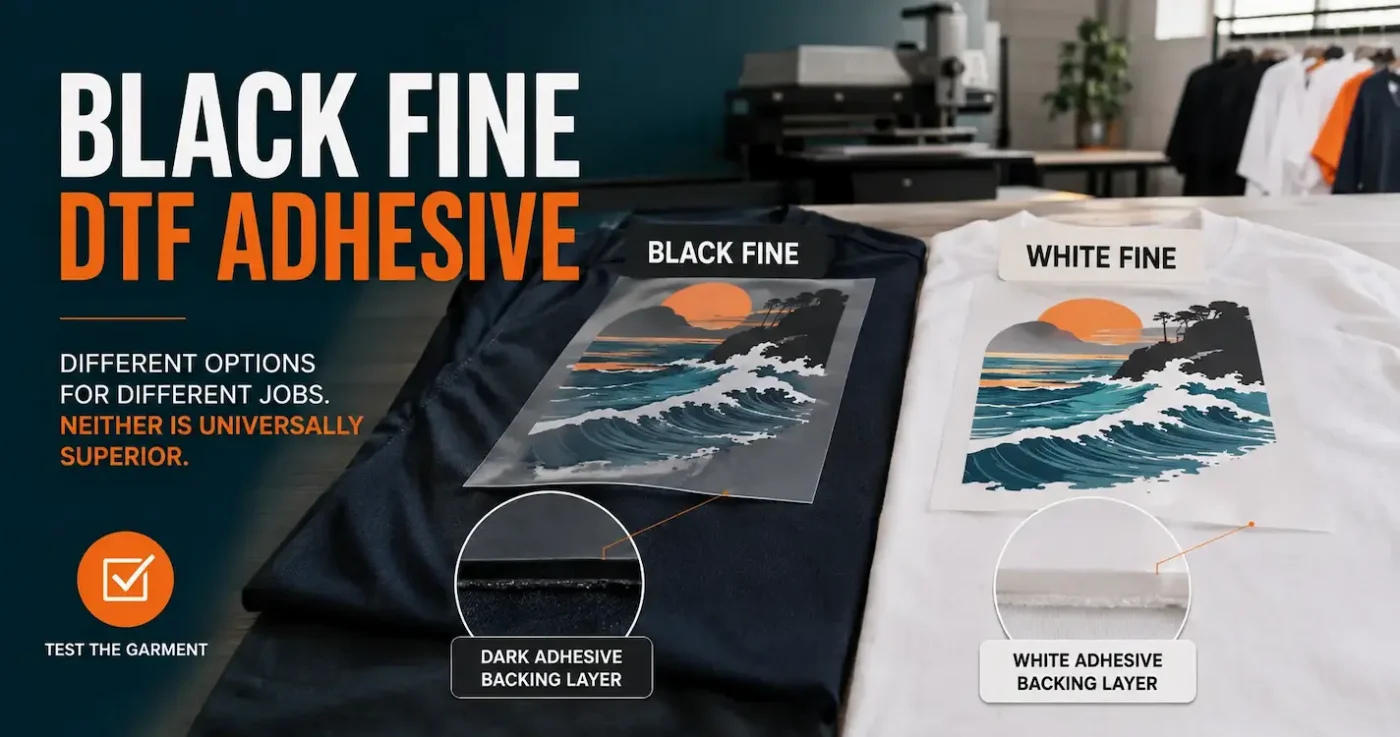
Black Fine DTF adhesive is a specialised part of the transfer—not a universal upgrade. It can be useful in selected applications involving dark or dye-prone garments, while White Fine remains a versatile choice for many everyday jobs. The best result depends on the complete combination of artwork, ink, film, adhesive, garment, heat press and application method.
Important: DTF Transfers Australia does not currently sell loose adhesive powder to the public. We use White Fine and Black Fine adhesive in our production process and supply finished, cured transfers that are ready to press. If separate adhesive sales return in the future, we will let customers know.
On this page
- The quick answer
- What DTF adhesive does
- Black Fine vs White Fine
- When Black Fine may help
- Why it is not a dye-block guarantee
- Artwork and edge considerations
- Pressing your finished transfers
- How to test before production
- Frequently asked questions
The quick answer
Black Fine adhesive forms the bonding layer on the back of a DTF print. Its dark colour can make it a useful production option for some dark garments and some polyester fabrics where dye migration is a concern. However, the adhesive alone cannot guarantee that garment dye will not affect a print.
White Fine adhesive is often the more versatile choice, particularly for light-coloured garments and designs where a dark backing could become visible at very fine edges. Neither colour is inherently “better” in every situation.
What does DTF adhesive actually do?
A DTF image is printed onto film and coated with a fine thermoplastic adhesive while the ink is still receptive. During production, that adhesive is cured to form the bonding layer. When the customer heat presses the finished transfer, the layer melts and bonds the printed image to the textile.
Adhesive colour is only one part of the system. Particle size, coating consistency, curing, ink deposit, film, press accuracy and the garment itself can all affect the finished result. For a closer look at the production stage, see our guide to curing DTF transfers.
Black Fine vs White Fine DTF adhesive
| Consideration | Black Fine | White Fine |
|---|---|---|
| Typical role | A specialised option for selected dark or dye-prone garments | A versatile option for many standard jobs |
| Light garments | May be unnecessarily visible at very fine edges | Usually the more natural match |
| Dark garments | Dark backing may be visually helpful in some designs | Still suitable for many dark-garment jobs |
| Dye migration | May help as part of a tested system, but is not a guarantee | May require extra care on unstable dyed polyester |
| Best decision method | Test the exact garment, transfer and press settings before production | |
We no longer use a separate Low Temperature adhesive. Improvements in our current Fine adhesive options have closed the gap that product previously filled. Our current production range uses only White Fine and Black Fine adhesive.
When Black Fine adhesive may help
Black Fine may be considered when a dark backing better suits the job, especially on black or very dark textiles. It can also be useful as one element in a tested approach to difficult polyester garments that are prone to dye migration.
It is important to keep the wording “may help” in mind. Garments that look similar can behave differently because of their dye chemistry, coatings, manufacturing history and previous heat exposure. A black adhesive layer cannot correct an incompatible fabric, excessive temperature, poor pressure or an unsuitable artwork file.
Situations that deserve extra testing
- Black, red, maroon, navy and other heavily dyed polyester garments.
- Sublimated sportswear and performance garments.
- Water-resistant, coated or chemically treated fabrics.
- Garments with seams, zips, pockets or uneven pressing areas.
- Large solid white or pale areas where colour contamination would be obvious.
Read our polyester printing guide before committing a difficult garment to a full run.
Black adhesive is not a dye-block guarantee
Dye migration occurs when heat activates colour in a garment—most commonly polyester—and that colour moves into the printed layer. The effect may appear immediately or develop after the garment cools. White areas can become pink, grey, blue or dull depending on the fabric dye.
A dark adhesive backing may reduce the visual impact in some applications, but it does not make every sublimated or unstable garment safe to decorate. Lower application temperature can help with some polyester products, yet the transfer still needs enough heat, time and pressure to bond correctly. That balance must be confirmed by testing.
Production rule: Never approve a large run from an assumption or a supplier’s fabric description alone. Press one transfer onto the actual garment, let it cool completely, inspect it again after 24–48 hours, and wash-test it before proceeding.
Artwork and edge considerations
Black adhesive sits behind the printed ink; it does not change black, navy or other colours in the supplied artwork into brighter colours. The visible face of the transfer is determined by the print file and ink layers.
With extremely small isolated details or very fine edges, any adhesive colour may become noticeable if the artwork is too delicate for reliable production. Supply a tightly cropped transparent PNG at 300 DPI at the required print size, and avoid isolated elements thinner than approximately 1 mm or 4 pixels. We print the supplied file as received as part of our budget transfer service, so artwork preparation and final proofing remain the customer’s responsibility.
For more practical preparation advice, visit our DTF transfer tips and troubleshooting guide.
Pressing finished DTF transfers
Customers receive finished, cured transfers; no powdering or curing is required. Use the instructions supplied with your order, because specialty products may have different settings. For our standard Insta-Peel transfers, the following settings are the current starting points:
| Garment | Temperature | First press | Peel | Final press |
|---|---|---|---|---|
| Cotton and suitable standard fabrics | 140°C | 8–10 seconds, firm pressure | Immediate hot peel | 10 seconds |
| Polyester | 120°C | 30 seconds, firm pressure | Cold peel only — cool completely before peeling | 10 seconds at 120°C |
Pre-press until no steam is released. Heat presses vary, so confirm the platen temperature with an appropriate measuring device and adjust only after a controlled test. These settings do not override the care instructions or heat limits of the garment manufacturer.
A simple test before production
- Use the real garment. A spare from the same style, colour and batch is best.
- Pre-press it. Remove moisture and flatten the application area.
- Apply a representative design. Include pale colours, small detail and solid areas if the production artwork contains them.
- Inspect after cooling. Check colour, edges, adhesion, stretch and surface texture.
- Recheck after 24–48 hours. Dye migration can become clearer after pressing.
- Wash-test. Follow the intended care routine and confirm the result before approving the full run.
Frequently asked questions
Is Black Fine adhesive always better on black garments?
No. It can be useful, but White Fine also performs well in many dark-garment applications. The complete transfer system and garment matter more than adhesive colour alone.
Does Black Fine adhesive stop polyester dye migration?
It may help reduce visible contamination in some tested applications, but it cannot guarantee protection on every polyester, sublimated or heavily dyed fabric.
Can I buy Black Fine adhesive powder from DTF Transfers Australia?
Not at this time. We use Black Fine and White Fine adhesive to manufacture finished transfers, but neither adhesive is currently sold separately to the public.
Do I need to cure the transfer?
No. Transfers supplied by us are already cured and ready to apply with a suitable heat press.
Why was Low Temperature adhesive discontinued?
Our current Fine adhesive options now cover the production needs that previously required a separate Low Temperature product, so we no longer use it.
Choose the transfer for the job—not the strongest claim
Black Fine DTF adhesive is a useful production tool when its properties suit the artwork and garment. It should not be presented as universally superior, and it cannot replace testing. For everyday transfers, difficult polyester or specialty effects, start with the intended garment and confirm the complete process before production.
Explore our current DTF transfer range, or read the broader guide to the adhesives used in our DTF production.
