
Film and Finishes
Glow in the Dark DTF Transfers: How the Glow Works
Jun
Originally posted: 3 June 2023. Last updated: 5 October 2026.
Quick summary
Glow-in-the-dark DTF is a cold-peel cut sheet. Light colours charge and show in the dark. Black and navy barely glow. It is not a gang sheet and it is not safety clothing. Press cotton and most fabrics at 160°C for 8 seconds, firm, let it cool, then peel. Polyester is 120°C for 30 seconds, cold peel, then 10 seconds at 120°C. A household iron will not press it.
On this page
How the glow works
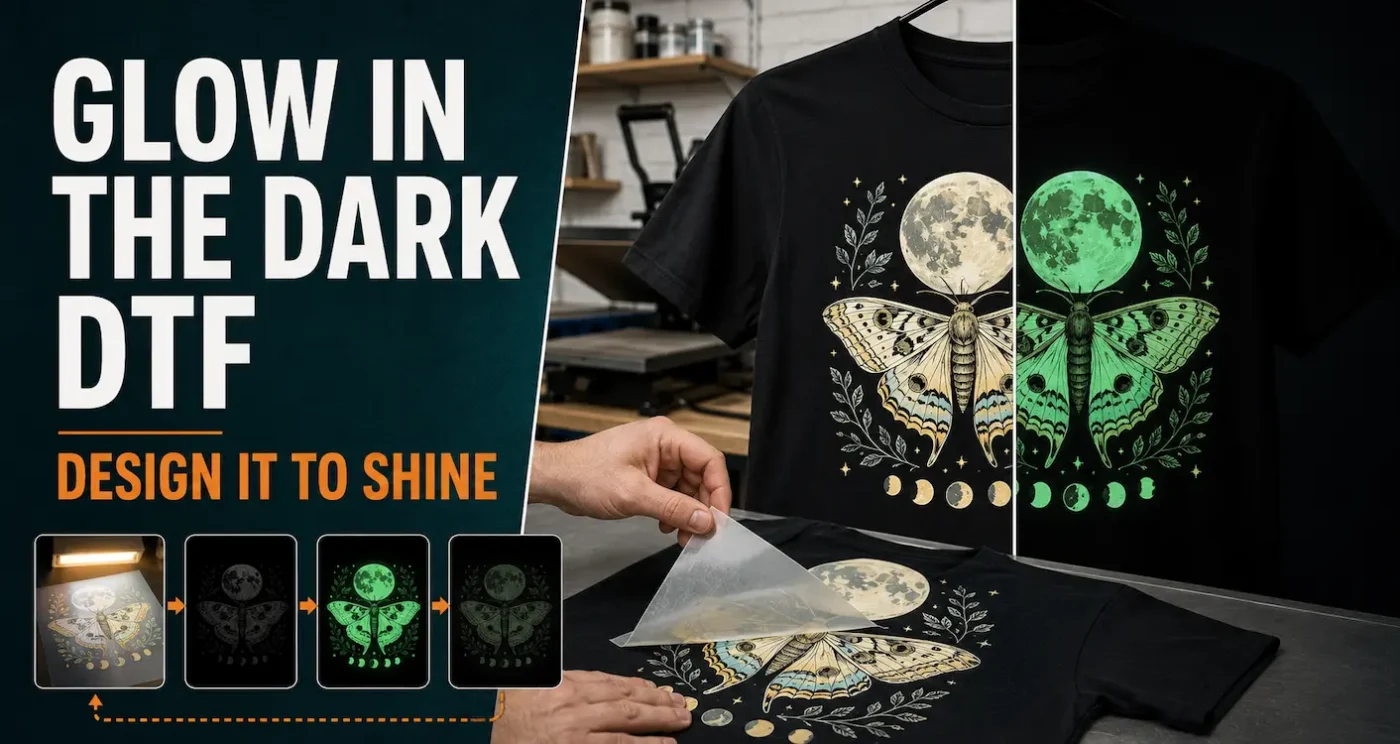
By day you see the printed colour. In the dark, the film that was charged by light gives off a greenish glow. The glow is in the light parts of the art. A black shape on a black shirt has almost nothing to charge. We have pressed jobs where the customer expected the outline to blaze and the outline was navy. It stayed dark.
Charge it under a lamp or daylight, then take it into a dark room. Sunlight can charge it. The glow fades. It is not a substitute for certified high-visibility or safety clothing. Do not sell it as that.
The sheet is a specialty cut sheet, not a gang sheet by the metre. Other finishes are in specialty DTF finishes.
Artwork
Use light, solid areas if you want a glow you can see. Fine dark lines will read in daylight and disappear at night. Send PNG, JPEG, or WebP. A transparent PNG at about 300 DPI at final size, cropped, with lines at least about 1 mm, under 254 MB, and not mirrored.
We print the file you send. We do not redraw it so it will glow. If you are unsure, order one sheet and press it before you print a team set. Blank shirts are at T Shirts Australia.
How to press
Glow film is cold peel, and it is less forgiving than a standard cotton logo.
- Lint-roll. Pre-press until the fabric does not steam. Moisture is a common reason a glow edge lifts.
- Place the adhesive on the shirt. Cover with your own parchment, baking paper, or Teflon.
- Cotton and most fabrics: 160°C, 8 seconds, firm pressure. Cool completely. Peel low and slow.
- Polyester: 120°C, 30 seconds, firm, cold peel, then 10 seconds at 120°C. Test the garment. See DTF on polyester.
- If the design lifts with the carrier, stop, lay the film back, and press again.
A heat press that covers the design is the reliable tool. A Cricut EasyPress is fine when the platen fully covers the design. A household iron is only for products labelled iron-on. The coverage rule is in how to use an EasyPress.
After you press
Look at the edges before you fold the shirt. Wait 24–48 hours before the first wash. Wash inside out on a gentle cycle. Do not iron on the print. Charge it and check the glow in a dark room before you tell a customer what the night version looks like.
FAQ
Are glow transfers hot peel or cold peel?
Cold peel. Cotton and most fabrics: 160°C for 8 seconds, firm pressure, cool completely, then peel. Polyester: 120°C for 30 seconds, cold peel, then a 10-second second press at 120°C. Do not peel glow film while it is hot.
Which colours glow best?
Light, solid areas. White and pale colours charge and show. Black, navy, and very dark art stay dark at night. The daytime print can still look fine. The glow will not.
Can I apply it with a household iron or an EasyPress?
Not with a household iron. An EasyPress is fine when the platen fully covers the design. If the design is larger than the plate, use a heat press that covers it. Glow film is less forgiving of a second overlapping press.
How long will it glow?
It fades after you take the light away. Charge it under a lamp or in daylight, then look in a dark room. There is no single minute-count that holds for every design, shirt, and charge. Test the finished print before you promise a time.
Is this suitable for safety clothing?
No. A glow transfer is a decorative print. It is not certified high-visibility workwear, and it should not be sold as a substitute for safety gear.
