
Film and Finishes
How We Test DTF Transfers: From First Print to Real-World Use
Apr
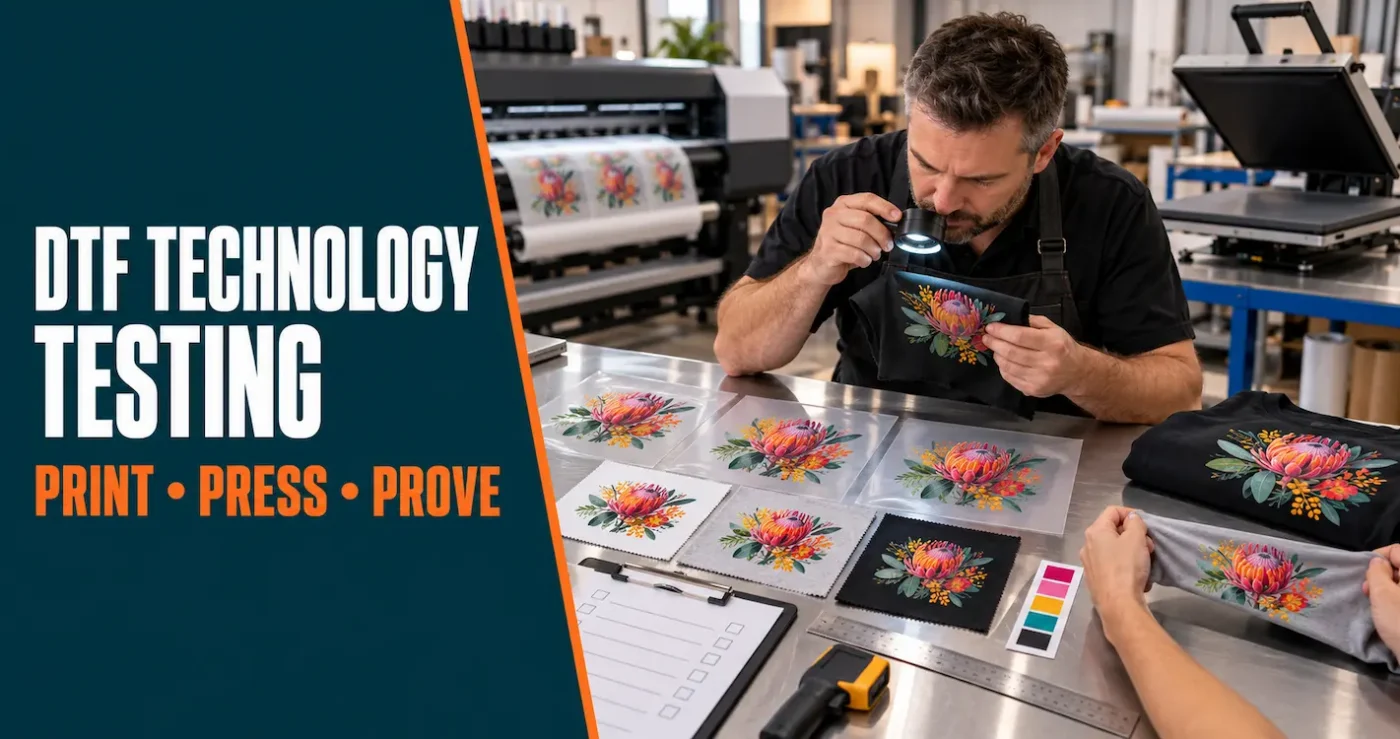
A new film can produce a beautiful sample in the first few minutes. The more useful questions come later: does it still print cleanly through a longer run? Can another operator peel it successfully? What happens when the garment has been worn and washed?
At DTF Transfers Australia, we evaluate transfer technology as a complete system: artwork, ink, film, adhesive, curing, application and the finished garment. A change earns its place in our range when its benefits hold up through practical production and customer use.
This guide explains our assessment framework, the questions behind it and a lesson from our own workshop: why we stopped supplying liquid-adhesive DTF transfers despite their appealing soft feel. It also gives you a practical way to record tests on your own garments.
At a glance
- We assess how the whole transfer system behaves, including production, pressing and wear.
- Test artwork needs to include difficult details as well as attractive, easy-to-print designs.
- A useful ready-to-press product must have a practical application process on suitable customer equipment.
- Garment composition, colour, construction and finish can change the result.
- Wash observations need recorded conditions and a defined scope; a broad wash-count claim is not enough.
- Testing can lead to new instructions, restricted uses or withdrawal of a product.
- Customers should still test the exact garment and transfer combination before production.
In this guide
- What makes a DTF transfer ready for real use?
- Making useful comparisons
- Print quality and production reliability
- Artwork stress tests
- Pressing tolerance and garment compatibility
- Washing, wear and the limits of a result
- Storage, transport and commercial practicality
- What liquid adhesive taught us
- How testing changes product decisions
- A useful test record for your own jobs
- Frequently asked questions
What makes a DTF transfer ready for real use?
Our customers buy ready-to-press film because they want to decorate garments without running a DTF production line themselves. That puts an important responsibility on the supplier: the transfer needs to be practical to receive, handle and apply.
Before assessing an improvement, we ask what it should actually achieve. Faster peeling? Better fine detail? A different finish? More consistent output? A softer feel on the garment? Defining the benefit makes it easier to judge whether the change delivers it.
We then look for the trade-offs. A pleasant hand feel has less value if the transfer becomes difficult to apply. A faster printer offers little advantage if more output has to be rejected. The final decision needs to account for the customer’s result as well as the workshop’s ability to supply it consistently.
This framework describes our workshop assessment. Specific findings need to be read alongside the equipment, materials and conditions involved; they do not establish universal performance across every DTF system.
Making useful comparisons
A fair comparison begins with knowing what changed. Replacing the film, ink, adhesive and press settings at the same time may produce a different print, but it makes the reason for that difference difficult to identify.
Where practical, compare the candidate with a known reference using the same artwork, garment and recorded application method. When several components must change together, describe the new system as a whole and record those changes.
There are three useful questions to keep separate:
- Does it work? Can the combination produce an acceptable result under the intended conditions?
- Does it repeat? Can that result be reproduced through further prints and applications?
- Where does it stop working well? What artwork, garment or operating limits need to be explained?
The third question is particularly valuable. Clear limitations help someone choose the right product and avoid a job that the transfer was never intended to handle.
Print quality and production reliability
A transfer has to be dependable before it reaches a heat press. We assess colour, white coverage, detail, adhesive coverage and curing alongside the behaviour of the production equipment.
| Area | What we examine | Why it matters to the customer |
|---|---|---|
| Printed image | Banding, edges, colour consistency and white coverage. | Repeated logos should have a consistent, usable appearance. |
| Adhesive and curing | Coverage on large areas and fine elements, and consistency across the output. | A sharp image still needs an effective bond to the garment. |
| Longer runs | Changes in output as production continues. | An attractive first sample should not hide problems later in the run. |
| Maintenance and waste | Cleaning interruptions, rejected material and usable output. | The process needs to support reliable supply. |
For equipment comparisons, usable output is more informative than a headline speed. Cleaning, stoppages and rejected film all affect what can actually be supplied.
Ink is also part of a wider system. Our DTF ink quality guide explains why the ink, white layer, profiles and materials need to work together.
Artwork stress tests: look beyond the easy sample
A bold logo with generous lines can be a helpful starting sample. Customer files are more varied, so the assessment also needs to consider designs that reveal weaknesses.
- Large solid areas, where banding and uneven coverage are easier to see.
- Small lettering and fine positive or negative detail.
- Isolated dots, distressed textures and details that need individual adhesion.
- Photographs, colour transitions and contrasting edges.
- Suitable halftones and artwork with demanding background removal.
The inspection needs to follow the design from file to film to garment. A fine line might be visible on the carrier but fail during peeling or wear. Equally, an apparent transfer defect may originate in a pale fringe or unwanted pixel already present in the file.
Always work at the intended print size. Reducing a design also reduces every line, gap and dot. Our artwork requirements explain the digital and physical detail limits, while the gang-sheet guide covers layout and approval.
Pressing tolerance and garment compatibility
Ready-to-press transfers leave our Coorparoo workshop and are applied on customer equipment. A process that is extremely sensitive to small variations in heat or pressure can become difficult to use outside a tightly controlled setup.
We assess the application behaviour around the intended settings: release from the carrier, fine-detail adhesion, finishing press and the effect of normal equipment variation. The aim is to understand a practical working range and the conditions that need special care.
An application range is not permission to disregard the supplied instructions. The customer’s starting point remains the method for the specific product, followed by a test on the actual garment and press.
The garment belongs in the test
Fibre composition is only part of the story. Colour, dyes, surface treatments, stretch, texture and construction can affect the result. A transfer that works on one cotton shirt does not establish compatibility with every coated jacket or performance garment.
Useful observations include:
- Whether the transfer releases and bonds cleanly.
- Whether seams, pockets or texture disrupt even contact.
- Changes to the fabric, including gloss, shrinkage or heat marks.
- Dye movement into lighter printed areas, including changes that appear later.
- How the print behaves when the cooled garment is handled and stretched normally.
Use the current fitting instructions for application settings. Standard Insta-Peel, specialty cold-peel and dedicated iron-on products have different requirements. The fabric guide and moisture guide explain important variables.
Washing, wear and the limits of a result
The finished shirt gives you information that the unpressed transfer cannot. After application, assess the edges, small elements, print surface and garment itself. Then consider how those observations change through washing and normal use.
A useful wash record identifies the garment and transfer, application method, detergent, cycle temperature, drying method and number of completed cycles. Keep a baseline photograph and compare the same areas under similar lighting.
Look separately for edge lift, missing detail, cracking, colour change and garment deterioration. These are different observations and may have different causes. A faded shirt with an intact print should not be recorded as the same outcome as a print lifting from an otherwise sound garment.
A wash count describes the samples and conditions tested. It should not automatically become a promise for every garment, transfer type or care routine. Claims about a particular result need the supporting records, including sample numbers and failures.
This article explains the framework; it does not present a numerical wash-test dataset for the whole range. Follow our care instructions and assess the exact combination you intend to sell.
Storage, transport and commercial practicality
Our product travels as film before it becomes a garment print. Handling and storage therefore belong in the assessment too: curling, sticking, contamination, abrasion and changes in application behaviour can affect whether a transfer remains easy to use.
Packaging and storage advice need to support the material’s requirements. See our transfer storage guide for practical customer guidance.
We also consider supply continuity, service support, maintenance and waste. A material may produce promising samples while still being difficult to obtain or impractical to produce consistently. Those constraints matter when customers rely on repeat orders.
What liquid-adhesive DTF taught us
Liquid-adhesive DTF was an appealing development. In our experience, the transfers could have a light, soft feel, and printing the adhesive removed the separate powdering stage. Those benefits gave us a reason to trial and supply the product.
Our production and customer-use experience exposed limitations that outweighed those benefits:
- Application was too sensitive. The pressing tolerances were difficult to support across varied customer equipment.
- Fine details involved a compromise. Extending clear adhesive around them could improve bonding but leave a visible outline.
- Fades fell short of expectations. The promoted performance did not consistently translate to our artwork and production results.
- Longer runs created problems. On our setup, approximately four metres could be printed before a deep clean was needed. Pushing further increased the risk of banding or inadequate adhesive coverage.
- Durability was too variable. Incomplete coverage or application outside the narrow working range could undermine long-term adhesion.
We withdrew the product. The four-metre observation describes the equipment and workflow we used; it is not a specification for every liquid-adhesive system. Other platforms may behave differently, and future developments deserve assessment on their own results.
Read the full account in Liquid Adhesive DTF Transfers: Why We Stopped Selling Them.
How testing changes product decisions
Product evaluation is ongoing. The appropriate response depends on what the evidence shows:
| Finding | Practical response |
|---|---|
| The intended benefit is repeatable and the process is practical. | Consider release with clear instructions and continued monitoring. |
| It works for a narrower set of jobs. | Restrict the application, format or claims to the supported uses. |
| Instructions need more clarity. | Revise the guidance and check that it describes the working process accurately. |
| Production or application remains unreliable. | Continue development, delay release or withdraw the product. |
Different transfer products need different assessments. Insta-Peel raises questions about release behaviour and workflow; specialty finishes also need attention to their visual effect, artwork limitations and application method.
A film being suitable for a specialty sheet does not automatically make it a standard gang-sheet option. Check the current product format and instructions rather than assuming every new material can be used in the same way.
A useful test record for your own jobs
You do not need an elaborate report for a small trial. You do need enough detail to repeat the successful method and recognise what changed if the next result differs.
| Record | Details to keep |
|---|---|
| Date and job reference | When the trial took place and which order it supports. |
| Transfer and artwork | Product, order/batch reference where available, file version and finished dimensions. |
| Garment | Brand, style, size, colour, composition and any relevant finish. |
| Sample count | How many pieces were tested and how many showed each outcome. |
| Equipment and setup | Press used, platen, loading, cover sheet and pressure setting/method. |
| Application | Pre-press, temperature, time, peel procedure and finishing press. |
| Observations | Release, adhesion, fine detail, fabric changes and later changes. |
| Wash and wear checks | Actual care conditions, completed cycles and observations. |
| Evidence and decision | Photographs, retained sample, limitations and whether to proceed. |
Keep the approved sample with the job record where practical. If the garment, artwork or product changes, review whether the earlier result still applies. For a problem, send the supplier the product reference, settings and clear photographs before continuing through valuable garments.
Frequently asked questions
What is the best way to test a DTF transfer?
Apply the correct product to a spare example of the actual garment using its supplied instructions. Record the equipment and method, inspect the cooled print and fabric, then assess washing and wear according to the job’s needs. Repeat the trial when a single sample would not provide enough confidence.
Does a successful cotton test prove suitability for polyester?
No. Polyester has different heat, dye and application considerations. Use the relevant product instructions and test the exact garment style and colour.
Why can results differ between heat presses?
Platen temperature, pressure, pad condition and garment loading can differ. The same displayed setting does not necessarily produce the same contact conditions across two machines.
How many washes should a transfer survive?
A meaningful answer needs a specific product, garment, application method and care conditions. Use documented results for that combination rather than treating a general wash count as a universal lifespan.
Is this an independent laboratory certification?
This is our workshop assessment framework and first-hand production experience. Any independent certification or standardised laboratory result would need to identify its scope and supporting documentation separately.
Do customers still need to test their garments?
Yes. Our evaluation helps establish the product and its instructions; your trial checks the exact garment, equipment and workflow you will use.
Would you consider liquid-adhesive DTF again?
A future system would need to demonstrate practical application, consistent adhesive coverage, manageable production and dependable garment performance. Our experience with one setup does not settle the potential of every future system.
Try the right product for your job
If you are new to our standard transfers, the free sample pack gives you a starting point for a practical trial. For a specific finish or unfamiliar garment, contact our team before ordering so you can choose the appropriate product.
We are based at Roller Door 2, 17 Castlemaine St, Coorparoo QLD 4151, supplying ready-to-press transfers to customers around Australia. Explore the current transfer range and keep its product-specific instructions with your test records.
About the author: David Seth owns DTF Transfers Australia and The Custom T Shirt Shop group. This article draws on the business’s published production and application experience and explains the framework behind product decisions. Meet the team and learn about the workshop on our About page.
