
Film and Finishes, Pressing and Care
Low Temp Hot Peel DTF Transfers: What Changed and What to Use Now
Mar
First published: 17 March 2024 | Last updated: 23 September 2026 | By: David Seth
Our original Low Temp Hot Peel DTF Transfers were introduced to help customers decorate polyester and other heat-sensitive garments at lower press temperatures. The range was useful at the time, but DTF film, ink and adhesive systems have continued to improve.
DTF Transfers Australia has now discontinued the dedicated Low Temperature adhesive. It has been replaced in our current workflow by newer transfer technology, including Insta-Peel film, which provides fast release and practical lower-temperature application without maintaining a separate Low Temp adhesive range.
This article explains what changed, what customers should use now and why no transfer can completely remove the need to test polyester, performance wear and other sensitive fabrics.
At a glance
- Our dedicated Low Temperature DTF adhesive has been discontinued.
- The old product has not simply been renamed; our current system uses newer film and adhesive technology.
- For current standard transfers, Insta-Peel film provides fast release with lower-temperature settings suitable for many cotton and polyester garments.
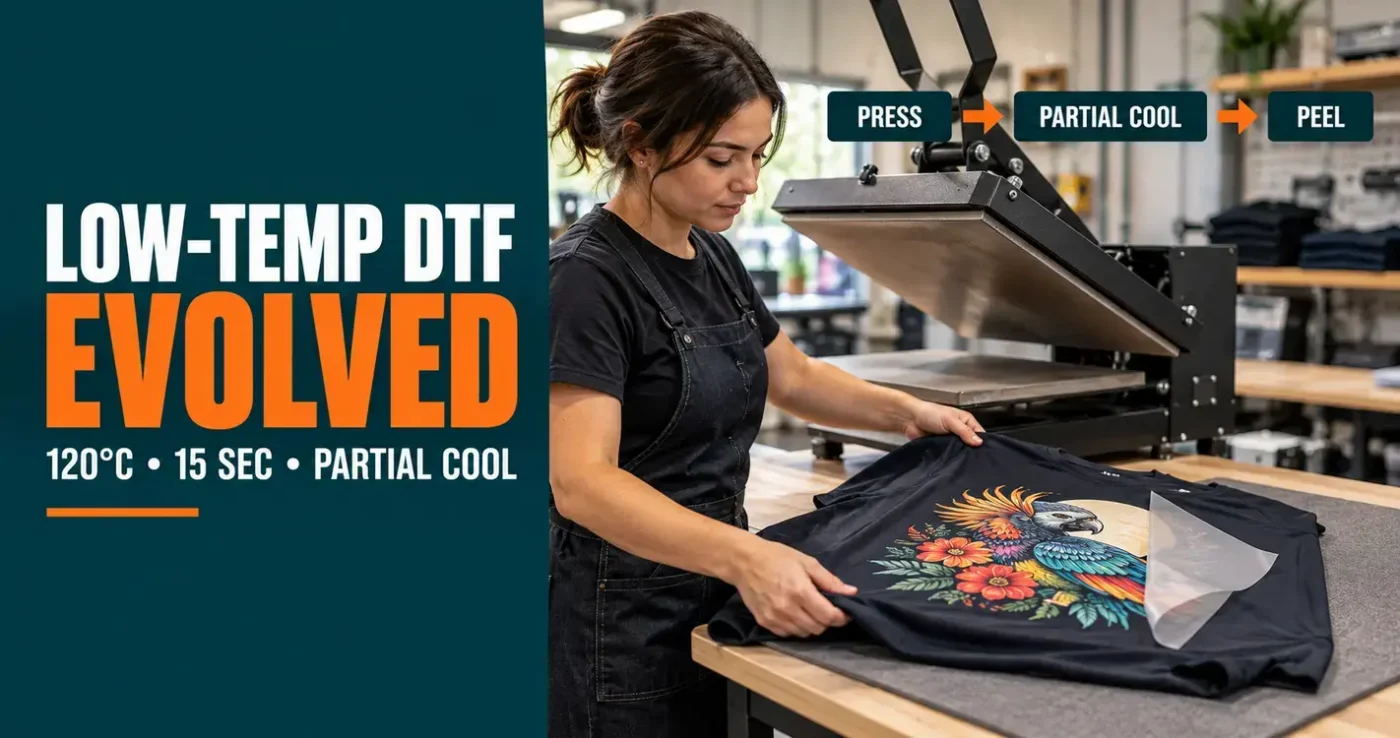
- Our current polyester method is 120°C for 30 seconds with firm pressure. Cold peel only — let the garment and transfer cool completely, then peel and complete the finishing press at 120°C for 10 seconds. Always test on a spare garment first — heat presses and fabrics vary.
- Lower heat can reduce the risk of dye migration, scorching and press marks, but it cannot guarantee they will never occur.
- Pre-press until no steam remains, test the actual garment and wash-test before starting a production run.
- Black Fine Adhesive may provide additional blocking on some dark polyester garments, but it is not a universal cure for unstable dyes.
What happened to Low Temp Hot Peel DTF Transfers?
When we introduced Low Temp Hot Peel DTF Transfers, they filled a genuine gap. Many conventional transfers were being applied at temperatures that could create problems on polyester and performance garments. A lower activation temperature gave customers another option.
However, “Low Temp” was not one isolated feature. The finished behaviour depended on the combination of adhesive, ink, film, curing and heat-press settings. As those materials evolved, it no longer made sense to keep a separate Low Temperature adhesive product simply because it had once been the best way to achieve a lower pressing window.
We have therefore retired the dedicated Low Temperature adhesive and simplified our production around our current White Fine and Black Fine DTF adhesives, matched with newer films and tested application methods.
This is product evolution—not a silent substitution
Customers should not assume that an old Low Temp transfer and a current Insta-Peel transfer are identical. They may both support lower-temperature application, but they are different generations of the process. Always use the instructions supplied with the transfer in front of you rather than relying on settings saved from an older order.
Keeping this page live allows us to preserve the history of the product while giving customers accurate current advice. It also reflects an important part of our approach: when technology changes, the instructions and recommendations must change with it.
Why lower-temperature DTF pressing still matters
Although the dedicated adhesive has been discontinued, the reason lower-temperature application became important has not disappeared. Heat can affect a garment long before it visibly burns.
Reduced dye-migration risk
Some polyester fabrics contain dyes that can move when heated. This is particularly common with sublimated garments and strong colours such as red, maroon, navy and black. Migrating dye can travel into the white ink and change a bright white or pale part of the transfer.
Reducing temperature can reduce the energy available to mobilise those dyes. It may lower the risk, but it does not make unstable fabric dye permanently stable. Migration can appear immediately or develop hours after pressing.
Fewer press marks and less surface change
Heat and pressure can flatten fibres, create gloss, leave a platen outline or change the surface of performance fabric. A lower temperature may reduce those effects, but time, pressure, platen condition, garment construction and cover-sheet choice also matter.
Less risk of distortion or shrinkage
Some lightweight polyester and stretch garments can distort under excessive heat. Seams, elastane content, bonded panels and printed finishes can all behave differently. Lower-temperature application can be gentler, but every garment still needs assessment.
A wider practical operating window
Modern lower-temperature fitting can make DTF transfers suitable for products that would be uncomfortable at older, hotter settings. It does not make every textile printable. Coated nylon, waterproof materials, silicone-treated fabric and laminated garments may still resist adhesion or suffer heat damage.
What replaced the old Low Temp range?
Our current standard transfer workflow uses Insta-Peel film. As its name suggests, the film can release very quickly after pressing rather than requiring a full cold peel. However, our production testing has shown that the safest workflow is not identical for every fabric.
On suitable cotton garments, the film can normally be peeled immediately according to the supplied instructions. On polyester, cold peel only: after pressing, let the garment and transfer cool completely before peeling, then complete the finishing press. This full cool-down has given us a safer and more consistent result at 120°C.
Insta-Peel is more than a quicker peel. In our testing, it gives customers a useful application window across common cotton, polyester and blended garments, with lower-temperature settings available for heat-sensitive jobs.
The practical advantage is a simpler standard range:
- one current transfer system can cover many everyday cotton and polyester applications;
- the customer does not need to order a separate Low Temperature adhesive product;
- fast, fabric-appropriate peeling supports efficient production; and
- the instructions can be adapted to the garment and heat press rather than treating adhesive name as the only variable.
Read our full Insta-Peel DTF film guide for the development, testing and use of the current film.
Current Insta-Peel starting settings
The settings below are practical starting points for current Insta-Peel transfers. They are not a substitute for testing, and instructions may be updated as materials and production processes change.
| Garment | Starting temperature | Starting time | Pressure | Peel method |
|---|---|---|---|---|
| Cotton | 140°C | 8–10 seconds | Firm | Peel immediately when the garment and transfer test successfully |
| Polyester | 120°C | 30 seconds | Firm | Cold peel only — cool completely before peeling |
Before positioning the transfer, pre-press until no steam is visible. If the garment releases significant steam, allow it to settle briefly before applying the transfer rather than trapping moisture beneath the film.
For hats, curved items or difficult surfaces, use heat-resistant tape to prevent movement. Make sure the decoration area has proper contact with the heated platen and is not being held away by seams or panels.
Use the instructions supplied with your order. Heat presses vary, platen temperatures can be inaccurate and fabrics with the same fibre percentage can behave differently.
The real risks when printing polyester
Polyester is not one uniform material. A white sports tee, sublimated team jersey, recycled-performance shirt, softshell jacket and coated sports bag may all be labelled polyester while reacting very differently to heat and adhesive.
Dye migration
Dye migration occurs when garment dye moves into the transfer. It is not the same as ink bleeding from the DTF print. Highly saturated or previously sublimated polyester can be particularly unpredictable.
Reducing temperature and time can help, but inspect the sample again after it has cooled and rested. A transfer that looks bright when it leaves the press may show colour contamination later.
Press marks and shine
The boundary of the platen, cover sheet or transfer film can leave a visible difference in the fabric surface. Try the lowest proven setting, use appropriate protective material and avoid more pressure than the transfer requires. Any protective layer changes heat transfer, so include it in your testing rather than adding it during production without checking.
Moisture
Polyester garments can hold moisture from storage, humid conditions and packaging. When heated, that moisture becomes steam and can interfere with adhesion or create inconsistent results. Our guide Moisture Is the Enemy of DTF Transfers explains why pre-pressing matters.
Fabric coatings
Water-repellent, stain-resistant, silicone and performance finishes can prevent adhesive from gripping the fibres. A fibre-content label does not normally tell you everything about the surface treatment. If the supplier cannot confirm the finish, test before accepting the job.
Seams, zips and uneven construction
A seam or zip can stop the platen from applying even pressure to the design. Use a suitable smaller platen or pressing pillow so the decoration area sits above obstructions. Do not compensate blindly with extreme pressure.
For a broader discussion, see our guide to DTF transfers on polyester garments.
Can Black Fine Adhesive help with polyester?
Black Fine Adhesive can provide an additional dark blocking layer between the garment and print. It is particularly useful on black and dark garments and may reduce the visible effect of dye migration in some polyester applications.
It is not a guarantee. If a garment has highly mobile dye, heat can still move that colour into or around the printed layers. The combination of Black Fine Adhesive, appropriate temperature and controlled time can improve the odds, but only a garment test can show how that specific product behaves.
White Fine Adhesive remains suitable for many light and mid-coloured fabrics. Adhesive colour should be selected as part of the complete transfer system, not treated as the only decision. Learn more in our Black Fine DTF adhesive guide.
How to test a heat-sensitive garment
A useful test is more than pressing one transfer and looking at it immediately. Use a repeatable process:
- Confirm the garment: record the brand, style, colour, fibre content and any known treatment.
- Choose a hidden or spare sample: never make a customer’s only garment your experiment.
- Check the press: verify that the platen provides even temperature and pressure.
- Pre-press: remove moisture and note whether the fabric changes colour, texture or shape.
- Start with the current instructions: do not begin with settings from the retired Low Temp range.
- Press a representative design: include white or pale detail if dye migration is a concern.
- Inspect immediately: check adhesion, edge release, press marks, gloss and distortion.
- Inspect later: review the sample after cooling and again after 24–48 hours for delayed migration.
- Wash-test: follow the garment care instructions and assess adhesion after washing.
- Record the successful settings: include temperature, time, pressure, peel, cover material and finishing press.
For ongoing production, keep a reference sample. If the garment supplier, colour, transfer batch or heat press changes, confirm the settings again.
Recommended workflow for current Insta-Peel transfers
- Read the instructions supplied with the transfer.
- Confirm the fabric and complete a test.
- Set the heat press and allow it to stabilise.
- Lint-roll the decoration area where appropriate.
- Pre-press until no steam remains and the surface is flat.
- Position the transfer adhesive-side down.
- Secure with heat-resistant tape if the shape or surface may allow movement.
- Press using the tested time, temperature and firm pressure.
- For suitable cotton: open the press and peel the Insta-Peel film immediately in one smooth, controlled movement.
- For polyester: after pressing at the tested setting—currently 120°C for 30 seconds—let the garment and transfer cool completely before peeling (cold peel only).
- Return the garment to the heat press and complete the instructed finishing press using a suitable cover sheet.
- Allow the garment to cool before folding, packing or judging the final colour.
Always use our current DTF transfer fitting instructions rather than a screenshot or printout from the retired Low Temp product. If your heat press struggles to apply even pressure or maintain temperature, the transfer settings alone cannot correct the machine. Our heat press buyer’s guide includes practical checks.
What lower-temperature pressing does not guarantee
It does not eliminate dye migration
Lower heat may reduce the risk, but fabric dye can still move. Dark sublimated polyester should always be treated as a test-first material.
It does not make every fabric DTF-compatible
Coatings, silicone, waterproofing, texture and construction can prevent adhesion even when the fabric survives the temperature.
It does not compensate for weak pressure
Reducing heat while also providing uneven pressure can leave the adhesive incompletely bonded. Time, heat and pressure must be considered together.
It does not mean “cooler is always safer”
If the temperature is too low for the time and adhesive system, the transfer may appear fitted but have poor wash durability. The goal is the lowest setting that produces a complete, tested bond—not simply the lowest number the press can display.
It does not make old instructions current
Our materials have changed since the original Low Temp range was launched. Use the instructions supplied with the current transfer.
Low Temp and Insta-Peel DTF FAQs
Do you still sell Low Temp Hot Peel DTF Transfers?
No. The dedicated Low Temperature adhesive range has been discontinued. Current standard transfers use our newer film and adhesive system, including Insta-Peel film.
Has Low Temp simply been renamed Insta-Peel?
No. Insta-Peel is a newer film and transfer system, not merely a new label on the retired Low Temperature adhesive product. Use the current Insta-Peel instructions.
Can Insta-Peel transfers be used on polyester?
Yes, they can be used on many polyester garments. Our current method is 120°C for 30 seconds with firm pressure. Cold peel only — cool completely, then peel and complete the instructed finishing press at 120°C. Always test on a spare garment first — heat presses and fabrics vary.
Can Insta-Peel transfers be used on cotton?
Yes. A starting setting for cotton is 140°C for 8–10 seconds with firm pressure. Adjust only after testing your press, garment and transfer.
Does lower-temperature pressing stop dye migration?
It can reduce the likelihood, but it cannot guarantee that unstable polyester dye will not migrate. Check the sample after 24–48 hours as well as immediately after pressing.
Should I use Black Fine Adhesive on polyester?
It may be helpful on black, dark or migration-prone polyester because it adds a dark blocking layer. It is not necessary for every polyester garment and does not replace testing.
Can I use a household iron?
For professional and repeatable application, use a proper heat press capable of maintaining even heat and medium-firm pressure. Some separate Iron-On DTF products are designed for household irons, but they have their own instructions and should not be confused with the standard transfer range.
Why must I pre-press polyester?
Pre-pressing helps remove moisture, flatten the decoration area and reveal whether the fabric is likely to mark or change under heat. Continue until visible steam has stopped.
What if the transfer lifts during the peel?
Lay the film back into position without shifting the design, cover it and press again. Then check moisture, actual platen temperature, pressure and whether the correct instructions were used before continuing with the job.
Technology changed—and the advice needed to change with it
The original Low Temp Hot Peel range helped us and our customers learn how valuable lower-temperature application could be for polyester. It also taught an equally important lesson: no product name can replace garment testing.
Today, Insta-Peel film and our current White Fine and Black Fine adhesives give us a more flexible standard transfer system. Customers gain a fast, fabric-appropriate peel and practical lower-temperature settings without needing a separate Low Temperature adhesive line. For polyester, that now means a cold peel only — allow the garment and transfer to cool completely before peeling.
The best result still comes from understanding the garment, removing moisture, verifying the heat press, following current instructions and testing before production. To try the current system, order a free DTF transfer sample pack or explore our custom ready-to-press DTF transfers.
About the author
David Seth has worked with screen printing and garment decoration since the 1990s. He founded The Custom T Shirt Shop in Brisbane in 2010 and DTF Transfers Australia in 2020. This update reflects practical testing across changing films, adhesives, heat presses and polyester garments—and a willingness to retire older products when a more useful production system becomes available.
