
Pressing and Care, Printing It Yourself
New vs Used Heat Press: Which Is the Better Investment?
Apr
Originally posted: 27 April 2024. Last updated: 5 October 2026.
Quick summary
Buy the heat press that holds an even temperature and even pressure, with parts you can get in Australia. A new press is the safer buy when a breakdown stops orders. A used commercial press can be the better machine if you test it from cold and the saving is real after freight and parts. A household iron is not a substitute for standard DTF.
On this page
- Quick summary
- What the press has to do
- New or used
- Size and style
- How to test a used press
- After you buy
- FAQ
What the press has to do
A heat press has one job: the same heat, the same pressure, and the same time across the whole design. The number on the controller is not that job. We see shirts where the centre is bonded and a corner lifts, because the platen was hot in the middle and tired at the edge.
- Temperature has to match the platen, not just the display. A cold corner leaves adhesive half set.
- Pressure has to repeat. A worn pad or a bent hinge makes one shirt fine and the next one patchy.
- The timer has to start and stop when you think it does. Auto-open helps only if the heat and pressure are already honest.
- The platen has to cover the design in one press. Overlapping two presses leaves a line.
The rest of the bench is in the equipment checklist.
New or used
For a shop that presses every day, a new press from a supplier who can freight parts in Australia is usually the lower risk. The higher price is the warranty and the fact you are not guessing the machine’s past.
A used press makes sense when it is a known commercial model, you can see it work from cold, and the discount still exists after a new pad, freight, and an electrical check. A cheap new press with a platen that does not meet evenly is not a bargain. A heavy used clamshell from a decorator who is upgrading often is.
Ask, before you pay, who covers the heating element, who pays freight if it has to be assessed, and whether the controller is still sold. A press that has to be crated to another state for a diagnosis is not really under warranty in any way that saves a Friday order.
Count purchase, delivery, electrical work, the first parts, and the days you cannot press. A machine that is cheaper on the listing and then needs a discontinued controller is the expensive one.
Size and style
Pick the platen for the prints you actually sell. Adult front prints and hoodies need more area than a left-chest logo. A bigger platen also means more weight, more power, and a bench that does not walk across the room.
- Clamshell: opens up, uses less bench. The hot platen swings toward your hands, and the back of the shirt can be awkward.
- Swing-away: the heat moves off the garment so you can place the film. It needs space beside the machine.
- Drawer platen: you load away from the heat. Check the drawer does not shift while it is closed.
- Auto-open, air, or two stations: buy these when you are waiting on the press, not because the brochure looks busy.
How to test a used press
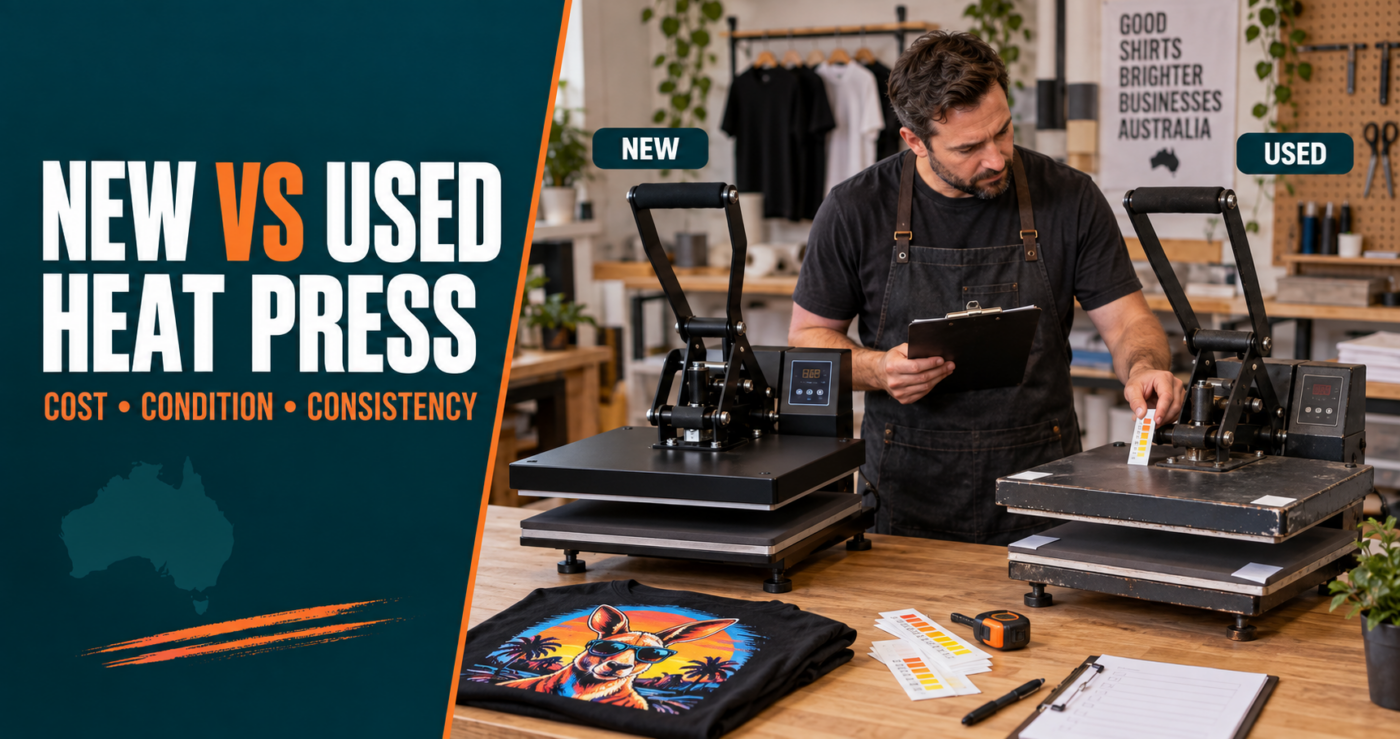
See it in person. Ask the seller not to preheat it. You want to watch it come up from cold.
- Photograph the make, model, serial, and the rating plate. Confirm the plug is right for an Australian circuit. If the plate is missing, walk away.
- Unplugged, look for a taped lead, cracked covers, burnt marks, or a frame that rocks. Do not run a press with a damaged cord. If you are unsure, get a qualified person to check it. Do not open the electrics yourself.
- Look at the lower pad. Deep dents and crumbling foam change the pressure. Look at the upper platen for warp and baked-on adhesive.
- Heat it from cold. Wait until it settles. Smoke, a burning smell, or a controller that hunts is a no.
- Measure more than the centre. Strips or a proper platen check will show a cold edge the display will not.
- Close the press on strips of paper at the corners and try to pull them. A loose corner is uneven pressure.
- Run several cycles. One good shirt does not mean it recovers heat on the tenth.
- Press a test transfer on a spare shirt, not a customer’s garment. A sample pack is there for that.
- Price the pad, the strut, the freight, and any electrical work before you call it cheap.
Leave it if the seller will not show it from cold, parts are gone, the platens do not meet, or the “saving” disappears once it is on your bench.
After you buy
Learn the press on waste shirts. Pre-press until there is no steam. Our standard film is Hot Insta Peel. Cotton and most fabrics: 160°C, 8 seconds, firm, peel while hot, then 10 seconds under your own parchment, baking paper, or Teflon. Polyester: 120°C, 30 seconds, firm, cold peel only, then 10 seconds at 120°C. The sequence is in pressing tips.
A household iron is only for products labelled iron-on. It will not give you repeatable pressure on a gang sheet. A Cricut EasyPress is usable when its platen fully covers the design. Treat it as a small heat press for standard sheets and Hot Insta Peel. If the design is larger than the platen, you need a larger press, not a second overlapping hit. Specialty finishes follow their own instructions.
If you are pressing for customers every day, a supported press is the one that lets you finish the pile. An EasyPress is a fair tool for designs that fit it. It is a poor only-press once the jobs get bigger than the platen.
FAQ
Is a used commercial press better than a new budget press?
Often, if you can test it. Even heat and even pressure matter more than a new plastic housing. A used press you cannot identify, or cannot see run from cold, is not a better buy.
What size heat press should I buy?
One platen that covers your usual design in a single press. A left-chest logo can live on a smaller platen. Front prints on adult shirts need more area. Do not plan to press a large design in overlapping sections.
Can I check the platen by touching it?
No. Touch tells you it is hot, not that the corners match the display. Use a method made for checking a platen, and compare the centre with the edges.
Can I use an EasyPress instead of a heat press?
Yes, when the platen fully covers the design. That suits standard DTF and Hot Insta Peel. A household iron does not. If the design sticks out past the EasyPress, use a heat press that covers it. Always test.
Should a used press be electrically tested?
Yes, if the lead, plug, or enclosure looks tired, or you do not know the circuit it needs. Do not hide a wrong plug behind an adapter. Ask a licensed electrician before you put a commercial machine on a household circuit.
