
Film and Finishes
DTF Transfer Adhesive Explained: What It Does and Why It Matters
Apr
First published: 7 April 2024 | Last updated: 23 September 2026 | By: David Seth
DTF transfer adhesive is rarely the part of a design that gets noticed, but it is one of the parts that matters most. It forms the heat-activated bond between the printed ink layers and the garment. If the adhesive, curing process or heat-press application is wrong, even a beautifully printed transfer can lift, peel or fail in the wash.
This guide explains what the adhesive does, how it becomes part of a ready-to-press transfer, why we currently use White Fine and Black Fine adhesive, and how moisture, temperature, pressure and garment choice affect the final result.
At a glance
- DTF adhesive is a heat-activated layer that bonds the printed design to the garment.
- It is applied while the printed ink is still wet and is cured as part of transfer production.
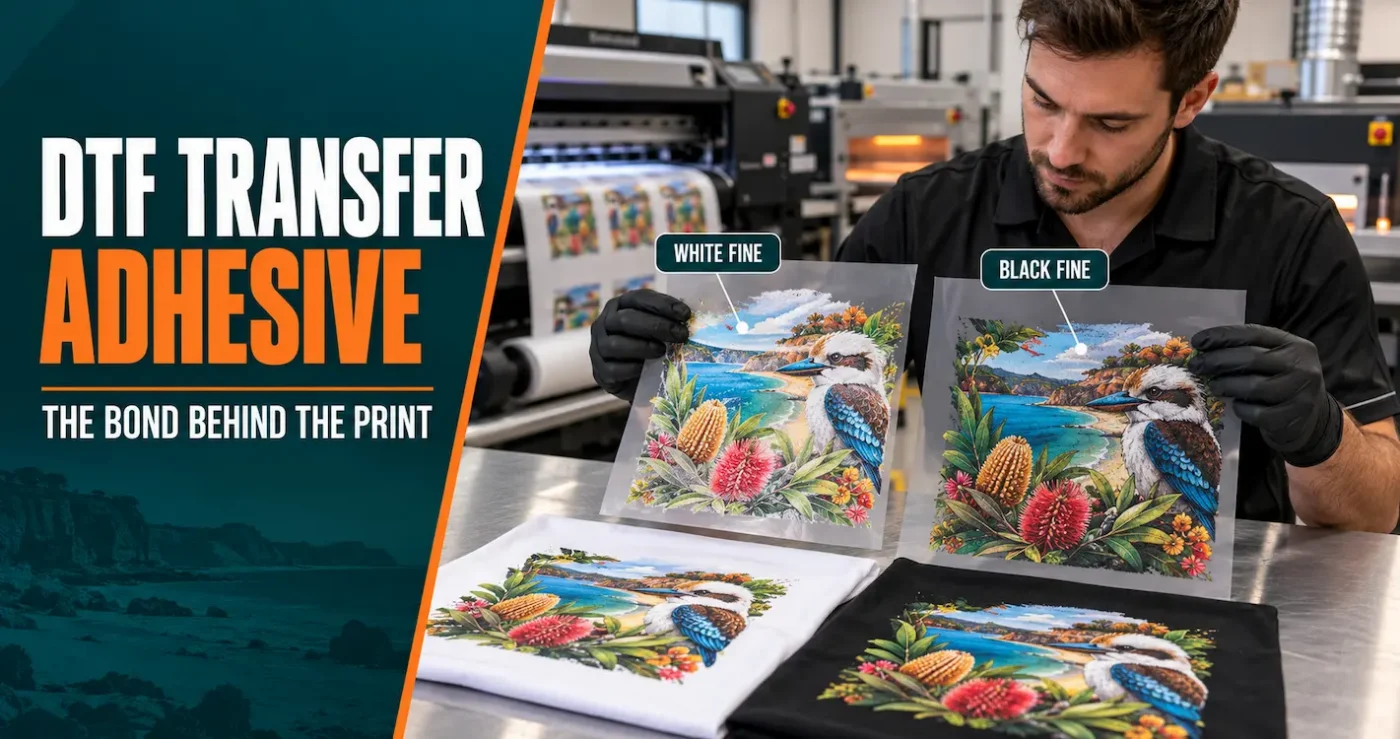
- DTF Transfers Australia currently uses White Fine Adhesive and Black Fine Adhesive.
- We no longer use Low Temperature adhesive or produce liquid-adhesive transfers.
- Our adhesive is part of our manufacturing process and is not sold separately to the public.
- Customers receive a complete, cured, ready-to-press transfer; adhesive cannot be added successfully after production.
- Reliable fitting still depends on a dry garment, an even heat press and the correct time, temperature, pressure and peel method.
What is DTF transfer adhesive?
DTF transfer adhesive is a thermoplastic hot-melt material formulated to activate under heat and pressure. During transfer production, it attaches to the wet ink on the film. During fitting, it softens again and flows into the surface of the textile, helping the printed ink layer become securely attached to the garment.
It is helpful to think of adhesive as part of a complete system rather than a stand-alone glue. A durable result depends on the relationship between:
- the artwork and minimum printable detail;
- the DTF ink layers;
- the film and its release characteristics;
- the adhesive formulation and particle size;
- how the transfer is cured during production;
- the garment fabric and any surface treatment;
- the heat press and its temperature and pressure consistency; and
- the fitting, peel and finishing process.
This is why changing one temperature setting does not solve every adhesion problem. The complete process has to work together.
Where does the adhesive sit in a DTF transfer?
A DTF transfer is built in reverse on a release film because the printed face eventually sits on the outside of the garment. In simplified form, the layers are:
- Release film: temporarily carries the transfer through printing, curing and application.
- Colour ink: creates the visible CMYK design.
- White ink: provides opacity and supports the colour, particularly on dark garments.
- Adhesive: bonds to the wet ink during production and later bonds the finished print to the textile.
Once the transfer has been pressed and the film removed, the visible ink faces outward while the adhesive remains between the print and fabric.
The adhesive should not cover unwanted transparent areas of the design. Good production control removes loose powder before curing, helping keep the transfer clean around its edges and internal cut-outs.
How DTF adhesive is applied and cured
Customers receive a finished, ready-to-press product, but several important production stages have already taken place before the transfer reaches them.
1. The artwork is printed onto film
The design is printed onto DTF film, normally with colour inks followed by a white ink layer. The ink remains wet enough for the adhesive to attach to the printed areas.
2. Adhesive is applied
The printed film is coated with fine adhesive. The powder attaches to the wet ink while excess material is removed from the clear film and open spaces. Consistent coverage matters: too little can leave weak areas, while poorly controlled excess can leave unwanted adhesive around a design.
3. The transfer is cured
Controlled heat melts or gels the adhesive and stabilises the printed layers without fitting them to a garment. This produces the dry, handled transfer that is packed and supplied to the customer.
4. The customer applies the finished transfer
At this stage, the adhesive is already part of the transfer. The customer positions it on the garment and uses a heat press according to the instructions for that film, adhesive and fabric combination.
Important: adhesive must be applied while the ink is wet and then cured under controlled production conditions. It cannot simply be sprinkled onto a completed transfer immediately before fitting.
White Fine vs Black Fine DTF adhesive
DTF Transfers Australia currently uses two adhesive options in production: White Fine Adhesive and Black Fine Adhesive. Neither is automatically “better” for every job. We select the option that best suits the transfer, garment colour and production requirements.
| Consideration | White Fine Adhesive | Black Fine Adhesive |
|---|---|---|
| Typical use | General production and light to mid-coloured garments | Black and dark garments, and selected polyester applications |
| Edge visibility | Less noticeable if a very fine trace is present on a light garment | Less noticeable around designs applied to black or dark fabric |
| Colour blocking | Standard option for many garments | Can provide an additional dark barrier beneath the print |
| Dye migration | Not selected specifically as a blocking layer | May help reduce visible migration in some polyester garments, but cannot guarantee prevention |
| Availability | Used internally in transfer production | Used internally in transfer production |
White Fine Adhesive
White Fine Adhesive is our general-purpose option and works well across many common garment colours and fabrics. Its pale colour helps minimise the visibility of a microscopic adhesive edge on white and lighter garments.
It is not chosen because the wearer should see a white layer. Correct production and fitting should leave the adhesive beneath the printed design and bonded into the garment.
Black Fine Adhesive
Black Fine Adhesive is useful on black and dark garments because any extremely fine trace around the artwork is less visually noticeable against the fabric. The dark adhesive layer can also add blocking beneath the print, which may help with some polyester dye-migration problems.
Black adhesive is not a universal cure for difficult polyester. Fabric dyes, sublimation history, garment treatments and heat exposure all vary. Testing the actual garment remains essential. Our dedicated guide to Black Fine Adhesive for DTF transfers explores that option in more detail.
Why do we use fine adhesive?
Particle size affects how adhesive coats the wet print and how the finished transfer feels and behaves. A fine, well-controlled adhesive helps us achieve consistent coverage around detailed artwork while avoiding the coarse, heavy feel associated with some older powders.
Fine adhesive does not remove the need for sensible artwork. Extremely narrow lines, tiny isolated dots and fragile distressed textures still have very little surface area to hold adhesive and bond to the garment. For our artwork, no important element should be narrower than 4 pixels, approximately 1 mm.
A design with generous negative space can feel lighter than one large solid rectangle because there is less ink and adhesive covering the fabric. This is a design decision as much as a material decision.
Why Low Temperature and liquid adhesive are no longer offered
Low Temperature adhesive
We previously offered a separate Low Temperature adhesive option. That range has been discontinued. Film, ink and adhesive technology has changed, and our current transfer systems provide a more practical production range without keeping a separate low-temperature powder product.
This does not mean every garment should be pressed at one universal setting. Polyester and other heat-sensitive materials can still require lower temperatures, different press times or transfer-specific instructions. Follow the current instructions supplied for the product and complete your own test before decorating finished garments.
Liquid adhesive
We also trialled and sold transfers made with a printed liquid adhesive system. The transfers could be light and soft, but the process was slow and difficult to keep consistent. It required tight heat-press tolerances, fine-detail artwork needed a visible clear adhesive allowance, promised fades and gradients did not consistently meet expectations, and production could develop banding or insufficient adhesive after short print runs.
Those limitations made the technology unsuitable for ready-to-press transfers being sent to customers using many different heat presses. We therefore stopped producing and selling liquid-adhesive transfers. Our article on why we discontinued liquid-adhesive DTF transfers records what we learned from using the technology in a real workshop.
This is part of our approach to new DTF technology: test it in production, evaluate the finished garments and stop offering it if the result is not dependable enough for customers.
What happens when you heat-press a DTF transfer?
During fitting, heat softens the cured adhesive while pressure holds the transfer in close, even contact with the textile. The adhesive flows into and around the surface fibres. As the garment cools, it forms the bond that keeps the print attached.
Four application variables must work together:
- Temperature: enough heat must reach the adhesive without unnecessarily damaging the fabric or encouraging dye migration.
- Time: the adhesive needs sufficient time under the correct conditions to activate and flow.
- Pressure: consistent contact is needed across the entire design.
- Peel and finishing process: the film must be removed at the correct stage, followed by any specified finishing press.
Heat-press displays are not always perfectly accurate, and two presses set to the same temperature can behave differently. This is why our current fitting instructions are a starting point and why customers should test their own press, fabric and transfer combination.
Common causes of DTF adhesion problems
Moisture in the garment
A garment can contain moisture even when it feels dry. During pressing, that moisture can turn to steam and interfere with the adhesive bond. Pre-press the garment until visible steam has stopped before positioning the transfer.
Humidity can also affect loose adhesive during manufacturing and storage. We keep our adhesive sealed and use colour-changing silica beads to help monitor and control moisture. If production adhesive has absorbed moisture, we replace it rather than trying to rescue an unreliable material. Read more in Moisture Is the Enemy of DTF Transfers.
Uneven or insufficient pressure
A heat press may feel firm while still applying less pressure at one edge or corner. This can be caused by platen alignment, a worn lower pad, seams, collars, pockets or a design positioned partly off the pressing surface.
Use a pressing pillow or appropriate platen arrangement when garment construction prevents the design area from sitting flat. Our new versus used heat press guide explains how to check a press for even heat and pressure.
Incorrect temperature or time
Too little heat or time may leave the adhesive only partly activated. Too much can damage the textile, change the finish, encourage dye migration or affect the film’s release behaviour. Follow the instructions for the actual transfer rather than a setting copied from an unrelated supplier or online video.
Wrong peel timing
Insta-peel, hot-peel and cold-peel films are designed to release differently. Pulling a cold-peel film while it is hot—or waiting unnecessarily with a film intended for immediate peeling—can affect the result. Identify the supplied film before starting.
Skipping the finishing press
The finishing press helps complete the bond and can influence the surface appearance of the print. Use the recommended cover sheet and finishing time rather than treating this step as optional.
Unsuitable or treated fabric
DTF transfers work on many cotton, polyester and blended textiles, but “fabric” is not a single surface. Waterproof coatings, stain-resistant finishes, silicone treatments, heavy texture and some performance garments can resist adhesion or react unpredictably to heat. Test the actual product before accepting a large order.
Artwork that is too fine
A tiny isolated element carries very little adhesive. It may transfer initially but have less bonded area to withstand wear and washing. Build important lettering, lines and details with sufficient width rather than asking the adhesive to compensate for unsuitable artwork.
DTF transfer fitting checklist
- Confirm the transfer type and current fitting instructions.
- Test on the actual garment or an equivalent sample.
- Check fabric composition and any surface treatment.
- Use a proper heat press with verified, even temperature and pressure.
- Lint-roll the application area where appropriate.
- Pre-press the garment to remove moisture and flatten the surface.
- Keep seams, collars, zips and pockets from interfering with pressure.
- Apply the stated temperature, time and pressure.
- Peel the film at the correct stage and in a controlled motion.
- Complete the specified finishing press with a suitable cover sheet.
- Allow the garment to cool before folding or packaging.
- Wash-test before moving into volume production.
Common myths about DTF adhesive
“More adhesive always makes a stronger transfer”
More is not automatically better. Excess adhesive can produce rough edges, unwanted residue and a heavier feel. The goal is controlled, consistent coverage suited to the ink and artwork.
“If a transfer lifts, the adhesive must be faulty”
Adhesive is one possible cause, but fitting problems can also come from moisture, incorrect pressure, inaccurate platen temperature, the wrong peel timing, a difficult fabric or an obstructed pressing surface. Diagnose the complete process before reaching a conclusion.
“Black adhesive is only cosmetic”
Its colour can make a fine edge less visible on dark fabric, but it can also contribute a dark blocking layer beneath the print. It may help in some dye-migration situations, although it cannot turn every unstable polyester garment into a safe decorating surface.
“Low-temperature adhesive is required for every polyester garment”
No. The complete transfer system and fitting method determine the workable application range. Our dedicated Low Temperature adhesive has been discontinued; customers should follow the current instructions for the supplied transfer and test the garment.
“Customers can add fresh powder to a finished transfer”
No. The powder must attach to wet printed ink and be cured during manufacturing. A completed transfer is not designed to accept another adhesive coating at the fitting stage.
DTF transfer adhesive FAQs
What does DTF adhesive do?
It creates the heat-activated bond between the printed ink layer and the textile. Without a correctly applied and cured adhesive layer, the printed design will not reliably remain attached to the garment.
What DTF adhesives does DTF Transfers Australia currently use?
We currently use White Fine Adhesive and Black Fine Adhesive in our production process. The option is selected according to the transfer, garment colour and application requirements.
Can I buy your DTF adhesive powder?
No. We do not sell adhesive powder to the public. It is a controlled part of how we manufacture our ready-to-press transfers.
Can you print a transfer without adhesive?
A film could carry printed ink, but it would not function as a normal ready-to-press DTF transfer because there would be no heat-activated layer to bond the print to the garment.
Can adhesive be added after the transfer has been printed?
No. Adhesive is applied while the ink is wet and then cured into the transfer during production. It cannot be reliably added to a completed transfer immediately before pressing.
Is black adhesive suitable for every garment?
No. Black Fine Adhesive is particularly useful for black and dark garments and selected polyester work. White Fine Adhesive remains a better general choice for many light and mid-coloured garments.
Does black adhesive completely stop dye migration?
No adhesive can guarantee that every polyester dye will remain stable. Black adhesive may help block some migration, but the garment, dye, previous sublimation, heat and press time all affect the outcome. Always test.
Why is there sometimes a fine adhesive edge?
A trace can come from powder attached to moisture, static, semi-transparent edge pixels or very fine artwork. Good production control minimises it, while choosing an adhesive colour suited to the garment can make a microscopic edge less noticeable.
Does a softer transfer always mean less adhesive?
Not necessarily. Hand feel is affected by ink coverage, artwork shape, white ink, adhesive, garment fabric and pressing. Designs with negative space often feel lighter than large solid blocks even when both are produced correctly.
What fabrics can DTF adhesive bond to?
DTF transfers are commonly applied to cotton, polyester and blended garments. Coated, waterproof, highly textured or heat-sensitive materials require extra testing because their surface or temperature tolerance may affect adhesion.
What should I do if a transfer starts lifting during the peel?
Lay the film back down without moving the design, cover it and press again using the product’s instructions. Then review the garment moisture, pressure, platen temperature and peel timing before continuing with the job.
The adhesive is invisible—but never unimportant
Customers normally judge a DTF transfer by its colour, detail and feel. Behind those visible qualities is an adhesive layer that has to be selected, applied, cured, stored and activated correctly.
Our current White Fine and Black Fine adhesives give us two practical production options without promising one universal solution for every fabric. We make that adhesive part of the complete ready-to-press transfer, while the customer controls the final stage: a dry garment, an even heat press, correct settings, the right peel and a proper finishing press.
If you are ready to order, explore our custom DTF transfers or build a DTF gang sheet. For quick answers about artwork, ordering and application, visit our DTF Transfers Australia FAQ.
About the author
David Seth has worked with screen printing and garment decoration since the 1990s. He founded The Custom T Shirt Shop in Brisbane in 2010 and DTF Transfers Australia in 2020. The adhesive recommendations in this guide reflect practical testing and production experience across different films, inks, adhesives, garments and heat presses—not simply supplier claims.
