
Pressing and Care
How to Store DTF Transfers So They Still Press
Oct
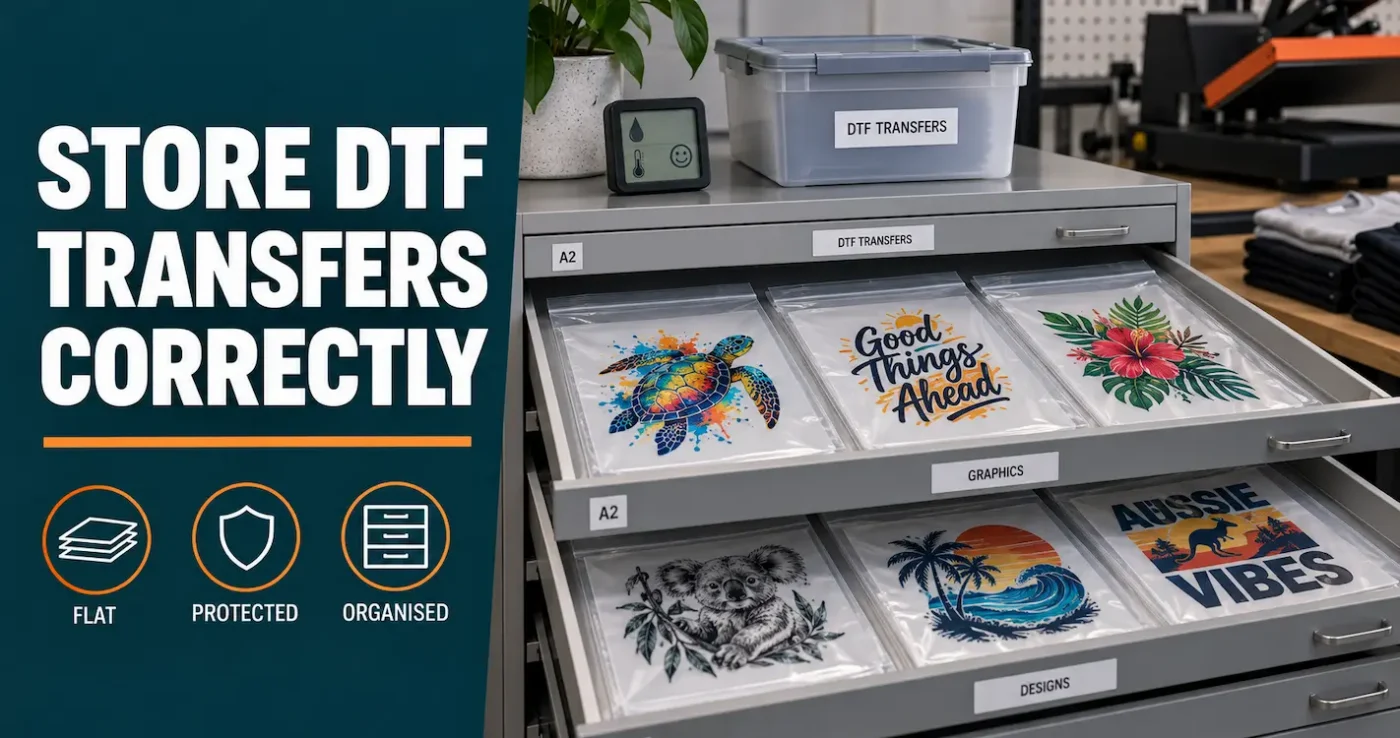
Short answer: Store unused ready-to-press DTF transfers in a clean, dry and temperature-stable indoor area. Keep them flat, sealed in protective packaging and away from direct sunlight, heat, condensation, dust and pressure that could crease the film. Label the transfers, rotate older stock first and press-test anything that has been stored for a long time or exposed to questionable conditions.
There is no universal shelf-life number that applies to every DTF transfer. Film, ink, adhesive, curing, transport and storage conditions all affect how a transfer behaves. Good storage reduces avoidable risk, but it cannot turn an unlimited period in storage into a guarantee.
Quick DTF transfer storage checklist
- Dry: protect transfers from humidity, condensation and water.
- Flat: prevent folds, creases, tight rolling and uneven pressure.
- Sealed: use the supplied packaging, a resealable bag or a suitable closed container.
- Dark: keep transfers away from windows and direct sunlight.
- Stable: avoid hot cars, sheds, garages and locations with large temperature changes.
- Clean: handle with clean, dry hands and protect the adhesive surface from dust, lint and oil.
- Labelled: record the design, order date, transfer type and fitting instructions.
- Tested: use a sample transfer before pressing old or questionable stock onto a customer’s garment.
Why storage conditions matter
A ready-to-press DTF transfer is a printed and cured product made from several working layers. The printed image and white ink sit on a carrier film, while the cured adhesive layer is designed to melt and bond to the garment under controlled heat and pressure.
Before pressing, that exposed adhesive surface can collect moisture, dust, lint and skin oils. The carrier film can also be scratched, folded or distorted. A transfer may still look colourful after poor storage but become difficult to position, peel or bond consistently.
This article covers the storage of finished, cured, ready-to-press transfers supplied to customers. It is not a guide to storing raw film, inks or loose DTF adhesive. DTF Transfers Australia currently supplies finished transfers ready to fit; customers do not need to powder or cure them.
The best storage environment
The most useful target is a comfortable, stable indoor environment rather than one exact number. A clean air-conditioned room is generally more suitable than a hot workshop mezzanine, shipping container, garden shed or vehicle.
Keep humidity controlled
Humidity is a particular concern in Queensland and other humid parts of Australia. The adhesive layer can be affected by moisture in the air, while temperature changes can create condensation inside packaging. A small room hygrometer can help identify whether a storage area regularly becomes damp.
As a practical guide, many workshops aim for normal indoor room conditions with moderate relative humidity. Maintaining a reasonably stable environment is more useful than repeatedly moving transfers between very cold air conditioning and hot, humid air. If the storage room regularly rises above approximately 60% relative humidity, improving the room, container or dehumidification strategy is worth considering.
Moisture can also remain inside garments even when the fabric feels dry. That is a separate application issue, covered in Moisture Is the Enemy of DTF Transfers. Always pre-press the garment until no steam remains before fitting a transfer.
Avoid excess heat and large temperature swings
Do not leave transfers in a parked vehicle, beside a heater, above a heat press or in direct sunlight. A broadly comfortable indoor range—roughly 18–25°C—is a useful storage target where practical, but it should not be treated as a guaranteed specification. The transfer’s materials, packaging and history still matter.
Do not refrigerate or freeze DTF transfers. Cold storage creates a condensation risk when the package is returned to a warmer room, and household refrigerators are not clean, dry production-storage cabinets.
Protect transfers from light
Store transfers in a drawer, cupboard, closed box or opaque tub rather than on a windowsill or open shelf exposed to sunlight. Protective storage also reduces dust and accidental handling.
Keep transfers flat and uncreased
A crease in the carrier film can make a transfer difficult to position and may prevent even contact during pressing. Store cut transfers and smaller sheets flat in a wide drawer, document box or protective folder that does not bend them.
Do not fold a gang sheet to make it fit a smaller container. If a long gang sheet arrives rolled, keep it loosely supported in its original packaging for short-term protection and avoid crushing or tightening the roll. Where practical, cut the individual designs apart and store them flat once the sheet has been checked.
A light, even cover can stop stored sheets from curling, but do not place a heavy object directly on the printed or adhesive surface. Avoid overfilling folders or drawers, because pressure from a large stack can mark, distort or make the lower sheets difficult to remove cleanly.
Use sealed, protective packaging
Keep transfers in the packaging in which they arrived until they are needed. After opening, a clean resealable bag or suitable lidded container can help limit exposure to humidity, dust and workshop contamination.
A small fresh silica-gel sachet may be placed inside a sealed bag or container as an extra moisture-control measure. Keep the sachet away from the transfer surface, replace it when exhausted and do not treat it as a substitute for a dry storage room. A desiccant cannot reliably repair a transfer that has already absorbed moisture or been damaged by condensation.
If several designs share one container:
- place each design in its own labelled sleeve or resealable bag;
- keep the adhesive surface clean and free from contact with rough materials;
- use clean, unprinted interleaving sheets if separation is needed;
- avoid tissue, cardboard dust or printed paper that may shed or transfer marks; and
- close the main container after every use.
What to do when transfers arrive
- Bring the parcel indoors promptly. Do not leave it in a hot vehicle, exposed loading area or damp location.
- Let a very hot or cold sealed parcel settle to room conditions. This reduces the chance of humid air condensing on a cold transfer when the package is opened.
- Open it on a clean, dry bench. Keep drinks, food, powder, lint and general workshop debris away.
- Check the order. Confirm the designs, quantities, film condition and fitting instructions.
- Label the remaining stock. Record the received or order date, transfer type and any job information needed later.
- Return unused transfers to protected storage. Do not leave them beside the heat press after the first part of the job is complete.
Short-term versus longer-term storage
| Situation | Recommended approach | Main risk to control |
|---|---|---|
| Using within a few days | Keep the transfers in their supplied packaging, indoors, flat and away from the press until required. | Handling damage, dust, heat and unexpected humidity. |
| Holding repeat designs | Separate and label each design in a sealed sleeve, then store flat in a drawer, folder or closed container. | Mixing jobs, losing instructions and using newer stock before older stock. |
| Storing for months | Use stable indoor storage, sealed packaging, stock rotation and periodic visual checks. Press-test before an important run. | Unknown shelf history, humidity exposure and gradual physical damage. |
Order quantities should reflect realistic production demand. Good packaging can reduce storage risk, but it does not make it sensible to purchase years of stock based on a claimed shelf life. Smaller, more regular orders may be cheaper than losing a large batch or discovering that an old transfer no longer suits a changed garment.
How to organise transfer stock
An organised storage system protects the transfers and reduces production errors. An A2 display folder can work for a small catalogue if it is stored flat or upright without bending, kept in a dark dry cupboard and not overfilled. The folder itself is not necessarily airtight, so sealed inner sleeves may still be useful in humid conditions.
For larger quantities, wide plan drawers, shallow document drawers or labelled lidded containers are easier to manage. Use a simple first-in, first-out system so the oldest suitable transfers are used before newer stock.
Each sleeve or stock record should identify:
- the customer, job or design name;
- the received or order date;
- the transfer type, including any specialty finish;
- the artwork size and quantity remaining;
- the current fitting instructions; and
- the result of any test press.
Do not assume that all transfers use the same peeling method. Standard Insta-Peel transfers are peeled immediately while hot, while current specialty finishes are cold peel. Clear labels prevent an older instruction from being applied to the wrong product.
Inspect and test before pressing
Inspect stored transfers under good lighting before starting a job. Warning signs can include:
- creases, deep curl, scratches or pressure marks in the carrier film;
- dust, lint, hair, oil or water marks on the adhesive surface;
- adhesive that looks patchy, clumped, disturbed or detached;
- unusual discolouration or separation in the printed layers;
- transfers sticking to packaging or to each other; and
- evidence of condensation or a damp smell inside the container.
A visual check cannot confirm performance. If a transfer is old, has an uncertain history or may have been exposed to humidity or heat, press a spare transfer onto the same garment type first. Follow the current DTF transfer fitting instructions, then inspect the peel, edges and bond. For a production run, a wash test provides stronger evidence than appearance immediately after pressing.
Do not use a customer’s expensive garment as the test piece. If there is no spare transfer or test garment, replacing the questionable transfer stock may be the safer commercial decision.
Transporting DTF transfers safely
Storage care should continue when transfers leave the workshop. Use a rigid document folio, flat box or the original protective packaging. Keep the package sealed, supported and out of direct sun. Do not place heavy boxes on top or leave transfers in a vehicle while completing other deliveries.
If transfers are taken into a humid event space or moved between air-conditioned and outdoor environments, keep them sealed until the package has settled to the working-room temperature. Return unused transfers to dry protected storage rather than leaving them exposed overnight.
Common DTF transfer storage mistakes
- Leaving transfers beside the heat press: the area may be hotter, dustier and more exposed than the storage room.
- Storing them in a clear box near a window: a closed container does not protect against heat and sunlight if it is placed badly.
- Folding a long sheet: the fold can interfere with positioning and even pressure.
- Using an open display folder in a humid room: organisation alone does not provide moisture protection.
- Handling the adhesive surface: fingerprints, oil and lint can contaminate the area intended to bond to the garment.
- Mixing transfer types: different products may require different peel and fitting instructions.
- Trusting an old shelf-life claim: time is only one factor; actual storage history and a test press matter more.
- Trying to rescue visibly damp stock without testing: apparent dryness does not prove that the transfer will press reliably.
Frequently asked questions
What is the best way to store DTF transfers?
Keep them dry, clean, flat and sealed in protective packaging. Store them indoors in stable room conditions, away from direct sunlight, heat, condensation, dust and anything that could crease or scratch the carrier film.
How long do DTF transfers last before pressing?
There is no reliable universal answer. The materials, curing, packaging, transport and storage conditions all affect usable life. Do not rely on the old claim that every DTF transfer will remain usable for three to seven years. Rotate stock, inspect older transfers and complete a test press before using them for an important job.
Can DTF transfers be stored rolled?
A long gang sheet can remain loosely supported in its original rolled packaging for short-term protection if it cannot be stored flat immediately. Do not fold it, crush the tube or tighten the roll. Where practical, cut the individual designs and store them flat before longer storage.
Should DTF transfers be kept in a refrigerator?
No. Refrigeration is unnecessary and can create condensation when a cold package is opened in warmer humid air. Use a clean, dry, temperature-stable indoor cupboard, drawer or container instead.
Can I put silica gel in the storage bag?
A fresh silica-gel sachet can provide extra protection inside a sealed bag or container. Keep it away from the transfer surface and replace it when exhausted. It cannot compensate for a damp room or guarantee that old transfers remain usable.
Is an A2 display folder suitable?
It can be a practical way to organise cut transfers if the pages remain flat, clean and uncrushed. Store the folder away from sunlight and humidity, avoid overfilling it and consider separate sealed inner sleeves where moisture is difficult to control.
What should I do if transfers have been exposed to humidity?
Seal them in a dry protected environment and assess their condition, but do not assume this reverses any damage. Use a spare transfer on a test garment and check application and wash performance. Replace the stock if the result is inconsistent or if there are visible signs of moisture damage.
Do specialty DTF transfers need separate storage?
They should be labelled and separated so the correct instructions remain with the product. Keep them dry, clean, flat and protected, and follow any product-specific guidance. DTF Transfers Australia’s current specialty finishes are sheet-only and cold peel, which differs from the immediate hot peel used for standard Insta-Peel transfers.
Protect the transfer before it reaches the press
Most DTF storage problems are avoidable. Keep the transfer in a stable indoor environment, protect it from moisture and contamination, prevent creasing and record what the product is and when it arrived. Just as importantly, do not let tidy storage create false confidence: inspect and test older stock before committing a customer’s garments.
When you are ready to press, use the current fitting instructions. For new work, explore ready-to-press DTF transfers or arrange repeat designs efficiently with a custom DTF gang sheet.
