
Ordering and Gang Sheets, Running a Print Business
DTF Transfers for Trade Printers and Apparel Businesses
Oct
Short answer: Ready-to-press DTF transfers allow print shops, embroiderers, signwriters, uniform suppliers and apparel businesses to sell full-colour garment printing without buying and maintaining a DTF printer. Your business prepares the artwork, orders the transfers, supplies the garments and controls the pressing and customer service. The model works best when you price every step properly, submit genuinely print-ready files and test the exact transfer, garment and heat-press combination before production.
What “DTF transfers for the trade” means
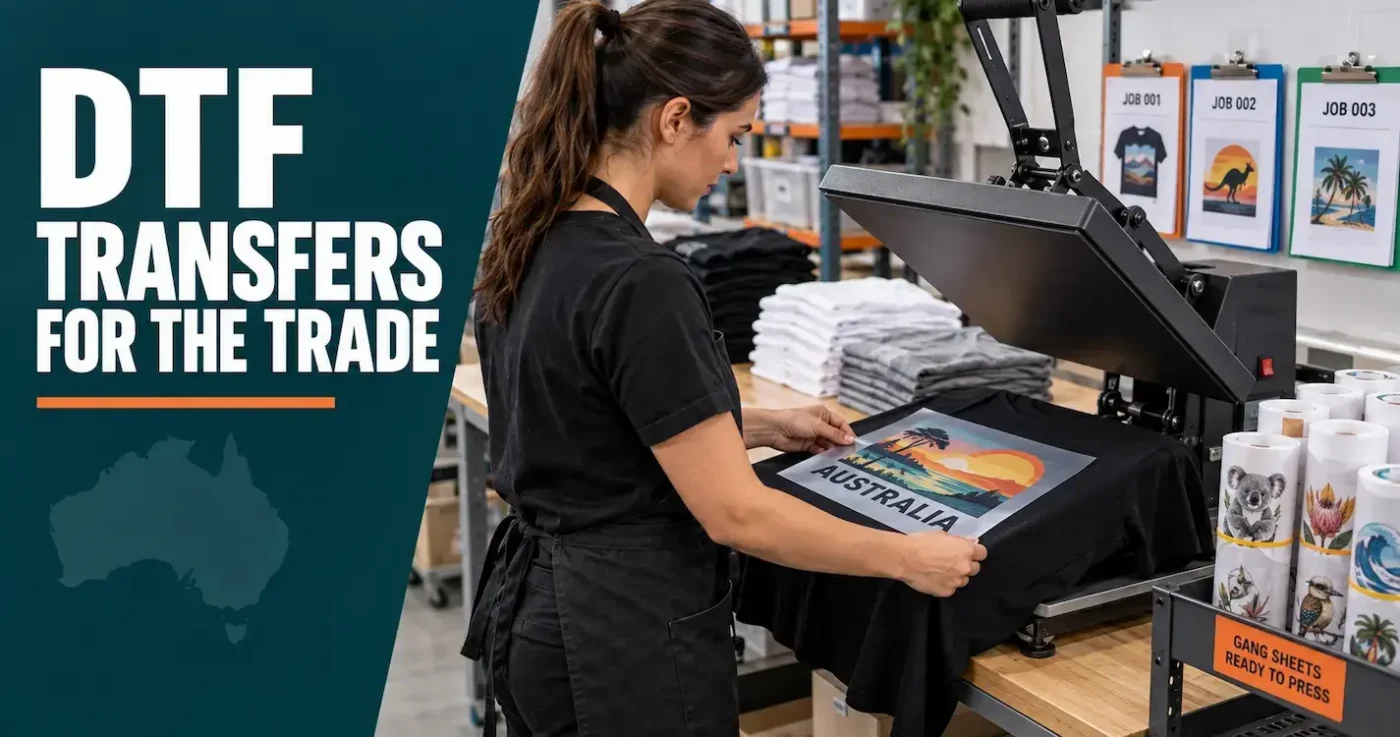
For this article, “trade” means a business that orders finished DTF transfers and applies them to garments or other suitable textile products for its own customers. The DTF supplier handles the specialised printing, white ink, adhesive application and curing. The decorator receives a finished transfer that is ready to apply with a suitable heat press.
This separates the production process into two businesses:
- DTF Transfers Australia: prints and cures the supplied artwork onto transfer film.
- The trade decorator: checks the artwork, chooses the garment, quotes the job, applies the transfer, completes quality control and supplies the finished order.
The arrangement is simple, but responsibilities must remain clear. DTF Transfers Australia operates a budget print-as-supplied service. Routine manual artwork checking is not included, so the trade customer remains responsible for file quality, dimensions, transparency, spelling, dates, colours and unwanted pixels.
Which trade businesses can benefit?
Ready-to-press DTF transfers may suit:
- screen printers needing an option for small full-colour orders;
- embroidery businesses receiving work that is too detailed or large to stitch economically;
- signwriters and promotional-product suppliers adding apparel to an existing service;
- uniform suppliers handling names, logos and short replenishment runs;
- print shops and copy centres expanding into garment decoration;
- clothing brands that want to press stock as it sells;
- event, merchandise and fundraising businesses; and
- established apparel decorators needing overflow capacity.
The trade advantage is not that DTF is automatically the best process for every job. It is that the business gains another production option without immediately taking on a printer, shaker or adhesive system, curing equipment, white-ink maintenance, ventilation, consumables inventory and the learning curve of DTF production.
Outsource transfers or own a DTF printer?
Buying a DTF printer can make sense when order volume is consistent, in-house speed is essential and the business is ready to manage production every day. The purchase price is only part of that decision. White ink must be circulated and maintained, printheads and ink paths need attention, colour and curing must be controlled, and failed production consumes time and materials.
Outsourcing ready-to-press transfers shifts those production tasks to a specialist supplier. You can test demand, accept occasional DTF work and add capacity during busy periods while using equipment that many decorators already own: a commercial heat press.
| Consideration | Outsourced ready-to-press transfers | In-house DTF printing |
|---|---|---|
| Initial equipment | Suitable heat press and production accessories | Printer, curing system, ventilation, workflow equipment and heat press |
| Maintenance | Mainly heat-press calibration and normal workshop care | Regular printer, white-ink and curing-system maintenance |
| Best fit | Variable demand, short runs, overflow and businesses adding a service | Predictable volume with staff and systems dedicated to production |
| Lead time | Must include supplier handling and transport or collection | Potentially faster once equipment, staff and consumables are ready |
| Control | Decorator controls garments and pressing; supplier controls transfer production | Business controls the complete workflow and every associated risk |
If your business is considering equipment, read what to know before buying a DTF printer. Outsourcing first can provide real sales evidence before a major investment.
Jobs that suit ready-to-press DTF transfers
DTF is particularly useful for artwork with multiple colours, gradients, fine detail or photographic elements where colour separations and vinyl weeding would add time. It can also help with short runs and repeat orders because there are no screens to reclaim and the transfer can be applied when the garment is required.
Typical jobs include:
- multi-colour business and event logos;
- short merchandise runs and online brand orders;
- front, back and sleeve combinations;
- individual names or small artwork variations;
- full-colour graphics on cotton, suitable polyester and blended garments;
- replenishment orders where only a few sizes are required; and
- overflow work when another production department is at capacity.
Suitability still depends on the garment. Seams, zips, pockets, coatings, waterproof treatments, dye migration, heat-sensitive fabrics and uneven pressing surfaces can create problems. Approve the exact blank garment and test it before quoting a result as routine.
Choosing the right transfer format
DTF gang sheets
DTF gang sheets are available in 280 mm and 580 mm widths and are purchased by the metre. They suit trade customers who can prepare a space-efficient layout containing repeated logos, mixed garment placements or several customer jobs. The decorator cuts the individual transfers apart before pressing.
A gang sheet is not automatically the cheapest choice. Empty film, poor nesting, artwork that is larger than necessary and excess speculative stock can remove the advantage. Build the layout at the final print dimensions and compare the usable artwork area, not only the sheet price.
Standard sheet transfers
Standard DTF transfer sheets are useful when the required artwork fits an available sheet size or when the customer does not want to build a gang-sheet layout. They can be a straightforward option for small quantities, large individual designs and jobs that need predictable sheet dimensions.
Specialty finishes
Gold Foil, Silver Foil, Glitter, Glow in the Dark, Neon, Pearl and Reflective finishes are specialty sheet transfers. They are not offered as gang sheets and are cold peel. These products need artwork planned for the finish, separate testing and clear production labels so they are not confused with standard Insta-Peel transfers.
Check the current shop listings for available formats, prices and volume discounts. Eligible discounts of up to 20% are applied through the current online ordering system; the old separate wholesale portal described in the earlier version of this article is no longer the ordering path.
Trade artwork requirements
Good production begins before the file is uploaded. The preferred supplied file is:
- a transparent PNG;
- 300 DPI at the intended print size;
- tightly cropped around the required artwork;
- no more than 254 MB;
- free from stray pixels and unwanted background areas; and
- designed without isolated elements below approximately 4 pixels or 1 mm.
Do not enlarge a small web image and assume changing the DPI number restores missing detail. Check the actual pixel dimensions and inspect edges, transparency, spelling and fine lines at full size. The DTF artwork FAQ covers these requirements in more detail.
Where a design will be offered at several sizes, build and label each size deliberately. Do not rely on the press operator to guess which transfer belongs on a child’s shirt, adult front, pocket or back. A clear filename such as customer-design-front-280mm-v3.png is much safer than final-final-new.png.
Files are printed as supplied. Trade customers should complete their own preflight process before ordering, including customer approval of the final artwork and print dimensions.
A reliable trade ordering workflow
- Qualify the garment and job. Confirm fabric, colour, construction, print positions, quantities, sizes and deadline.
- Choose the decoration method. Decide whether DTF is appropriate or whether screen printing, embroidery, sublimation or vinyl better suits the brief.
- Price the complete job. Include transfer production, freight, garments, labour, rejects, packing and overhead before the customer approves.
- Prepare and approve the artwork. Record the final dimensions and obtain written approval for spelling, colours, layout and placements.
- Select the transfer format. Compare gang sheets, standard sheets and specialty sheets based on usable area, quantity and application method.
- Order with enough time. Allow for current handling, delivery or collection, testing and a recovery buffer before the customer’s deadline.
- Inspect the transfers on arrival. Check job labels, quantities, physical condition and fitting instructions before production day.
- Press a sample. Use the same garment style, colour and batch wherever possible.
- Record the approved settings. Keep time, temperature, pressure, peel method, final press and placement information with the job.
- Run quality control throughout production. Do not wait until the full order is finished before looking closely at adhesion and alignment.
Pressing and quality control
A professional transfer does not remove the need for professional application. Heat-press temperature, time and pressure must work together, and the platen needs to apply them evenly across the whole design.
For standard Insta-Peel transfers, useful starting settings are:
- Cotton and suitable standard fabrics: 160°C for 8 seconds with firm pressure, peel immediately while hot, then final-press for 10 seconds.
- Polyester: 120°C for 30 seconds with firm pressure, cold peel only, then final-press for 10 seconds at 120°C. Always test on a spare garment first — heat presses and fabrics vary.
These are starting settings, not universal guarantees. Pre-press until no steam remains, test the exact garment and follow the current transfer fitting instructions. Specialty finishes are cold peel and require their correct product instructions.
During production, check:
- the correct design, size and orientation;
- consistent distance from the collar, seam or reference point;
- full contact across the artwork;
- clean edges and complete film release;
- fabric damage, marks or dye movement; and
- the final press and cooling procedure.
For repeat commercial work, a wash test is more useful than judging the print only while it is new. Heat presses, garments and production batches can change, so repeat testing when any part of the workflow changes.
Pricing DTF jobs profitably
The transfer price is only one part of the job cost. A trade quote should account for:
- blank garments and inbound freight;
- DTF transfers and delivery or collection costs;
- artwork setup, revisions and customer approval;
- cutting gang sheets and organising sizes;
- pre-pressing, positioning, pressing and final pressing;
- quality control, folding, labels and packaging;
- test garments, waste and a realistic reject allowance;
- payment fees, GST and general business overhead; and
- the margin needed to make the work worthwhile.
If another decorator or reseller buys the finished garment from you, leave enough margin for both businesses. A low transfer price does not rescue a quote that ignores labour, risk and reprints. See how much to charge for printed T-shirts for a broader pricing framework.
Turnaround and production planning
Do not promise a customer deadline based only on the supplier’s stated handling time. Your schedule also needs to allow for artwork approval, order cut-off times, freight, collection, test pressing, garment availability, production and correction if something unexpected occurs.
Use the handling option displayed on the current product page and order before the relevant cut-off. Same-day production can help with urgent work when available, but it should not replace sensible planning. Freight delays, incorrect artwork and unsuitable garments are not solved by a faster transfer-production option.
For regular work, hold approved blank garments and repeat transfers only in quantities supported by real demand. Store unused transfers flat, dry and protected using the guidance in How to Store DTF Transfers Before Pressing.
When another print method may be better
DTF belongs in a trade workshop’s toolkit; it does not need to replace every other process.
- Screen printing may be more economical for large repeat runs with a small number of colours and stable artwork.
- Embroidery may better suit polos, caps, corporate wear and jobs where a stitched finish is part of the brief.
- Sublimation can be ideal for suitable white or light polyester products where the image needs to become part of the fabric.
- Heat-transfer vinyl remains useful for simple names, numbers and selected special-effect materials.
- DTG printing can suit certain cotton garments and workflows, especially where the business already operates suitable equipment.
Compare DTF transfers and screen printing, DTF and vinyl transfers, and DTF and sublimation before standardising a quote.
Frequently asked questions
Do trade customers need a separate wholesale account?
No separate wholesale portal is required for the current ordering workflow. Trade and other customers order through the main DTF Transfers Australia website. Available volume discounts are shown on the relevant products and applied through the online ordering system.
Is there a minimum order?
The current standard range allows small orders, including gang sheets starting from one metre. Check the product page for the current minimum, sizes, pricing and handling options before quoting a customer.
Will DTF Transfers Australia fix or check my artwork?
Orders are printed as supplied and routine manual artwork checks are not included. Trade customers should submit print-ready transparent PNG artwork at the correct dimensions and complete their own preflight and customer-approval process.
Do I need a commercial heat press?
A reliable heat press with even temperature and controllable pressure is strongly recommended for repeat trade production. Domestic irons and small craft presses make it harder to achieve consistent time, heat and pressure across larger artwork.
Can DTF transfers be applied to polyester?
They can be applied to many suitable polyester garments, but polyester varies and can be sensitive to heat, pressure and dye migration. Start with the current lower-temperature polyester guidance and test the exact garment, colour and transfer before production.
Are gang sheets always cheaper?
No. They can reduce transfer cost when the layout uses the film efficiently, but empty space, excess stock and extra cutting labour affect the real saving. Compare usable printed area and the complete job cost.
Are specialty finishes available on gang sheets?
No. Current Gold Foil, Silver Foil, Glitter, Glow in the Dark, Neon, Pearl and Reflective finishes are sold as specialty sheet transfers. They are cold peel and require suitable artwork and separate testing.
Is DTF better than screen printing?
Neither process is better for every job. DTF is often useful for detailed full-colour artwork, short runs and repeat-on-demand work. Screen printing can be more efficient for larger quantities with limited colours. Choose by artwork, quantity, garment, deadline, equipment and total production cost.
We print the transfers; you control the finished garment
Ready-to-press DTF transfers give trade decorators a practical way to add full-colour apparel printing or increase capacity without operating another printing system. The strongest results come from treating the service as a real production partnership: supply correct artwork, order early, test the garment, control the heat press and price the work for a sustainable margin.
Explore the current DTF transfer range, build a custom gang sheet or review the artwork requirements before submitting your next trade job.
