
Printing It Yourself
Roland BY-20 VersaSTUDIO DTF Printer Review: Pros, Cons and Real Costs
Jun
Roland VersaSTUDIO BY-20 DTF Printer Review: Strengths, Limitations and Real Ownership Costs
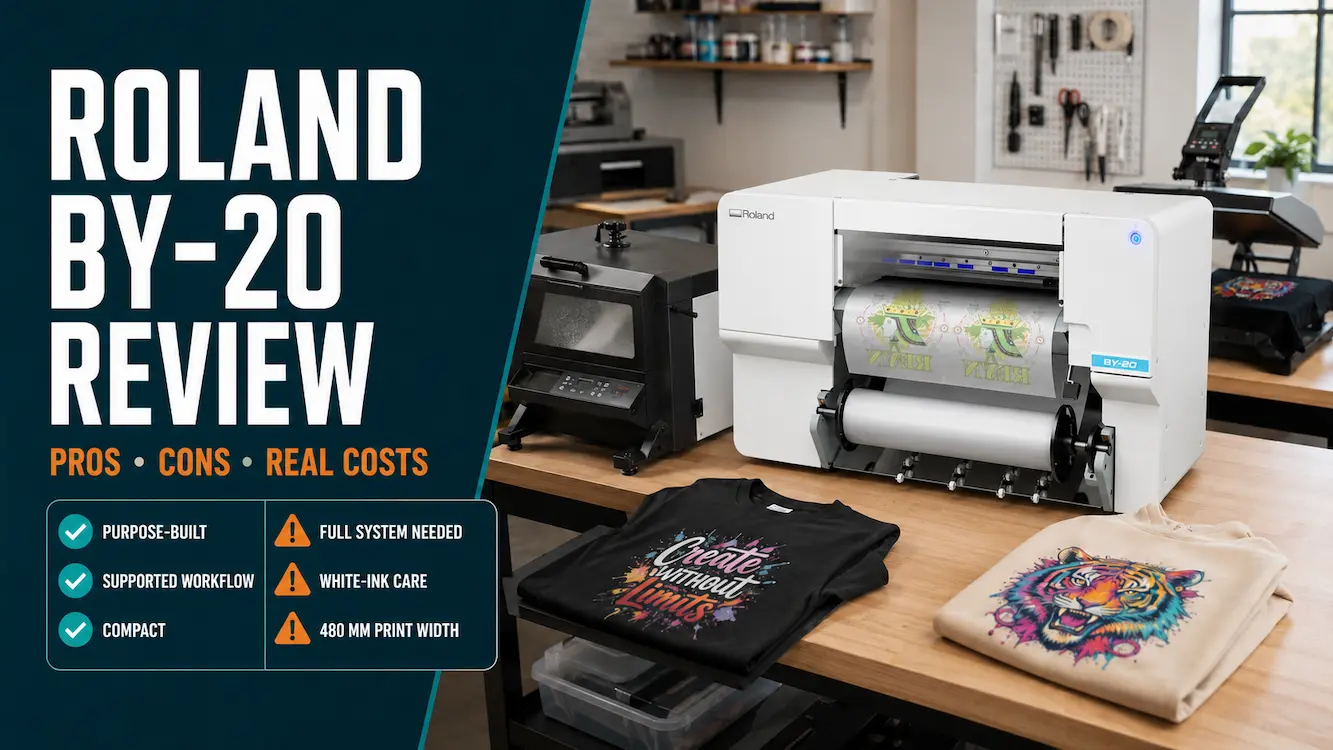
The Roland VersaSTUDIO BY-20 replaced the BN-20D in Roland DG Australia’s compact direct-to-film range. It is a purpose-built 20-inch DTF printer designed for apparel decorators, screen printers, small print shops and businesses wanting to bring transfer production in-house.
Its strongest arguments are not that it makes DTF effortless or guarantees a profit. They are that it brings the printer, ink, software, profiles, monitoring and dealer support into a recognised manufacturer’s ecosystem. That matters in a market crowded with converted printers and machines whose long-term support can be uncertain.
However, the BY-20 remains only one part of a DTF production line. It prints the film; you still need powder application, controlled curing, ventilation, a reliable heat press, maintenance time, trained staff and enough consistent work to justify ownership.
Review disclosure: DTF Transfers Australia does not sell or service Roland printers. This independent review combines Roland DG Australia’s published specifications with practical DTF production experience. It is not presented as a long-term hands-on ownership test of the BY-20. Verify current specifications, packages and support with an authorised Roland dealer.
TL;DR: Is the Roland BY-20 a Good DTF Printer?
- The BY-20 is the relevant Australian-market successor to the older Roland BN-20D.
- It is a purpose-built 20-inch DTF printer, not an ordinary printer/cutter converted to handle white DTF ink.
- Major strengths include recognised local support, a 480 mm maximum print width, front-access operation, Ethernet, VersaWorks 7, monitoring software and standalone cutting capability.
- It can integrate with compatible shaker/heater equipment, avoiding the BN-20D’s more restrictive older workflow.
- The printer does not eliminate powdering, curing, ventilation, heat pressing, maintenance or testing.
- At 1,069 × 617 × 622 mm and 62 kg, it is compact compared with industrial systems but not a small hobby printer.
- Roland specifies an operating environment of 20–28°C and 40–60% relative humidity, so room control matters.
- The maximum printable width is 480 mm even though it accepts media up to 515 mm wide.
- The integrated cutter adds versatility for HTV and other media, but it is not a major advantage for ordinary DTF transfers because DTF does not normally require contour cutting.
- Buy only after comparing the complete installed cost and your real monthly volume with outsourced ready-to-press transfers.
How the BY-20 Replaced the Roland BN-20D
Roland introduced the BN-20D in 2023 as a compact, purpose-built DTF printer. The name was close to the established BN-20 and BN-20A eco-solvent printer/cutters, but the D model had a different ink and white-ink workflow designed for direct-to-film output.
The BY-20 became the practical replacement in Roland’s desktop DTF range. It remains a compact 20-inch platform but improves the workflow with front-loading media and ink, updated utility software and compatibility with suitable shaker/heater units.
Do not confuse the model families:
- BN-20 and BN-20A: eco-solvent printer/cutters, not purpose-built DTF printers.
- BN-20D: the earlier purpose-built desktop DTF model.
- BN2 series: newer eco-solvent printer/cutters, still separate from Roland’s DTF range.
- BY-20: the replacement compact purpose-built DTF printer reviewed here.
Do not buy an ordinary BN printer assuming that changing inks will create a BY-20 equivalent. White-ink circulation, film handling, profiles, firmware, maintenance, warranty and manufacturer support all matter.
Important Roland BY-20 Specifications
The following details come from the current Roland DG Australia BY-20 product page. Confirm them again when obtaining a quote because ink configurations, software and packages can change.
| Specification | Published BY-20 detail | Why it matters |
|---|---|---|
| Media width | 150–515 mm | Check film and shaker compatibility rather than assuming every “20-inch” accessory matches. |
| Maximum printing/cutting width | 480 mm | The usable printed width is narrower than the maximum media width. |
| Ink | 220 ml cartridges in cyan, magenta, yellow, black and white | Cartridge format is convenient, but compare consumable cost and white-ink use with your expected volume. |
| Maximum stated print resolution | 1,440 DPI | Maximum resolution does not mean every production mode runs at this setting or speed. |
| Connectivity | Ethernet | Useful for a networked production environment and monitoring. |
| Dimensions | 1,069 × 617 × 622 mm | Allow additional space for access, film, shaker, curing, cutting and heat pressing. |
| Weight | 62 kg | Requires a suitable stand, careful delivery and safe installation—not an ordinary desk. |
| Operating environment | 20–28°C and 40–60% RH, without condensation | Air conditioning or humidity management may be necessary in an Australian workshop. |
| Warm-up | Approximately 5–20 minutes depending on conditions | Startup and room conditions affect real workflow time. |
| Software | VersaWorks 7 and Roland DG Connect tools | A supported software ecosystem is one of the machine’s stronger benefits. |
The Main Advantages of the Roland BY-20
1. It is purpose-built for DTF
The BY-20 is designed around CMYK plus white DTF ink, film output and the maintenance requirements of white pigment. This is preferable to relying on a printer originally engineered for another ink system and later converted.
2. Manufacturer, dealer and warranty support
A recognised Australian support structure can be valuable when production stops. Roland DG Australia publishes local product information, dealer contacts, service pathways and a one-year Heads N’ All warranty for the BY-20. Confirm exactly what the warranty covers and which maintenance items remain the owner’s responsibility.
3. Integrated software and colour workflow
VersaWorks 7 provides RIP, layout and colour-management tools matched to Roland hardware, ink and media profiles. Roland DG Connect adds monitoring and machine information. A coordinated ecosystem can reduce some of the uncertainty found in generic printer, ink and RIP combinations.
4. Compact front-access design
Media loading, ink access and routine operations are arranged from the front. That can make the BY-20 easier to place in a smaller print room than a larger industrial printer. “Desktop”, however, describes its category—not a lightweight office appliance.
5. Compatible automated finishing workflow
Roland states that the BY-20 can integrate with compatible shaker and heater units. This is a meaningful improvement over a process that requires every sheet to be manually powdered and moved to a separate curing step.
6. Useful standalone cutting capability
The cutter can produce HTV lettering, numbers and other cut-media applications. That gives a small decorator another production option from the same footprint.
7. S-PG2 ink and certified consumables
The current Australian product page specifies S-PG2 ink and states that the relevant inks and powder have OEKO-TEX ECO PASSPORT certification. Certification is useful product information, but operators must still follow safety data sheets, ventilation requirements and workplace controls.
The Limitations and Disadvantages of the Roland BY-20
1. The printer is not a complete production line
You still need compatible film, ink and powder, controlled powder application, a curing solution, ventilation, cutting space, a heat press and quality-control procedures. Some packages may include more of this equipment than others, so compare written inclusions rather than the headline machine price.
2. White ink still requires maintenance
Purpose-built circulation and automated routines reduce risk but do not eliminate settling, nozzle checks, cleaning, consumable replacement or operator attention. The machine is not a “print only when convenient and forget it for weeks” appliance.
3. Compact does not mean tiny
The printer alone is more than one metre wide and weighs 62 kg. The full workflow needs significantly more space once media, shaker, curing, ventilation, cutting, storage and heat pressing are included.
4. Environmental control is part of ownership
Roland specifies 20–28°C and 40–60% relative humidity during operation. A hot, dry, damp or unconditioned Australian shed may sit outside that range, potentially affecting ink and media behaviour.
5. The usable width is 480 mm
Although the machine accepts media up to 515 mm, its maximum published print/cut width is 480 mm. Check whether that width suits your most common back prints and gang-sheet layouts.
6. Accessory compatibility needs checking
Do not assume any shaker advertised as “20 inch” will align, feed and cure correctly. Confirm film width, roll diameter, take-up, feed direction, temperature control, exhaust and warranty compatibility with the dealer.
7. Cutting adds versatility, not faster DTF
Ordinary DTF transfers do not need contour cutting or weeding. The cutter is valuable if you also produce HTV or related applications, but it should not be treated as a core DTF productivity advantage.
8. Manufacturer production and profit examples are not your forecast
Published output and profit examples use assumed artwork sizes, selling prices and costs. Your usable output also depends on RIP mode, white coverage, artwork nesting, curing, cutting, heat pressing, rejects, wages and customer demand. Build your own conservative model.
9. Cartridge ink may not suit every production scale
Cartridges simplify handling and support a controlled ink system, but high-volume businesses should compare cartridge capacity and cost with wider production machines designed around larger ink supplies.
What Else Do You Need to Operate a BY-20?
| Workflow area | Required planning |
|---|---|
| Computer and artwork | Compatible computer, reliable storage, design tools, RIP training and print-ready files |
| Printing consumables | Approved ink, film, powder, cleaning products and spare maintenance consumables |
| Powder application | Manual process or compatible shaker with controlled excess-powder removal |
| Curing | Compatible heater, oven or shaker/heater unit with tested time and temperature |
| Environment | Ventilation, temperature and humidity control, cleaning area and safe waste handling |
| Application | Reliable heat press, cover sheets, garment tests and documented fitting settings |
| Production space | Film loading, curing, cutting, labelling, transfer storage, garment storage and packing |
| Support | Trained operator, maintenance schedule, dealer contact and an outsourcing backup for downtime |
Roland describes a four-step print, powder, cure and heat-transfer process. In real production, file preparation, maintenance, testing, cutting, sorting and quality control add further steps.
The BY-20 uses the conventional powder-based DTF workflow. Based on our own trials, liquid-adhesive or “powderless” DTF is not yet a production-ready replacement for the normal process and can be more difficult to fit and work with.
Software, Artwork and Colour Workflow
VersaWorks 7 is included and provides print queues, profiles, nesting, white-layer preparation and colour controls. Roland DG Connect supports monitoring, while Connect Designer offers artwork-preparation functions. The Australian page notes that some Visual Communication modules are free only for an introductory period, so ask which features require ongoing payment.
Software does not make poor artwork production ready. Establish rules for:
- transparent backgrounds;
- resolution at the intended print size;
- minimum fine-detail size;
- colour expectations and approved swatches;
- white-ink generation;
- gang-sheet nesting and cutting clearance;
- customer proofs and version control; and
- archiving approved production files.
Our DTF artwork FAQ and DTF gang-sheet guide cover the customer-file and layout issues that remain relevant whether transfers are printed in-house or outsourced.
Maintenance and White-Ink Reality
The correct maintenance schedule is the one supplied for the installed BY-20, firmware and ink system. Avoid applying old BN-20D instructions or generic online advice without checking the current manual.
- Perform nozzle checks and cleaning as directed.
- Keep the machine within its specified environmental range.
- Use approved inks, cleaning fluids and consumables.
- Inspect caps, wipers and surrounding areas at the stated intervals.
- Record cleaning, nozzle loss, cartridge use and recurring faults.
- Follow the correct procedure before holidays or extended inactivity.
- Assign responsibility to a trained person rather than assuming anyone can maintain it.
Ask the dealer to perform the full daily, weekly and periodic routine during training. Time it and include that labour in your costing.
Production Speed: Look Beyond the Printer Specification
Roland states that the BY-20 prints twice as fast as the previous model. That comparison is useful context, but it does not establish your finished-garment output.
Measure the complete job:
- Artwork checks and RIP processing
- Film loading and printer warm-up
- Printing CMYK and white
- Powder application and excess removal
- Curing
- Cooling, cutting and labelling
- Garment preparation and testing
- Initial press, peel and final press
- Inspection, folding and packing
A fast print mode does not help if manual powdering, a small curing unit or one heat press becomes the bottleneck. Take representative artwork to the demonstration and time saleable transfers from file import to completed, inspected garment.
Calculate the Real BY-20 Ownership Cost
Do not use printer finance alone as the cost of bringing DTF in-house.
Monthly ownership cost = finance or depreciation + ink + film + powder + cleaning + software + labour + power + climate control + waste + maintenance + service allowance + floor space + downtime
Then divide by saleable—not merely printed—output:
Usable transfer cost = total monthly ownership cost ÷ saleable transfers produced
Include nozzle checks, cleaning ink, setup film, colour tests, curing failures, damaged transfers and application tests. Run quiet, expected and busy-month scenarios. If the machine only makes financial sense at uninterrupted maximum demand, the plan has little room for reality.
Who Is the Roland BY-20 Suitable For?
Potentially suitable
- A small print shop with proven, regular DTF demand
- A screen printer needing controlled short-run, full-colour production
- An embroidery or workwear business adding garment transfers
- A business that values Australian dealer support over the lowest equipment price
- An operator with suitable environmental control, ventilation and maintenance discipline
- A shop that can also use the standalone cutter for HTV work
Potentially unsuitable
- A hobbyist wanting maintenance-free occasional printing
- A business without space for powder, curing, ventilation and finishing
- A buyer relying only on an online profit calculator
- A shop whose common artwork exceeds the 480 mm printable width
- A high-volume producer that may outgrow 220 ml cartridges and compact throughput
- A business with no trained backup operator or downtime plan
Buy a BY-20 or Outsource Ready-to-Press Transfers?
| Consideration | Outsource transfers | Own a BY-20 |
|---|---|---|
| Initial commitment | Heat press and application workflow | Complete print, powder, cure, ventilation and application system |
| Maintenance | Supplier manages print equipment | Your business manages white ink, cleaning and service |
| Scheduling control | Depends on supplier production and delivery | More direct control while equipment and staff are available |
| Quiet periods | No idle printer cost | Maintenance and fixed costs continue |
| Best starting point | Testing demand and serving intermittent orders | Established recurring volume with trained operators |
Track outsourced spend, order frequency, turnaround pressure and rejected work for several months. Compare that evidence with a complete installed BY-20 quote. Our broader DTF printer buying guide explains the decision in more detail.
Screen printers can also read our guide to adding outsourced DTF without replacing screen printing. If outsourcing remains the better fit, review the DTF gang-sheet service.
Questions to Ask Before Buying a BY-20
- Which BY-20 ink configuration and firmware are included?
- Is the quote for the printer alone or a complete working system?
- Which shaker and curing unit are approved and included?
- How will ventilation and powder management be designed?
- Which software features are permanent, introductory or subscription-based?
- What daily, weekly and periodic maintenance is required?
- What is included in installation and operator training?
- What does the warranty exclude?
- Where is the nearest trained technician and how is downtime handled?
- Can the dealer demonstrate our artwork from RIP through pressing?
- What output can be demonstrated in the quality mode we will actually use?
- What are current lead times for ink, film, powder and maintenance parts?
- What is the recommended extended-idle or holiday procedure?
- Will the proposed room remain inside 20–28°C and 40–60% RH?
Our Verdict on the Roland VersaSTUDIO BY-20
The BY-20’s strongest advantage is that it is a coherent, purpose-built compact DTF platform from a recognised manufacturer. Its software, profiles, front-access design, local dealer channel and shaker/heater compatibility make it a more credible production option than an improvised conversion.
Its main weakness is not a single design fault; it is the risk that buyers mistake a compact printer for a simple or complete business. White-ink maintenance, powder handling, curing, environmental control, heat pressing and consistent demand remain unavoidable. The 480 mm printable width and cartridge-based ink system also place natural limits on the work and volume it suits.
Bottom line: the BY-20 deserves consideration from small professional decorators with proven demand, appropriate facilities and access to dealer support. It is much harder to justify for occasional hobby use, uncertain sales or businesses unwilling to operate the full DTF workflow every week.
Frequently Asked Questions About the Roland BY-20
Did the Roland BY-20 replace the BN-20D?
Yes. The BY-20 is the relevant replacement in Roland DG Australia’s compact desktop DTF range.
Is the BY-20 a converted printer?
No. It is a purpose-built Roland DTF system using CMYK and white ink, dedicated film and a supported DTF workflow.
What is the maximum printable width?
Roland publishes a maximum print/cut width of 480 mm. The machine accepts media up to 515 mm wide.
Does the BY-20 come with a shaker and curing oven?
Do not assume so. Roland states that the printer integrates with compatible shaker/heater units, but inclusions vary by dealer package. Obtain a complete written equipment list.
Can the BY-20 produce powderless DTF?
The published Roland workflow uses adhesive powder. Our current production experience is that liquid-adhesive or powderless output is not yet a proven replacement for the normal process.
Does the cutter cut around DTF transfers?
DTF designs normally release from their printed areas without contour cutting. The cutter is more useful for standalone HTV, lettering, numbers and other cut-media applications.
Can the BY-20 be used in a home business?
Potentially, but only with appropriate space, ventilation, powder control, temperature and humidity management, safe electrical installation and separation from normal living areas. Follow manufacturer and workplace requirements.
Is the Roland BY-20 maintenance free?
No. Automated functions assist with maintenance, but white ink still requires nozzle monitoring, cleaning, consumable replacement and correct environmental conditions.
Does the BY-20 guarantee colour matching?
No digital printer guarantees that every screen colour or customer file will match automatically. Profiles and a coordinated ink/software system help, but colour-critical work still requires controlled files, calibrated displays and printed swatches.
Is the BY-20 suitable for high-volume production?
It may suit regular small-shop production, but high-volume businesses should compare its 480 mm width, 220 ml cartridges and complete finishing capacity with wider production systems.
Should I buy a BY-20 or outsource?
Buy only when recurring demand, turnaround savings and production control justify the complete system and maintenance. Outsource when demand is intermittent, space is limited or you want to test the market first.
Does DTF Transfers Australia sell or service the BY-20?
No. Contact Roland DG Australia or an authorised dealer for current pricing, availability, demonstrations, installation and technical support.
