
DTF vs Other Methods
DTF Transfers vs Screen Printing: Which Suits Your Job?
Mar
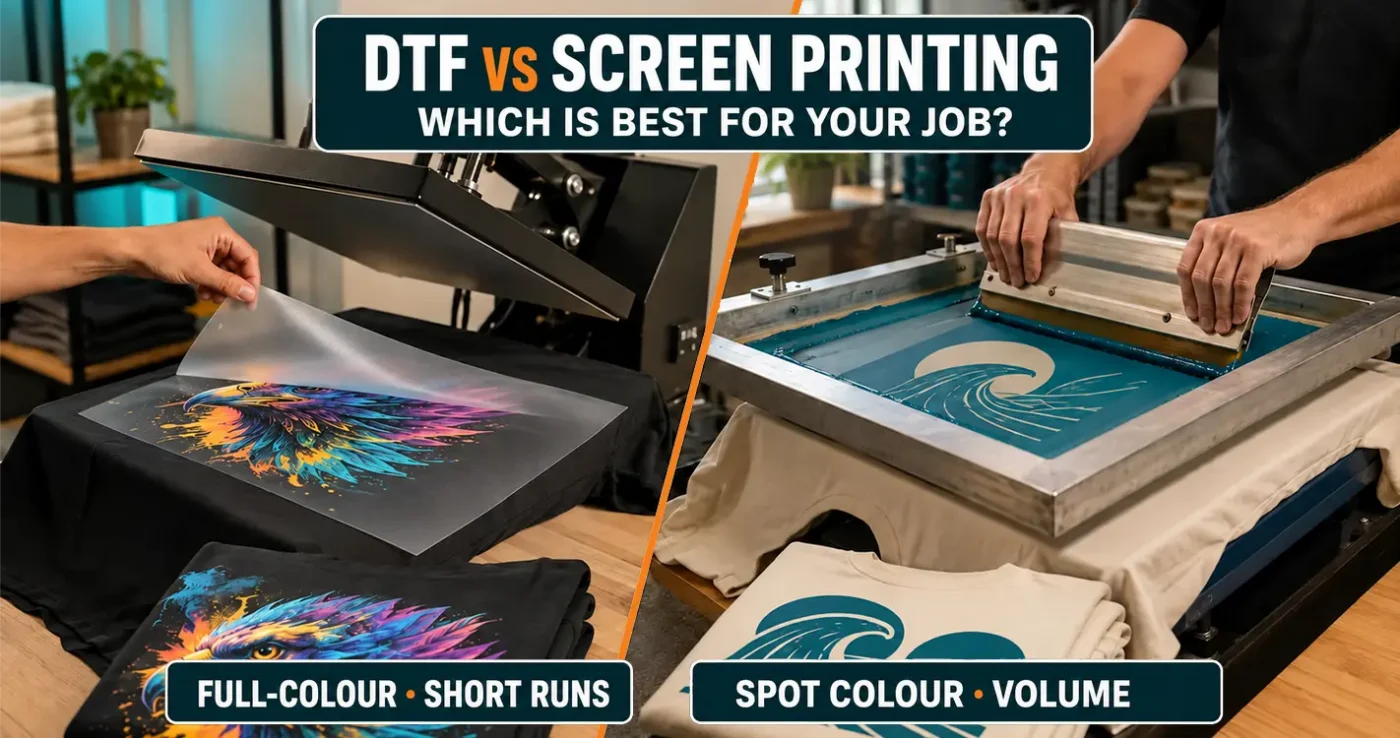
DTF transfers and screen printing can both produce good-quality custom T-shirts. DTF often suits small orders, full-colour artwork and personalised designs. Screen printing is often a strong choice for larger quantities of the same design, particularly when it uses a few solid colours.
The best option depends on the complete job: the artwork, garment, print size, quantity, finish and delivery requirements. There is no fixed order quantity at which one method automatically becomes cheaper or better.
This guide compares the two methods so you can choose a suitable process and compare quotes on equal terms.
TL;DR — DTF or screen printing?
- Consider DTF for small or mixed orders. Multiple colours, different designs and individual names do not require separate screen setups.
- Consider screen printing for larger repeat designs. Setup costs can be spread across the run, particularly for artwork with fewer colours.
- Both can reproduce detailed artwork. Screen printing can use halftones and colour separations for gradients and photographic images.
- Compare the complete finished-garment cost. A DTF transfer price alone is not equivalent to a printed T-shirt quote.
- Check samples for colour, feel and durability. The actual materials and production process matter more than the method’s name.
- You can use both methods. A common design can be screen printed while individual names are added with DTF, subject to testing.
DTF transfers and screen printing compared
| Consideration | DTF transfers | Screen printing |
|---|---|---|
| Application | A printed transfer is heat pressed onto the garment, then the carrier film is removed. | Ink is printed through a stencil onto the garment and cured. |
| Colour preparation | Artwork is processed digitally; each design colour does not need a separate screen. | Usually requires a separate screen for each ink colour or separation. |
| Often suits | Small runs, mixed designs, full-colour artwork and personalisation. | Larger identical runs, spot-colour logos and particular ink finishes. |
| Colour matching | Depends on the digital colour system and printable colour range. | Spot inks can be mixed to target specified colours. |
| Print feel | A printed layer sits on the fabric; coverage affects how noticeable it feels. | Varies with the ink type, deposit, underbase and garment. |
| Stock planning | Transfers can be held separately from blank garments and applied as needed. | Direct printing commonly suits a planned batch of finished garments. |
This comparison focuses on DTF transfers and screen printing directly onto garments. Screen-printed transfers are another option and have their own application and ordering requirements.
How DTF transfers work
DTF stands for direct to film. The design is printed onto a coated carrier film using coloured and white inks, prepared with adhesive and cured. A heat press then bonds the transfer to a suitable garment.
The carrier film is peeled away, leaving the printed design on the fabric. The white ink base helps coloured artwork remain visible on dark garments.
You can produce transfers yourself or buy them ready to press. When you order from DTF Transfers Australia, the transfer printing and curing have already been completed. You apply the transfers to your garments.
Our direct-to-film printing guide explains the process in more detail.
How screen printing works
Screen printing uses a mesh screen and stencil to control where ink reaches the garment. A squeegee pushes the ink through the open areas of the stencil.
Each ink colour or separation usually has its own screen. The printer aligns the screens so the design’s colours sit in the correct positions, then cures the printed ink according to the ink system.
Shops may use manual presses or automatic equipment. Once a job is set up, an automatic press can print repeated artwork efficiently across a large run.
Screen printing is not limited to simple logos. Skilled printers can reproduce tonal and photographic images using halftones and suitable colour separations.
Artwork, fine detail and colour matching
Full-colour and photographic designs
DTF is a practical option for photographs, illustrations and designs with many colours. Adding another colour to the artwork does not require another physical screen.
Screen printing can reproduce gradients and photographs too, but the artwork needs to be separated for the chosen ink and screen arrangement. This preparation may make more sense for a larger run than a handful of shirts.
Neither method can recover detail missing from a poor source file. For DTF, tiny isolated elements and faint transparent edges can also be difficult to transfer reliably. Read our DTF artwork requirements before preparing the print file.
Brand and spot colours
If a logo needs a closely controlled spot colour, screen printing is worth discussing with the printer. Mixing an ink to a target colour gives a different approach from reproducing that colour through digital process inks.
DTF can produce strong colour, but not every colour shown on a screen can be reproduced exactly. Screen printing also depends on the garment, ink coverage and curing. Approve a physical sample when colour accuracy is important.
Setup and minimum orders
DTF avoids screen preparation, but it is not free of production work. Files still need to be prepared, printed and turned into usable transfers.
Screen printing involves preparing the screens, aligning the design and setting up the inks before the run begins. Suppliers may charge separately for this work, include it in the price or set a minimum order.
Minimum quantities are supplier and product rules, not universal limits of the technology. Check the available sheet sizes and order requirements for DTF, and ask screen printers how their setup charges apply to your design.
Compare the complete finished-garment cost
A ready-to-press transfer and a finished printed T-shirt are different purchases. When comparing a DTF transfer price with a screen-printing quote, include everything needed to produce the same finished item.
For DTF, allow for the garment, transfer, incoming freight, cutting, positioning, pressing, finishing and any rework. Packaging and delivery may need to be added too.
For screen printing, check whether the quote includes garments, artwork preparation, screen setup, ink matching, every print location and delivery.
DTF pricing is often linked to print area and how efficiently the sheet is used. Screen-printing setup is strongly affected by the number of screens and print positions, while the cost per garment can improve as the run grows.
There is no reliable rule such as “switch to screen printing at 50 shirts”. A small one-colour logo and a large full-colour illustration are different jobs. Ask both suppliers to quote the same specification.
Quantities and repeat orders
DTF can be useful for small top-up orders and collections containing several designs. Approved transfers can be stored and applied when the relevant garment size is needed.
Screen printing becomes attractive when the same design is repeated across a planned run. A mix of garment sizes alone does not make it unsuitable: if the print dimensions stay the same, the same screen setup may serve several sizes.
If the artwork needs different print dimensions for adult and children’s shirts, ask how that changes the quote. Changes to design size can add setup work for screen printing and affect sheet use for DTF.
Keep an approved sample for repeat jobs. Colours and finishes can vary when materials, garments or production settings change.
Print feel and special finishes
A DTF transfer adds a printed layer to the garment. A small chest logo can feel quite different from a large solid back print. Open spaces in the artwork leave more fabric uncovered and can make the design less noticeable to wear.
Screen-print feel varies with the ink system and the amount of ink applied. A light deposit can feel soft, while an opaque design with an underbase may be more substantial. It is not accurate to describe every screen print as soft or every DTF print as heavy.
Compare similar artwork at the same size on the garment you intend to use. Assess the feel after washing as well as straight after printing.
Special finishes also need a product-by-product comparison. A metallic transfer and a metallic screen-printing ink may create different appearances. Our speciality DTF finishes are supplied on sheets and use a cold-peel process; they do not use the standard Insta-Peel application method.
Fabric and garment suitability
Both methods can work on suitable cotton, polyester and blended garments. The transfer or ink system must suit the fabric and its intended use.
Polyester dye migration can affect either process. Coatings, stretch, texture and heat sensitivity can also cause problems. DTF requires even pressure across the design; screen-printing ink needs an appropriate cure without damaging the garment.
Check the exact garment style and colour, particularly for sportswear, coated fabrics and highly stretchy products. Our T-shirt fabric guide explains the main considerations.
Which print lasts longer?
Both DTF and screen printing can produce durable results. A method name alone does not provide a fair lifespan comparison.
DTF relies on a well-made transfer, suitable fabric and correct application. Screen printing relies on the correct ink and proper curing. Washing, abrasion and the garment’s normal stretch affect both.
Assess samples under the conditions in which the shirts will be used. Avoid relying on an unsupported wash-count claim, and provide the appropriate care instructions with finished orders.
For our transfers, use the current DTF fitting instructions, including the peeling method and finishing press required for the product.
Names, numbers and changing designs
DTF makes it practical to prepare different names, numbers or designs as separate digital images. They can be combined on a gang sheet without making a new screen for each person’s details.
For a team order, keep a clear record linking each transfer to the correct garment and size. A layout reference kept separately from the printed artwork helps prevent mix-ups.
Screen printing is efficient for the shared design. Personalisation can then be added with another suitable method, including DTF, after the full process has been tested.
Which method is quicker?
DTF can simplify preparation for small full-colour jobs because there are no screens to make and align. However, ready-to-press transfers still need to be produced, delivered where applicable and applied to every garment.
For a large repeat run, an automatic screen-printing setup can print quickly once preparation is complete.
Ask for the total turnaround, including artwork approval, garment availability, production and delivery. Neither method guarantees the earliest completion date if the supplier is busy or the garments are unavailable.
Equipment and workspace
If you buy ready-to-press DTF transfers, you need a suitable heat press, basic preparation tools and space to organise and finish the garments. The supplier operates the transfer-printing equipment.
Producing DTF transfers in-house adds printing, adhesive application, curing, maintenance and ventilation requirements. Compare that full commitment with buying transfers.
An in-house screen-printing operation needs equipment and space for printing, curing and screen preparation or access to outsourced screen-making services. Cleaning and reclaiming screens also form part of the production work.
For a small business starting with ready-to-press transfers, our T-shirt business guide covers the broader setup and costing decisions.
Check the actual printed sample
Approve the garment and result you want to sell, not just a digital preview. Check colour, alignment, detail, opacity, feel and any fabric marking.
Wear and wash the sample as appropriate, and assess stretch where it matters. Keep the approved artwork version and garment details with the sample so the production order has a clear reference.
For important colour work, agree how the sample will be assessed before approving the full run.
Waste and environmental considerations
It is too broad to call either process environmentally better in every situation. Consider the materials, energy, cleaning, transport and quantity of unused stock involved in the actual job.
DTF uses carrier film and adhesive, and inefficient layouts leave unused sheet area. Printing garments as needed may reduce unsold finished stock. Screen printing can use a production run efficiently, but screen preparation, cleaning and unused ink also need to be considered.
Ask suppliers about specific practices and evidence rather than relying on a general “eco-friendly” description. A well-planned quantity and a product people continue to wear matter whichever printing method you choose.
Which method suits your project?
| Example job | What to consider first |
|---|---|
| Ten shirts with a full-colour illustration | DTF is worth quoting because it avoids multiple screen setups for a small run. |
| Five hundred shirts with a one-colour logo | Screen printing is worth quoting because the setup can be spread across a large repeated design. |
| An online label printing after each order | DTF can let you hold transfers separately from blank garments. |
| A corporate logo with a specified spot colour | Discuss screen-print ink matching and sample approval; compare the cost for the required quantity. |
| A shared team logo with individual names | Compare DTF for the whole job with screen printing plus separate personalisation. |
| A large photographic event print | Quote both. Digital preparation and specialist screen-print separations offer different cost structures. |
| A large solid design where comfort matters | Compare physical samples and consider whether open spaces in the artwork would help. |
These examples are starting points for quotes, not guaranteed price or quality outcomes.
Can you use both methods?
Yes. An apparel business can select a method for each job or use both within an order. For example, screen printing may suit a shared team design while DTF handles individual names.
Test the production sequence. Later heat pressing must not damage an existing print or the garment, and overlapping decorations need specific compatibility checks.
You can also test demand for a design with a small DTF run before considering a larger screen-printed order. If you change methods, check the new sample because the colour and feel may differ.
What to include when requesting a quote
- The artwork and whether it includes gradients, photographs or specified colours.
- The garment brand, style, colour and fabric.
- The quantity and size breakdown.
- The width, height and location of every print.
- Any individual names, numbers or artwork variations.
- The desired feel or special finish.
- The deadline, delivery destination and likely repeat orders.
- Whether you need transfers only or completed printed garments.
Ask what is included in the total, including setup, GST where applicable, delivery and any artwork work. This makes the comparison useful.
Frequently asked questions
Is DTF better than screen printing?
It depends on the job. DTF often suits small full-colour or personalised orders. Screen printing often suits larger repeat designs and controlled spot-colour work.
At what quantity does screen printing become cheaper?
There is no fixed crossover quantity. Artwork, print dimensions, colour count, print locations, labour and supplier pricing all affect the result. Compare quotes for the same specification.
Can screen printing reproduce photographs?
Yes. Photographic and tonal artwork can be prepared using halftones and suitable colour separations. The extra preparation needs to make sense for the quantity and budget.
Are DTF transfers and screen-printed transfers the same?
No. Both can be applied with heat, but the designs are produced using different printing processes. Use the instructions and product specifications for the transfer you have ordered.
Does DTF always feel heavier?
No. Feel depends on design coverage, materials and the garment. Compare similar designs at the same size rather than a small screen-printed logo with a large solid DTF image.
Does screen printing always last longer?
No blanket comparison is reliable. Both can be durable when the materials suit the garment and the application or curing is correct. Test the finished product and follow its care instructions.
Can I use ready-to-press DTF transfers without a printer?
Yes. Your supplier produces the transfers, and you apply them with suitable equipment. Allow for garment and pressing costs when comparing this option with a finished screen-printed order.
Choose the process that suits the finished product
Start with your artwork, garment and quantity, then compare the complete cost and a representative sample. That gives you a more useful answer than choosing by printing method alone.
If DTF suits your project, order a custom DTF gang sheet, browse our transfer range or read the complete DTF transfer printing guide before ordering.
