
Film and Finishes
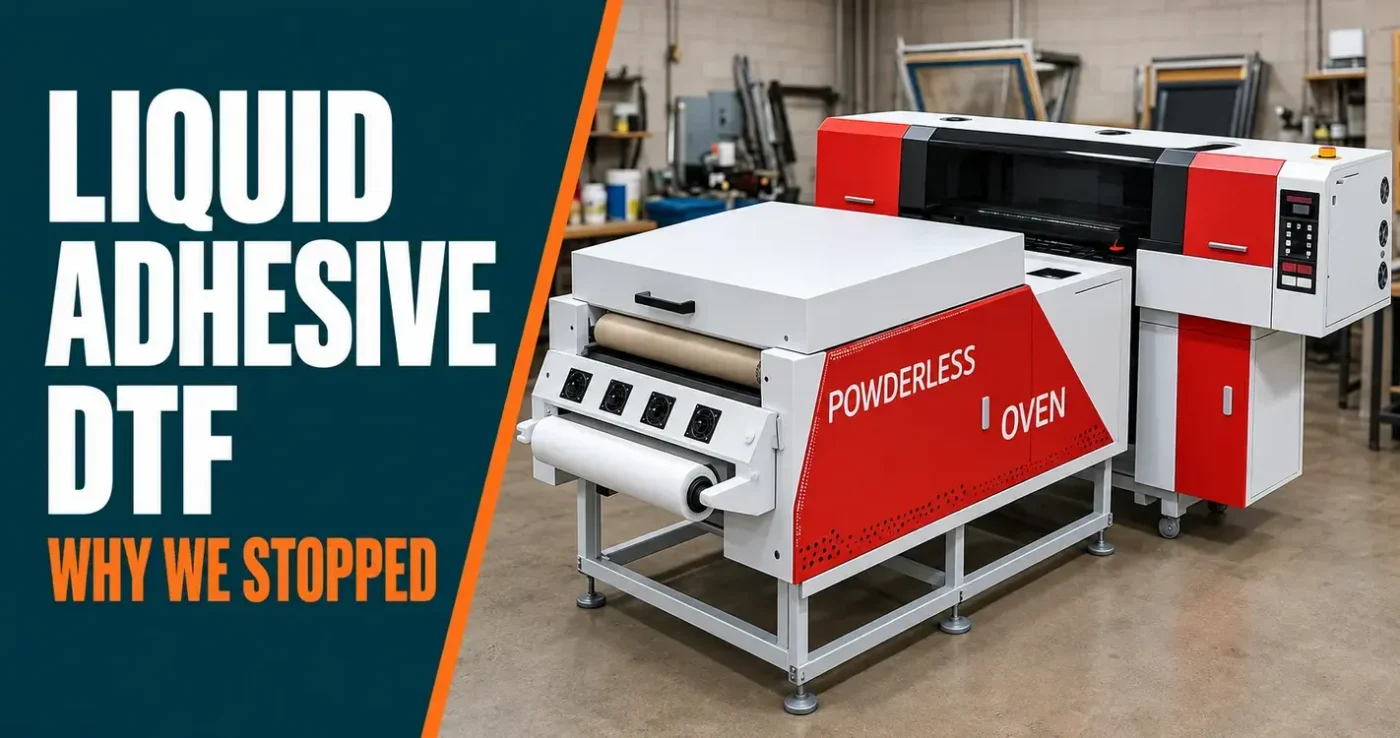
Liquid Adhesive DTF Transfers: Why We Stopped Selling Them
May
First published: | Last updated:
Important update: DTF Transfers Australia no longer produces or sells liquid-adhesive DTF transfers. We trialled the technology in real production and supplied the finished transfers to customers. Although the prints could feel lighter and softer, the process did not give us the application tolerance, production consistency or durability we require from a dependable ready-to-press transfer.
This is not a prediction based on a brochure or a quick sample test. It is an account of what we learned by producing liquid-adhesive transfers commercially, pressing them in-house and assessing how they performed when applied with different equipment.
At a glance
- Liquid adhesive produced a light transfer with an appealingly soft hand feel.
- Successful application required tight control of heat, pressure and pressing time.
- That narrow pressing window was unsuitable for transfers being sent to customers using heat presses of varying quality and calibration.
- Fine detail required a clear adhesive allowance outside the printed artwork, which could leave a visible outline.
- The promised performance with smooth fades and gradients did not match our production results.
- Our system could print only about four metres reliably before requiring a deep clean.
- Longer runs could develop banding or inconsistent adhesive coverage, which affected reliability and wash life.
- We have returned to proven DTF transfer systems and will reconsider liquid adhesive only if the technology improves substantially.
What is liquid-adhesive DTF?
Liquid-adhesive DTF, sometimes called powderless DTF, replaces the loose hot-melt powder used in a conventional direct-to-film workflow with a printable liquid adhesive.
In the system we operated, the printer laid down the colour image, the white ink and then the liquid adhesive. The transfer was flashed and cured before being applied to a garment with a heat press. The aim was to create a cleaner production workflow and a thinner, softer finished print.
The idea is attractive. Precisely printing the adhesive should, in theory, place it only where it is needed and remove the powdering stage. In practice, however, a ready-to-press transfer must do more than look good when it leaves the printer. It must also travel well, apply consistently and remain durable when used on heat presses we do not own or control.
Why we trialled liquid-adhesive DTF transfers
We are willing to test new technology when it has the potential to produce a better transfer for our customers. Liquid adhesive offered several genuine advantages during our trials:
- A softer hand feel: the finished print could feel lighter and less substantial on the garment.
- A thinner construction: there was less of the heavier feel sometimes associated with large, solid transfer areas.
- No loose powdering stage: the adhesive was printed as part of the production sequence.
- Promising detail: the controlled adhesive layer appeared capable of supporting intricate artwork.
Those benefits were real enough for us to introduce the product. The problem was not that the technology had no potential. The problem was that its strengths were outweighed by limitations that became apparent through everyday production and customer use.
Why we stopped producing liquid-adhesive DTF transfers
1. The pressing window was too narrow
Liquid-adhesive transfers were extremely sensitive to press settings. Heat, pressure and dwell time needed to remain within tight tolerances. A small variation could change the result.
That may be manageable in a controlled workshop using a well-maintained and accurately calibrated press. It becomes a serious issue when supplying ready-to-press transfers to customers using many different heat press brands, platen sizes and pressure systems. Displayed temperature is not always the true platen temperature, and pressure descriptions such as “medium” are not standard measurements.
A commercial transfer needs a reasonable application window. Customers should not need laboratory-level control to achieve a dependable result. In our view, the liquid-adhesive product was too unforgiving for the varied real-world equipment used by our customer base.
2. Fine detail needed a visible adhesive outline
Adhesive must be present wherever the printed image needs to bond to the garment. With very fine lines and small details, the adhesive layer needed to extend slightly beyond the coloured artwork to provide enough grip.
Because the adhesive was clear, this was less noticeable on some garments and designs. On others, it created a visible clear outline or halo around the artwork. Increasing that allowance could improve bonding, but it also made the outline more apparent. Reducing it improved the appearance while increasing the risk that fine elements would not adhere securely.
That compromise was not acceptable for a product promoted for precise, detailed printing.
3. Gradients and fades did not meet the promise
Liquid adhesive was promoted to us as a way to improve gradients, fades and very fine transitions. Our results did not consistently support that promise.
A printed transfer cannot rely on barely visible ink alone; every printed area also needs enough adhesive to remain attached. Soft transparent edges therefore create a difficult balance between appearance and adhesion. In our testing, smooth fades and semi-transparent details did not reproduce as reliably as expected.
For DTF artwork, controlled halftones remain a more dependable way to create a visual fade than relying on partially transparent pixels. Our DTF artwork guide and FAQs explain why correctly prepared artwork matters to the finished result.
4. Production was too slow and maintenance-intensive
On our production setup, we could print approximately four metres before the printer needed a deep clean. Trying to extend the run increased the likelihood of banding, inconsistent output or insufficient adhesive being deposited onto parts of the transfer.
This interrupted production, reduced usable output and created more waste. More importantly, a transfer could appear acceptable at first glance while having inadequate adhesive coverage. That is not a risk we are prepared to pass on to customers.
This four-metre limit describes our experience with the equipment, inks, adhesive and workflow we used. It should not be treated as a universal specification for every liquid-adhesive system. It is, however, the real production result on which we had to base our decision.
5. Durability was not consistent enough
The final concern was longevity. When adhesive coverage was incomplete, or when application conditions were slightly outside the narrow working range, some transfers did not remain securely bonded through normal wear and washing.
Initial appearance is only one part of transfer quality. A product also needs to survive after the customer has pressed, worn and washed the garment. We could not confidently promise the consistent life customers should expect, so continuing to sell the transfers would not have been responsible.
Our decision: a softer feel was not enough to outweigh difficult application, visible adhesive margins, slow production and inconsistent long-term performance.
Liquid adhesive vs conventional powder-adhesive DTF
Liquid adhesive should not automatically be considered better simply because it is newer. The right process is the one that produces a repeatable transfer and gives the end user a practical application window.
| Consideration | Liquid adhesive in our testing | Our current DTF transfers |
|---|---|---|
| Hand feel | Light and soft | Soft and flexible when correctly applied |
| Pressing tolerance | Very narrow | More practical across customer heat presses |
| Fine-detail adhesion | Could require a visible clear outline | More consistent for ready-to-press use |
| Fades and transparency | Did not meet the promoted result | Best prepared with controlled halftones |
| Production reliability | Frequent deep cleaning and short reliable runs | Better suited to consistent commercial production |
| Durability | Too dependent on perfect coverage and pressing | Proven and repeatable when instructions are followed |
Conventional DTF is not maintenance-free, and every transfer still needs correct time, temperature and pressure. However, our current process has proven substantially more dependable for transfers produced in Brisbane and sent to customers around Australia.
What DTF Transfers Australia offers now
We now concentrate on transfer films, inks and adhesive systems that have performed reliably through our own production and application testing. This includes our standard ready-to-press transfers, custom DTF gang sheets and selected specialty finishes.
We have also introduced Insta-Peel DTF film, which improves production speed at the application stage without relying on the liquid-adhesive process described here. It is a different technology and should not be confused with powderless DTF.
Whatever transfer type you choose, artwork quality still plays a major role. Supply a transparent PNG at 300 DPI, crop it tightly and avoid details that are too small to print and bond reliably. You can learn more in our guide to ordering custom T-shirt transfers.
Will we revisit liquid-adhesive DTF?
Yes—if the technology becomes genuinely ready for the way our customers use transfers.
We are not claiming that liquid-adhesive DTF can never work or that every system will behave exactly like ours. Equipment, printheads, adhesive chemistry, films and curing systems continue to develop. A newer platform may eventually solve the issues we encountered.
Before we offer it again, we would need to see:
- a wider and more forgiving heat-press application window;
- reliable bonding of fine details without an objectionable adhesive halo;
- convincing fades and gradients in real artwork, not only demonstration samples;
- consistent adhesive delivery throughout commercially useful print runs;
- manageable cleaning and maintenance requirements; and
- repeatable wash durability across different garments and customer heat presses.
New technology earns a place in our range by being more dependable for the customer—not simply by being new.
Frequently asked questions
Does DTF Transfers Australia still sell liquid-adhesive DTF transfers?
No. We have stopped producing and selling liquid-adhesive DTF transfers because our testing and commercial production showed that the technology was not reliable enough for our ready-to-press customers.
Why were liquid-adhesive transfers difficult to press?
They required tightly controlled temperature, pressure and pressing time. Differences between heat presses, including temperature calibration and platen pressure, made the result less predictable when transfers were applied outside our workshop.
Did liquid adhesive produce a softer transfer?
Yes. A lighter, softer hand feel was one of its genuine strengths. We discontinued it because that benefit did not outweigh the narrow pressing tolerance, production interruptions, adhesive outlines and inconsistent durability.
Can liquid-adhesive DTF print gradients and fades?
The systems we tested did not reproduce gradients and transparent fades as successfully as we had been led to expect. We recommend purpose-built halftones for a dependable faded effect in DTF artwork.
Is powderless DTF technology unsuitable in every situation?
Not necessarily. This article describes our equipment and first-hand production results. Other systems may perform differently, and the technology may improve. We will assess future developments on their measured results rather than marketing claims.
What should customers order instead?
For dependable ready-to-press printing, choose our current standard DTF transfers or gang sheets and follow the supplied pressing instructions. If you are unsure which product suits your artwork or garment, contact DTF Transfers Australia before ordering.
The bottom line
Liquid-adhesive DTF transfers had an appealing soft feel, but they did not deliver the production stability or customer-friendly application we require. The pressing tolerances were too tight, fine artwork could show a clear adhesive outline, gradients fell short of expectations, production required frequent deep cleaning and transfer life was not consistent enough.
Stopping the product was the right decision. Our responsibility is not to sell the newest process; it is to supply a transfer that customers can press successfully and trust on the finished garment.
About this review: This article is based on DTF Transfers Australia’s first-hand experience producing, applying and selling liquid-adhesive DTF transfers. David Seth has worked in garment decoration and T-shirt printing for more than two decades and operates DTF Transfers Australia in Brisbane.
