
Running a Print Business
The Benefits of DTF Transfers for Small Apparel Businesses
Mar
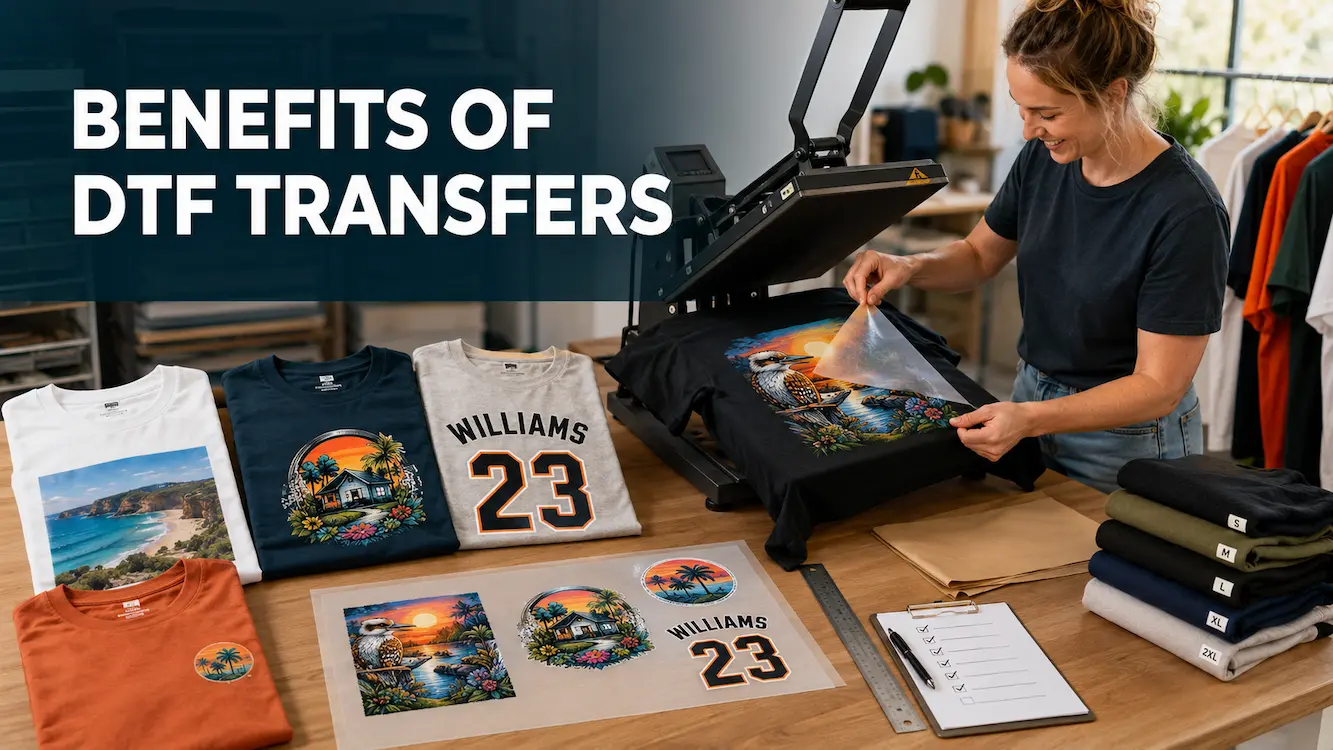
The main benefits of DTF transfers are full-colour printing, less design preparation at the press, and the flexibility to produce short or personalised runs. By buying ready-to-press transfers, a small apparel business can offer detailed prints without owning and maintaining a DTF printer.
That can be useful when you are testing a clothing range, adding logos to uniforms or producing merchandise with several different designs. You can focus on the garments, application and customer orders while a supplier produces the transfers.
The value depends on the job. This guide explains where direct-to-film (DTF) transfers help most, what you still need to do and which costs and limitations to consider.
TL;DR
- Print detailed colour in one transfer. DTF suits illustrations, photographs, gradients and multicolour logos.
- Avoid vinyl-style weeding. There is no need to remove unwanted material from inside the printed design.
- Start without a DTF printer. Buy ready-to-press transfers and apply them with suitable equipment.
- Produce short and mixed runs. Different designs, names and print sizes can share a standard gang sheet.
- Keep garment stock flexible. Decorate suitable blanks as orders arrive instead of printing every possible combination in advance.
- Test and cost the complete job. Artwork, fabric, application, labour and delivery all affect the result.
What is a DTF transfer?
A DTF transfer is a printed design supplied on a carrier film, ready to be applied to fabric. Colour and white ink form the image, and a prepared adhesive layer bonds it to a compatible garment when the correct heat and pressure are applied.
The carrier film is removed at the stage specified for that transfer. Any required finishing press completes the application process.
DTF Transfers Australia supplies the transfers; you supply the garment and apply the print. Buying transfers is a different commitment from operating the equipment that prints and cures them. Our introduction to direct-to-film printing explains the process in more detail.
This guide concerns ready-to-press production transfers. Developmental systems, including liquid-adhesive technology we have tested, should not be assumed to offer the same application process or reliability as the products you order.
The benefits at a glance
| Benefit | Practical value | What to allow for |
|---|---|---|
| Full-colour artwork | Detailed colour is supplied as one aligned image. | Print-ready artwork and realistic colour expectations |
| Less preparation | No screens to prepare or vinyl details to weed in your application workflow. | Separating transfers, positioning and pressing |
| Lower equipment commitment | You can buy transfers instead of operating a print line. | Suitable application equipment, workspace and training |
| Short and mixed runs | Test designs and produce personalised items. | Product formats, delivery costs and order checking |
| Flexible inventory | Keep garments blank until the design and size are ordered. | Blank availability and correct transfer storage |
| Range expansion | Use tested combinations across suitable apparel and accessories. | Fabric compatibility and product-specific instructions |
1. Full-colour designs with less preparation
DTF is particularly useful when the artwork contains several colours, fine detail, shading or a photograph. The complete image arrives on one carrier, so you do not align a separate piece of material for each colour.
For an artist’s illustration or a detailed business logo, that can make production more straightforward than rebuilding the design from coloured vinyl. You can retain colour variation without turning every shade into another physical application step.
File quality still matters. A small image enlarged beyond its useful resolution will not become sharp simply because it is printed with DTF. Tiny isolated details, unwanted backgrounds and semi-transparent edges also need attention.
Prepare the artwork at its final print dimensions and check our DTF artwork requirements. Our service prints files as supplied, so check spelling, size and transparency before ordering. Do not assume artwork correction or a proof is included.
No design weeding or screen preparation
With cut heat transfer vinyl, unwanted material is removed after cutting. This is called weeding, and intricate designs can take considerable time. DTF prints the design without that internal removal step.
DTF also avoids the physical screen preparation associated with screen printing. That helps make changing designs and detailed short runs practical.
There is still work involved. Your supplier produces the transfers, and you need to separate any gang-sheet designs, prepare the garments, position the artwork and complete the pressing process. The benefit is simpler preparation for the decorator, rather than a job with no setup at all.
2. Start without running a DTF printer
Buying transfers lets you add detailed garment printing without taking on printer maintenance, white ink management, adhesive application and curing.
For regular commercial production, the core setup is a suitable heat press with reliable temperature and pressure, the specified application accessories, positioning tools and a clean work area. You also need sample garments and time to learn the process.
This approach can suit a new business or an established decorator adding another service. For example, a business that already cuts vinyl can order DTF for artwork that would be slow to weed.
Running a DTF printer in-house is a separate decision involving equipment, maintenance, space and production volume. Purchasing transfers first can help you understand the demand before considering that investment.
3. Short runs, personalisation and gang sheets
DTF can be practical for a sample, replacement shirt or small event order because changing the image does not require a new set of physical screens.
You still order within the available product formats and conditions. A small job may carry a higher cost per garment once delivery, unused sheet space and application time are included.
Change the artwork without changing the basic process
Names, roles, sponsor logos and individual illustrations can all be supplied as separate transfers. This is useful for orders where each garment needs something different.
Personalisation needs careful records. Match each approved name or design to its garment size and check spelling before printing. A correctly made transfer on the wrong shirt is still a costly mistake.
For large, simple names and numbers, compare the preparation time with cut heat transfer vinyl. DTF is one useful option rather than the automatic choice for every personalised job.
Combine designs in the purchased print area
A gang sheet places several designs together within one printable sheet or length of film. It can contain repeated logos, different print sizes or artwork for several orders.
An efficient layout can reduce the transfer cost per usable design. Set the final dimensions before arranging the artwork, crop unnecessary empty space and leave enough room to cut the transfers apart safely.
Use the space for designs you need. Filling gaps with speculative prints does not save money if those transfers are never used. Our custom DTF gang sheets provide the current formats and ordering options.
4. Flexible stock and repeat orders
Keeping garments blank until orders arrive can reduce the amount of stock committed to particular designs. A suitable blank shirt can be used for whichever tested design the customer chooses.
For example, five designs offered in two shirt colours and six sizes create 60 possible finished combinations. You do not necessarily need to stock all 60 as printed garments. You can hold a controlled blank range and decorate to order.
This still requires planning. Blank stock can sell out, production takes time, and unused transfers need appropriate storage. Follow our advice on storing DTF transfers rather than assuming they can be kept indefinitely in any conditions.
Keep approved details for reordering
Save the final artwork, print dimensions, garment style and colour, placement and application settings. An approved sample or photograph helps you check future work.
Digital artwork makes reordering convenient, but a file alone does not guarantee an identical finished garment. Record any change in the blank, transfer product or application process, and sample again where needed.
5. A wider garment and finish range
Compatible DTF transfers can be used on many cotton, polyester and blended garments. This can let a business offer T-shirts, hoodies, sweatshirts and suitable bags through a familiar application process.
Suitability depends on the actual item. Fabric coatings, stretch, seams, texture and heat sensitivity can affect the result. Polyester can also develop heat marks or dye migration, where garment dye discolours the decoration.
Test the specific style and colour before adding it to your range. The T-shirt fabric guide explains useful garment terminology and selection considerations.
Offer effects as a separate product choice
Speciality DTF products can add finishes such as metallic, glitter, pearl, reflective, neon or glow effects. They give customers additional design choices, but should be sampled and described individually.
Our speciality transfers are supplied as sheets, not gang sheets, and use cold-peel instructions. Their artwork requirements and appearance can differ from standard full-colour transfers. Browse the current transfer range and check the selected product before promising a particular effect.
Application, print feel and durability
Ready-to-press means the transfer is prepared for application; it does not remove the need for correct pressing. Transfer quality, fabric compatibility, moisture, temperature, time and even pressure all contribute to the finished result.
Use the instructions for the transfer you have purchased. Settings remembered from an older film or another supplier may not be suitable.
Immediate peeling can simplify handling
Our standard Insta-Peel transfers are designed for the carrier to be removed immediately after the initial press. This removes a cooling wait from that stage of the workflow, but the required finishing press still needs to be completed.
Check the current fitting instructions for the fabric and transfer type. Speciality cold-peel products follow a different sequence.
Judge a sample at the intended print size
DTF can produce durable, detailed decoration when the materials and application are right. There is no single wash-life figure that applies to every transfer, garment and care routine.
Print coverage also changes the feel. A large solid panel can feel heavier and restrict more airflow than a small logo or open illustration. Test the actual design and garment, then check performance under the intended care conditions.
Costs and situations where another method may suit
Buying transfers reduces the equipment needed to get started, but your selling price must cover the complete job.
Include the garment, transfer, delivery, preparation, pressing, quality checks, packaging, selling fees and an allowance for samples and mistakes. Your application time has a cost even when you are doing the work yourself.
A detailed DTF design may save substantial labour compared with cutting and weeding several vinyl colours. That saving will differ from a job involving one simple name. For pricing guidance, see how to price your printed T-shirts.
Compare methods around the actual order
Screen printing may be more efficient for a larger run of identical artwork. Cut HTV may suit simple lettering or a particular texture. Compare the finished result and full production cost rather than choosing from a fixed quantity rule.
Our DTF versus screen printing comparison explains the main trade-offs for repeated designs and bulk orders.
Know the practical limits
- The garment must tolerate application. Heat-sensitive or coated fabrics may need another approach.
- Fine detail has limits. Very small or faint elements may not print and adhere reliably.
- Colour needs checking. A screen image is not an exact printed colour reference.
- Each garment needs handling. Separating, positioning, pressing and checking remain part of production.
- On-demand printing still uses resources. Carrier film, ink, adhesive, energy and delivery remain part of the process.
How to get started
Begin with one garment and a representative design. A tested combination gives you a more useful starting point than offering a large range you have not tried.
- Choose the garment and placement. Confirm the available print area and required size.
- Prepare the artwork. Check the transparent file, dimensions and spelling.
- Order a sample. Use the transfer product you intend to sell.
- Follow the application instructions. Check your press and record the settings.
- Inspect and test the result. Review appearance, feel, adhesion and care performance.
- Calculate the full cost. Include your labour and the time needed to fulfil the order.
- Expand from what works. Add garments or finishes after testing them.
Who is this approach useful for?
Ready-to-press DTF can suit small clothing labels testing designs, artists producing detailed merchandise, uniform suppliers handling small repeat orders, and established decorators adding full-colour work.
It is particularly useful when artwork changes frequently and you want to avoid owning the equipment that manufactures the transfer. Our guide to starting a T-shirt business with DTF transfers covers the wider business setup.
A quick decision check
DTF is worth considering when you have detailed or varied artwork, short quantities, suitable application equipment and a garment that has passed testing. Before confirming the order, also check product availability, delivery time and the complete cost.
Frequently asked questions
What is the main benefit of DTF transfers?
They let you apply a detailed full-colour design as one transfer, without preparing physical screens or weeding the internal spaces in vinyl artwork.
Do I need a DTF printer?
No. You can buy ready-to-press transfers and apply them to suitable garments. Operating a DTF printer involves additional equipment and maintenance.
Are DTF transfers suitable for one-off shirts?
The process suits one-off and short-run work, subject to the supplier’s product formats and ordering conditions. Include delivery, unused sheet space and application time when working out the cost.
Can different designs share a gang sheet?
Yes. Standard DTF gang sheets can contain repeated or different designs at their final print sizes. Leave room to separate them. Our speciality finishes are supplied as sheets rather than gang sheets.
Does DTF work on polyester?
It can, with a suitable transfer and correct application. Test the actual garment style and colour for adhesion, heat marks and dye migration.
Are DTF transfers cheaper than other methods?
They can be economical for detailed or mixed short runs, especially where they save preparation labour. Another method may cost less for a simple design or larger identical run.
Will the supplier fix my artwork?
Our service prints artwork as supplied. Check the current file requirements and confirm spelling, dimensions and transparency before uploading your design.
Are all DTF transfers peeled immediately?
No. Our standard Insta-Peel transfers are peeled immediately after the initial press, while our speciality transfers use cold-peel instructions. Follow the directions for the actual product.
How long do DTF prints last?
That depends on the transfer, garment, application and care. Test your chosen combination rather than relying on a universal wash-count claim.
Use DTF where it makes the job simpler
DTF offers the most value when its colour flexibility, reduced preparation and short-run capability match the work you need to produce. Start with a sample, establish a reliable application process and build your range from tested results.
When you are ready, order a custom DTF gang sheet or read the complete DTF transfer printing guide for more help with ordering and application.
