
Printing It Yourself
T-Shirt Printing Equipment for DTF Transfers: Complete Checklist
Oct
Originally posted: 5 October 2023. Last updated: 5 October 2026.
Quick summary
To press our transfers you need a heat press that covers the design, a lint roller, tape, and your own parchment, baking paper, or Teflon. You do not need a DTF printer, powder, or a roll of film. A household iron is only for iron-on transfers. A Cricut EasyPress is enough when its platen fully covers the print. Blank shirts are not part of a transfer order.
On this page
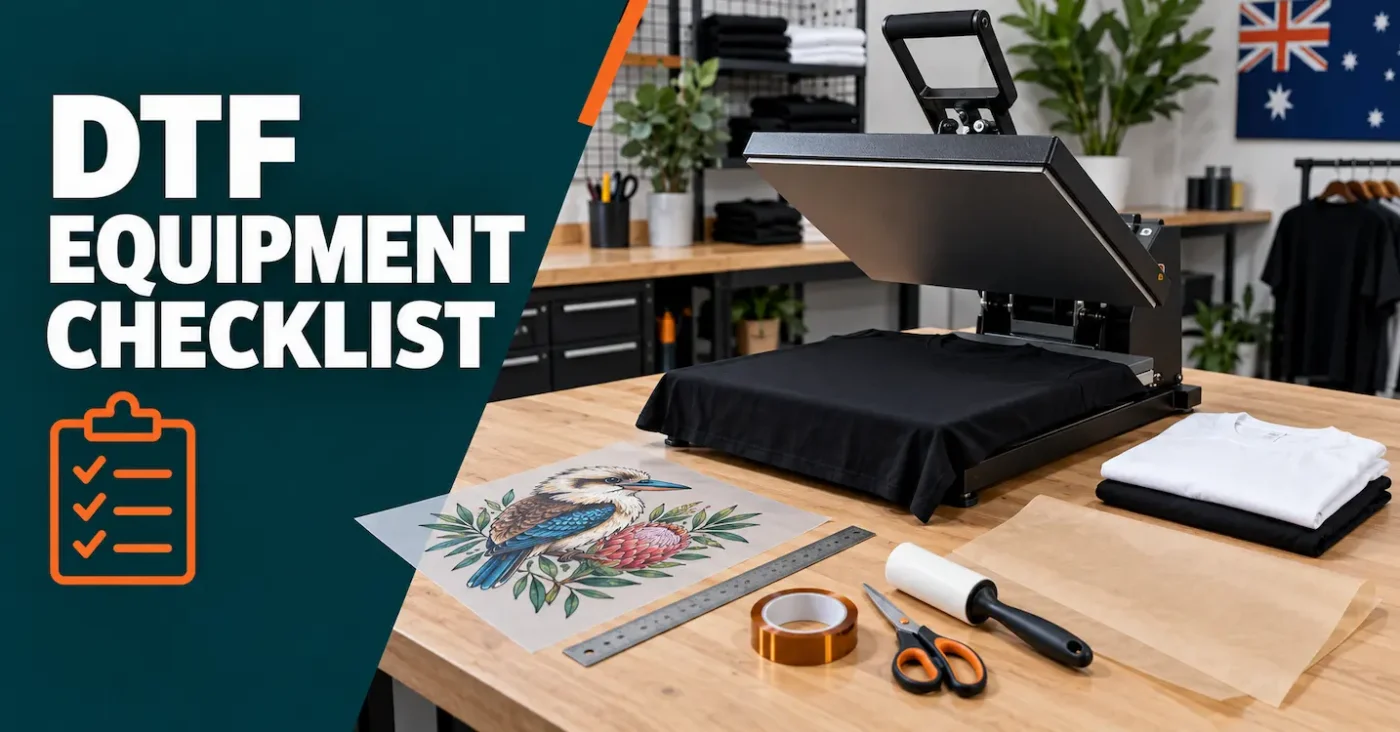
The checklist
This is the bench we expect when someone is pressing ready-to-press DTF, not running a print factory.
- A heat press with even heat and even pressure, large enough for the design in one hit.
- A bench that does not rock when you load a hoodie.
- A lint roller.
- Heat-resistant tape for small placements and shirts that shift.
- Your own parchment, baking paper, or Teflon. We do not put a finishing sheet in the box.
- A ruler or a simple placement guide, so the left chest is the left chest on every shirt.
- A few spare shirts for tests. Do not learn a new fabric on a customer’s only polo.
Choosing the machine is its own job. Use new vs used heat press before you pay for one you have not seen hot.
The heat press
The platen has to cover the design. A press that is “big enough if I do it twice” will show a line through a solid logo. Pressure has to be firm and repeatable. A worn lower pad is a common reason one side of a print looks milky.
Check the temperature at the platen, not only on the display. A corner can be cool while the controller says 160°C. If you are buying used, test from cold and use more than your hand.
A Cricut EasyPress counts as a small heat press when the platen fully covers the design. That is suitable for standard cut sheets, gang designs that fit, and Hot Insta Peel. If the art hangs over the edge, move up to a press that covers it. A household iron is a different tool. It is only for products labelled iron-on, and it is not how you press a gang sheet.
Caps need a cap press, or a platen made for that curve. An ordinary flat press, and a household iron, will not support the panel. Specialty finishes use the same sort of heat press, then follow the cold-peel instructions on that sheet. They are not iron-on.
Small tools
Lint shows up under a light print on a black fleece. Roll the area before you pre-press. Tape stops a small name badge walking as the press closes. A dirty cover sheet reprints yesterday’s adhesive as a gloss patch, so keep a spare piece of parchment and throw the shiny one away.
A pressing pillow helps when a seam or a zip would otherwise hold the platen off the fabric. It does not fix a press that is cold on one side.
What you do not need
You do not need a DTF printer, white ink, powder, or rolls of film to sell shirts decorated with our transfers. We print the film at 17 Castlemaine Street, Coorparoo. You press it. We do not sell blank shirts. Those, and finished custom printing, are at T Shirts Australia.
You do need a way to make the art. A transparent PNG, JPEG, or WebP at about 300 DPI at final size is enough. Crop it, keep fine lines at least about 1 mm, stay under 254 MB, and do not mirror it. Details are in artwork requirements.
The shop is open Monday to Friday, 9:00am–2:30pm. Orders in by 12:00 noon Brisbane time on a weekday go into that day’s standard handling, typically 3–5 business days. Same/Next Day handling is coming soon, aimed at November–December 2026, and cannot be ordered before then.
A pressing session
- Sort the film by job. Keep sheets flat and dry. See storing transfers.
- Lint-roll and pre-press until there is no steam. Pre-pressing is not optional on a humid day.
- Press. Cotton and most fabrics: 160°C, 8 seconds, firm, peel while hot. Polyester: 120°C, 30 seconds, firm, cold peel only.
- Second press for 10 seconds under a clean cover sheet. At 120°C on polyester.
- Look at the edges before the shirt goes on a hanger.
The full sequence, including what to do when a corner lifts, is in DTF pressing tips.
FAQ
What equipment do I need to start?
A heat press that covers the design, a stable bench, a lint roller, heat-resistant tape, and your own parchment, baking paper, or Teflon. Add a ruler so placement stays consistent. You order the transfers from us.
Do I need a DTF printer?
No. A printer, film, and adhesive are for people producing the transfers. If you are pressing shirts, order ready-to-press gang sheets or cut sheets. We do not sell the printer or the powder.
Can I use a household iron or a handheld craft press?
A household iron is only for products labelled iron-on. A Cricut EasyPress is fine for standard DTF and Hot Insta Peel when the platen fully covers the design. If it does not cover the design, use a larger heat press. Always test.
How do I know the heat press temperature is accurate?
Do not trust the display alone, and do not judge it by touch. Check the centre and the edges with a method made for platens. A corner that runs cool will leave that side of the print under-bonded.
Where do I order the transfers?
From DTF Transfers Australia. Gang sheets are 28 cm at $21.95 a metre or 58 cm at $30.95 a metre, GST included. Cut sheets are listed by size. The order does not include a blank shirt.
