
DTF vs Other Methods
DTF vs Heat Transfer Vinyl: Which Suits Your Design?
Mar
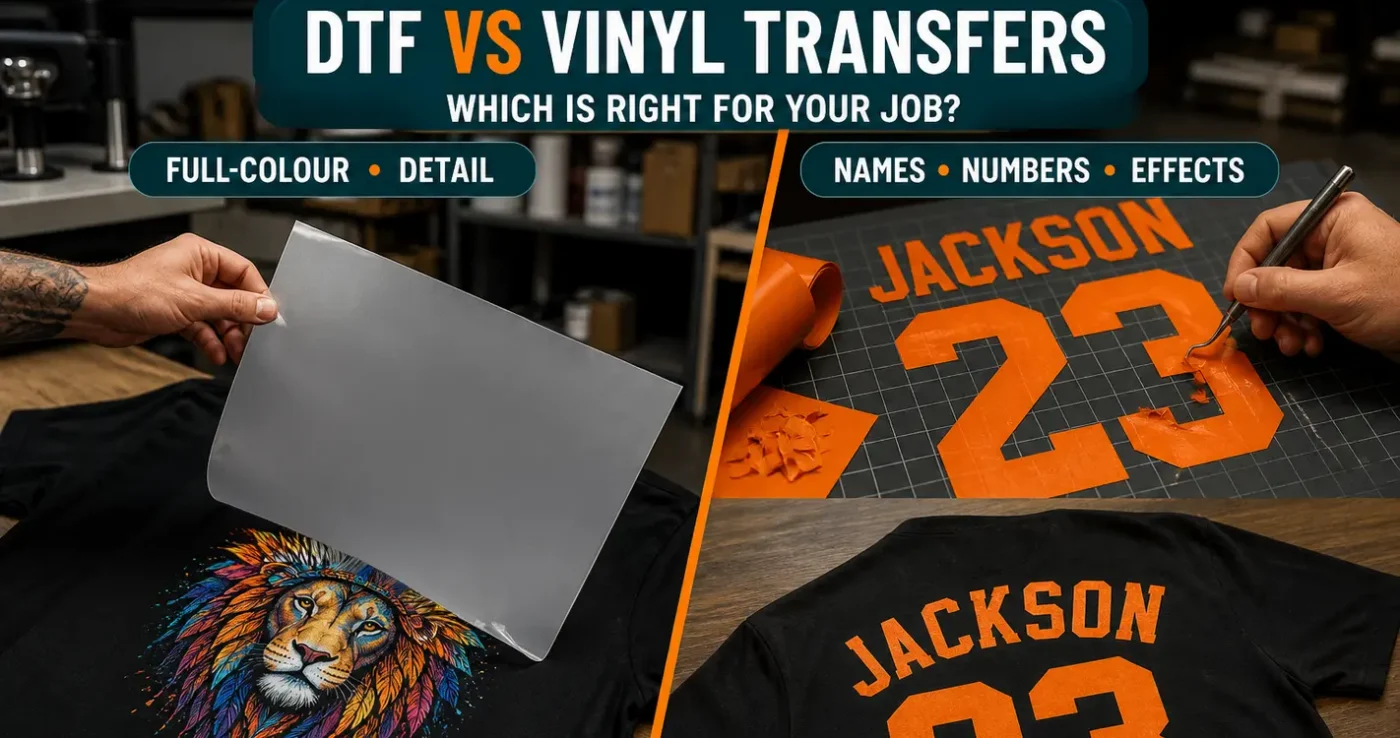
DTF transfers usually suit detailed, full-colour artwork, while cut heat transfer vinyl is often a practical choice for simple names, numbers and material effects. Both can produce professional T-shirts, workwear and merchandise. The better option depends on your design, garment, deadline and the work involved in preparing each print.
A photograph and a single-colour player number need very different production steps. Comparing those steps is more useful than choosing a method based on claims that it is always cheaper, softer or longer lasting.
This guide explains the differences between direct-to-film (DTF) transfers and cut heat transfer vinyl (HTV), with examples to help you choose for your next order.
TL;DR
- Choose DTF for photographs, gradients, detailed logos and designs that would be difficult to cut and weed.
- Consider cut HTV for bold lettering, large names and numbers, or finishes such as flock and puff.
- DTF does not need weeding. Transfers arranged on a gang sheet still need cutting apart.
- Count your labour. Cutting, weeding and aligning several vinyl colours can cost more time than the material itself.
- Test the actual garment. Neither method automatically suits every fabric or produces the same feel and durability.
- You do not need a DTF printer. You can buy ready-to-press transfers and apply them with suitable equipment.
DTF and cut HTV at a glance
| Factor | DTF transfers | Cut HTV |
|---|---|---|
| Design strengths | Full-colour images, gradients and intricate shapes | Solid-colour lettering, bold shapes and selected material effects |
| Artwork preparation | A print-ready file at the correct size | Clean cut paths that the cutter and material can reproduce |
| Weeding | No removal of unwanted material within the design | Excess material and spaces inside letters must be removed |
| Multiple colours | Printed together as one transfer | Usually separate cut pieces requiring alignment |
| Equipment when buying transfers | Suitable application equipment and basic positioning tools | A cutter and weeding tools if preparing the vinyl yourself, plus application equipment |
| Main time consideration | Supplier production and delivery, then separating and pressing transfers | Cutting, weeding, positioning and any additional application stages |
| Feel and durability | Depend on the transfer, coverage, garment, application and care | Depend on the HTV product, coverage, garment, application and care |
What the two methods involve
In this comparison, “vinyl” means cut heat transfer vinyl for garments. Printable HTV is a separate category that can carry full-colour images through a compatible printing and cutting process. Adhesive sign vinyl is different again and should not be substituted for garment HTV.
What is a DTF transfer?
DTF stands for direct to film. The design is printed onto a carrier film using colour and white ink, then prepared with an adhesive system and cured. The finished transfer is applied to a garment using controlled heat, time and pressure.
The image transfers to the fabric and the carrier film is peeled away at the stage specified for that product. You do not need to cut around each letter or remove the spaces inside the design.
Our introduction to direct-to-film T-shirt printing explains the process in more detail.
What is cut heat transfer vinyl?
Cut HTV starts as a coloured or effect material on a carrier sheet. A cutter follows the artwork’s paths, cutting the material while leaving the carrier intact. The operator then removes unwanted material, including spaces inside letters. This step is called weeding.
The remaining design is positioned on the garment and heat applied. The carrier keeps the separate letters and shapes together during positioning. Cutting orientation, mirroring, press settings and peel timing must follow the instructions for the particular HTV.
Cut HTV remains a useful professional process, especially for teamwear lettering and designs that use a specific colour, texture or raised finish.
Artwork, colour and fine detail
DTF generally makes complex designs easier to produce because the detail is printed rather than cut and weeded. An illustration with many small shapes can be transferred as a complete image.
That does not make every file suitable for DTF. Small isolated details still need enough area to print and adhere reliably. Poor resolution and unwanted backgrounds remain visible in the finished result.
For our DTF orders, prepare a transparent PNG at 300 DPI at the intended print size, crop away unnecessary empty space and check the current artwork requirements. Artwork is printed as supplied, so check spelling, dimensions and transparency before ordering.
For cut HTV, the cutter needs paths it can follow. Clean vector artwork is a useful starting point, but a vector file can still contain tiny shapes, overlapping paths or detail that is impractical to weed. Test cutting helps confirm that the artwork and material work together.
Photographs, gradients and solid colours
DTF is usually the simpler choice for photographs, shading and colour blends. The colours are printed together, avoiding the need to rebuild the image from separate pieces of material.
Ordinary solid-colour cut HTV uses colours manufactured into the material. This works well for bold lettering and simple logos, but it cannot reproduce photographic tones as a single cut layer. Adding colours generally adds cutting, weeding and positioning steps.
Neither method guarantees an exact match to a screen colour. For critical branding, approve a physical sample: DTF has a printable colour range, while cut HTV is limited to the available material colours.
Preparation, equipment and turnaround
The main difference in day-to-day production is how the design reaches the heat press.
Using ready-to-press DTF
- Prepare and size the artwork, then order the transfers.
- Cut individual transfers apart if they arrive on a gang sheet.
- Prepare the garment and position the transfer.
- Apply, peel and finish using the correct instructions for the transfer.
There is no weeding inside the artwork. However, arranging gang sheets, separating transfers, checking placement and pressing each garment still take time. Follow our transfer fitting instructions for the product you order.
Preparing cut HTV
- Prepare the cut paths, size the design and mirror it where required.
- Load the correct material and perform a test cut.
- Cut the design and weed the unwanted material.
- Repeat for any additional colours, then align and apply the components as instructed.
Some multicolour designs can be assembled with pieces beside each other; others involve layering or multiple press stages. Follow the material manufacturer’s guidance. Not every HTV is suitable for layering.
What equipment do you need?
Buying ready-to-press DTF transfers lets you offer detailed prints without running a DTF printer. Preparing cut HTV yourself adds a cutter, compatible software, blades, weeding tools and stocks of the colours you use.
A suitable heat press provides controlled application for commercial work. Some products also have household-iron instructions, but that approval is specific to the product. Do not apply one material’s iron or heat-press settings to another.
Producing DTF transfers in-house is a separate investment involving printing, adhesive application, curing, maintenance and an appropriate workspace. If you are comparing startup options, read our guide to starting a T-shirt business with purchased DTF transfers.
Which is faster?
For one urgent name, stocked HTV and an available cutter can be convenient. For a detailed batch, DTF can save substantial preparation time once the transfers arrive.
Include supplier production and delivery in your DTF schedule. For vinyl, include weeding and alignment rather than estimating from cutting time alone. Keep records of approved artwork, dimensions, garment and application settings to make repeat orders easier.
Names, numbers and personalisation
Both methods can handle changing names and numbers. Large single-colour lettering is often straightforward to cut in HTV, while multicolour names, sponsor graphics or detailed personalised designs may be easier to produce with DTF.
A team order can use both: DTF for the detailed front crest and cut HTV for bold back numbers. Check that the materials tolerate the application sequence and any repeated heat exposure.
Using two materials in separate positions is different from layering one directly over the other. Only layer products when that combination is supported and tested.
Print feel and speciality finishes
Neither method has one fixed feel. A small print with plenty of open space behaves differently from a large solid panel, even when both use the same transfer product.
Thin HTV can feel light and flexible. Thick, flocked or raised materials are deliberately more noticeable. DTF also varies with ink and adhesive coverage, the artwork and the garment beneath it. Large solid areas can restrict airflow with either method.
Compare samples at the intended print size. A small chest logo will not tell you how a full-front design will feel.
When the finish matters most
Cut HTV offers material effects such as flock, puff, glitter and metallic finishes. DTF also has speciality options, so standard DTF versus standard vinyl is not the whole comparison.
Our speciality DTF range includes metallic gold and silver, glitter, glow in the dark, neon, pearl and reflective finishes. These are supplied as sheets, not gang sheets, and use cold-peel instructions. Check the individual product before ordering and test the intended artwork and fabric.
For any effect, judge a physical sample where possible. A picture on a screen cannot fully show texture, reflectivity or changes under different lighting. Browse the available DTF transfer products to compare the current options.
Fabric suitability and durability
Both processes can work on cotton, polyester and blends when the chosen material is suitable. That does not mean every DTF transfer or vinyl product works on every garment.
For example, Siser lists cotton, polyester and cotton/polyester blends among the compatible fabrics for its EasyWeed HTV. That is a specification for a named product, rather than approval for all vinyl materials.
Check heat sensitivity, stretch, coatings and the garment’s intended use. Polyester may show heat marks or dye migration, where garment dye discolours the decoration. Lower heat alone is not a universal solution; the transfer or HTV must still bond correctly and suit the fabric.
Nylon, water-repellent finishes and heavily textured garments need particular attention. Test the actual garment style and colour, and use the T-shirt fabric guide to understand the main fabric differences.
Which lasts longer?
Good DTF and suitable HTV can both wear well. There is no reliable category-wide wash count or automatic winner. Material quality, garment compatibility, application, artwork coverage and laundering all affect the result.
Follow the specific care instructions for the decoration and garment. If wash performance matters to an order, test an applied sample under the intended care conditions before committing to the full run.
Which method costs less?
Compare the cost of producing the finished garment, including your time. A low material price does not necessarily make an intricate vinyl design inexpensive to produce.
Decoration cost per garment = materials + preparation labour + application labour + allocated delivery, equipment and spoilage costs.
For DTF, include the transfer area, gang-sheet layout, freight, separating the transfers and pressing. For cut HTV, include material use, test cuts, cutting, weeding, alignment and each required application stage.
As an illustrative calculation, four minutes of preparation at a labour rate of $30 per hour adds $2 per garment before material and pressing costs. Time a real sample to find your own figure.
A single simple name made from vinyl already in stock may be economical. A detailed six-colour illustration may favour DTF because it avoids multiple cut components. There is no fixed order quantity at which one method becomes cheaper for every design.
For larger runs of the same artwork, it can also be worth comparing DTF and screen printing.
Include material use and mistakes
HTV produces weeded material and offcuts; DTF uses carrier film and can leave unused space in a gang-sheet layout. Both can waste garments through application errors. Efficient layouts, useful offcuts and a tested sample can reduce waste, but neither process is automatically waste-free.
Choosing for common jobs
| Your project | Start by considering | Reason |
|---|---|---|
| Photographic or illustrated T-shirt | DTF | Colour blends and detail are printed together. |
| One large name and player number | Cut HTV | Bold single-colour lettering is usually straightforward to cut and weed. |
| Small detailed business logos | DTF | Avoids weeding many small shapes, provided the details meet print requirements. |
| Raised puff or flock lettering | A suitable speciality HTV | The chosen material creates the texture. |
| Team crest plus large back numbers | DTF, HTV or a combination | Choose separately for the detail, lettering and total labour. |
| Metallic or reflective decoration | Physical samples of suitable products | Appearance and application requirements vary within both categories. |
| Stretch or heat-sensitive garments | Product-specific testing | Fabric compatibility matters more than the process name. |
Before you commit to an order
Confirm the final artwork size, garment style and colour, quantity, personalisation, required finish and deadline. Then compare a sample for appearance, feel, preparation time and care performance. This gives you a useful basis for choosing and quoting the job.
Frequently asked questions
Is DTF better than heat transfer vinyl?
DTF is often more practical for full-colour artwork and intricate designs. Cut HTV can be a better fit for simple names, numbers and particular textures. The right choice depends on the actual job.
Does DTF need weeding?
No. You do not remove material from inside the printed design. If several designs share a gang sheet, you still need to cut the individual transfers apart before applying them.
Is DTF the same as printable vinyl?
No. DTF transfers a printed ink and adhesive design from a carrier film. Printable HTV uses a printable heat-transfer material and a compatible printing workflow, often with contour cutting and weeding.
Can I use a PNG file for cut HTV?
A PNG contains pixels rather than cut paths. Cutting software may be able to trace it, but the result needs checking and cleaning before cutting. A print-ready DTF file is not automatically a cut-ready vinyl file.
Can DTF and vinyl both go on polyester?
Yes, when the specific product is suitable and testing confirms the result. Check heat sensitivity, dye migration and stretch instead of relying only on the garment’s fibre label.
Which method feels softer?
It depends on the material and the design’s size and coverage. Compare the actual products on the intended garment rather than assuming that all DTF or all HTV feels the same.
Can I apply these transfers with an iron?
Only use an iron when the particular product includes that application method. Follow its instructions. A suitable heat press offers more controlled application for repeat production.
Do I need to buy a DTF printer?
No. You can order ready-to-press transfers and apply them yourself. Running a DTF printer is a separate production commitment with additional equipment and maintenance.
Choose around the design and the work involved
DTF makes detailed artwork easier to handle, while cut HTV remains useful for simple lettering and distinctive materials. The best result comes from matching the process to the garment and counting all the preparation involved.
If DTF suits your artwork, you can order a custom DTF gang sheet with your designs arranged for printing. For help understanding the ordering and application process, read our complete DTF transfer printing guide.
