
Ordering and Gang Sheets
DTF Transfer Printing: How to Choose the Right Transfer
Aug
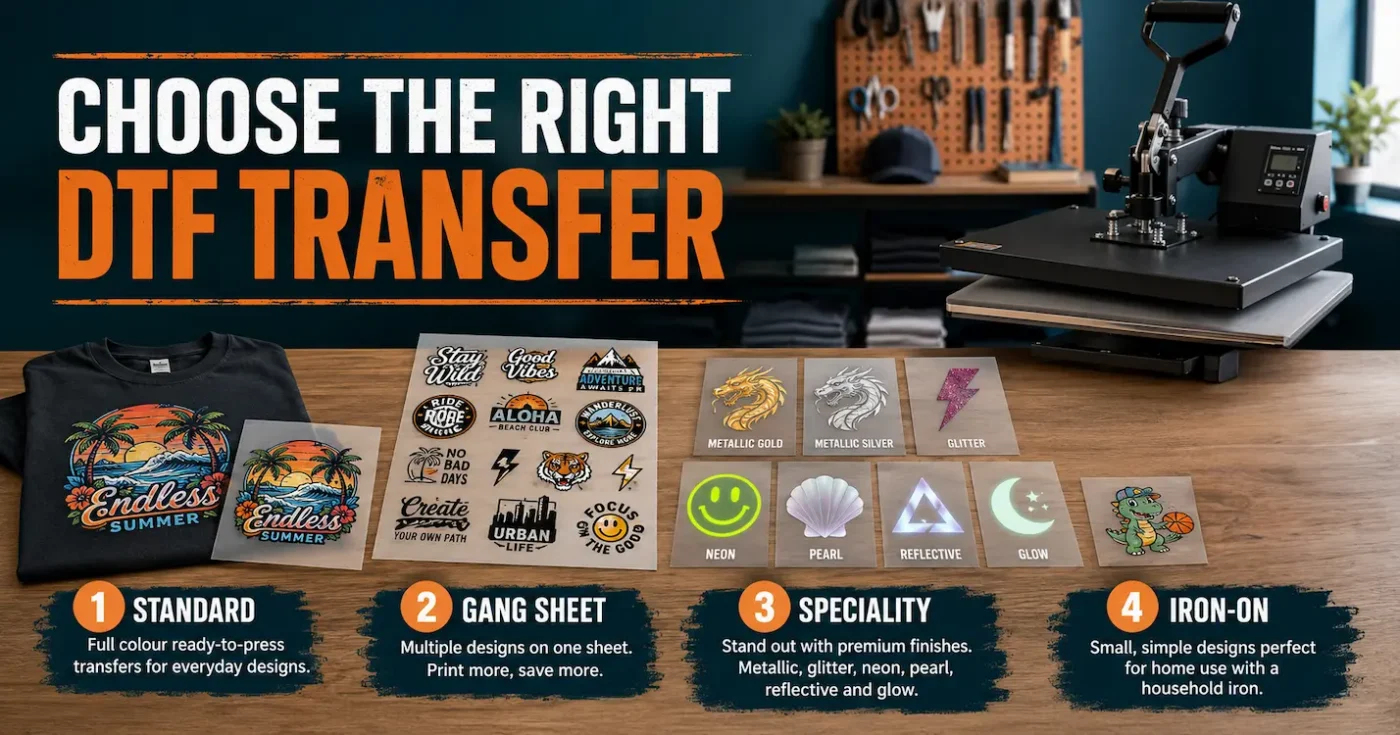
DTF transfer printing gives you several ways to add full-colour artwork to garments, but the best product depends on your design, quantity, fabric, equipment and required finish. Standard ready-to-press transfers suit most everyday heat-press projects. Gang sheets make efficient use of film when you need several designs. Speciality transfers add effects such as metallic, glitter or glow, while our separate iron-on range is designed for customers working without a professional heat press.
Quick answer: Choose a standard single sheet for a small or simple order, a gang sheet when you can fill a longer sheet with multiple transfers, a speciality sheet when the finish is the main feature, or an iron-on product when you only have a household iron. Standard and speciality ready-to-press transfers should be applied with a suitable heat press.
Contents
What is DTF transfer printing?
Direct-to-film, usually shortened to DTF, is a digital garment-decoration process. Artwork is printed onto coated film using colour and white ink. A compatible adhesive is applied and cured during production. The completed transfer is then positioned on a garment and applied with controlled heat, pressure and time.
The white ink layer allows DTF artwork to remain visible on both light and dark garments. Because it is a digital process, DTF can reproduce full-colour designs, photographs, gradients, fine lettering and multiple colours without creating a separate screen for every colour.
That does not mean every design should be printed in exactly the same way. A large solid rectangle, for example, will generally feel heavier and less breathable than artwork containing open space. A tiny logo may fit comfortably on a standard sheet, while dozens of repeat logos may be much more economical on a gang sheet. Choosing the right format is part of getting a good result.
Which DTF transfer should you choose?
| Transfer option | Best suited to | Peel method | Important limitation |
|---|---|---|---|
| Standard single sheets | Small orders, individual designs and customers who do not need a long gang sheet | Insta-Peel: hot peel on cotton/most fabrics; cold peel on polyester | Requires a suitable heat press |
| Gang sheets | Repeat logos, mixed artwork and businesses wanting to maximise the printable film area | Insta-Peel: hot peel on cotton/most fabrics; cold peel on polyester | The customer must prepare and check the complete layout |
| Speciality sheets | Designs where metallic, glitter, glow, neon, pearl or reflective appearance is central | Cold peel | Sheets only; no speciality gang sheets |
| Iron-on DTF transfers | Home users without a commercial heat press | Follow the instructions supplied with the particular film | A domestic iron is less consistent than a heat press |
Standard ready-to-press DTF transfers
Standard transfers are the everyday choice for full-colour logos, illustrations, photographs and text. They can be applied to common garment fabrics including cotton, polyester and many cotton-polyester blends, subject to testing the particular garment.
Our standard Insta-Peel film is designed to release immediately after the first press. This speeds up production because the operator does not need to wait for every transfer to cool before removing the carrier film. A final covered press completes the application.
A standard sheet is often the easiest choice when you need one larger design, several copies that fit conveniently on the sheet, or a small order where building a longer layout would add unnecessary work. Browse the current choices in our DTF transfer shop.
Standard DTF works particularly well for:
- full-colour business and club logos;
- short runs with multiple print colours;
- photographic and illustrated artwork;
- names, numbers and personalised garments;
- dark garments requiring a white base; and
- mixed cotton, polyester and blended garment orders.
When to reconsider the artwork
DTF creates a printed layer on top of the garment. Very large areas of solid ink can feel warmer and less flexible than a design broken up with negative space. Where the artwork allows it, removing unnecessary backgrounds or using intentional gaps can make a large print feel lighter without losing its visual impact.
DTF gang sheets for multiple designs
A gang sheet places several transfers on one longer printable sheet. It can contain repeated copies of one logo, different sizes of the same design or a mixture of unrelated artwork. Gang sheets are often the most efficient choice when you can make productive use of most of the available film area.
They are useful for clothing brands, screen printers, promotional-product businesses, market sellers and anyone holding transfers for later production. Read our cornerstone guide to building and ordering a gang sheet of DTF transfers before preparing your first layout.
Gang sheets work well when:
- you need many copies of a small chest logo;
- one design is required in several garment sizes;
- you want to combine front, back, sleeve and label transfers;
- you regularly press orders and can keep spare transfers for later; or
- you can fill the width and length without leaving large unused spaces.
Your uploaded gang sheet is printed as supplied. Check the page size, artwork size, spacing, transparency, orientation and quantity before ordering. Leave enough room to cut safely between designs. Do not rely on the printer to rearrange, resize or proof each element as part of a budget gang-sheet service.
Speciality DTF transfer sheets
Speciality finishes are designed for projects where the visual effect matters as much as the artwork. Our current speciality range includes:
- Gold Foil;
- Silver Foil;
- Glitter;
- Glow in the Dark;
- Neon Yellow, Neon Green, Neon Pink and Neon Orange;
- Pearl; and
- Reflective.
Every speciality option is supplied as a sheet transfer and is cold peel. Speciality gang sheets are not available. Wait until the transfer is completely cold before peeling and follow the instructions for the particular finish.
These products also require more planning and testing than a standard transfer. The film, artwork colour and viewing conditions can all influence the finished effect. Glow in the dark is a good example: light-coloured artwork generally glows more effectively, while black and dark navy areas will not glow as strongly. Read our glow-in-the-dark transfer guide before creating production artwork.
Our pearl-finish guide explains another finish that changes as it catches the light. You can compare the entire range in the overview of speciality DTF finishes.
Test before production: Speciality transfers can be more demanding to fit than standard DTF. Test the actual artwork, garment and heat press combination before committing to a production run. We print the file supplied and do not assess whether its colours or construction will produce the effect you imagined.
Transfers made for home ironing
Our standard ready-to-press products are intended for a suitable heat press. A heat press controls temperature, time and pressure across the design far more consistently than a household iron.
Customers without a heat press should select a product from the separate iron-on DTF range. These transfers are made for application with a household iron, Cricut-style press or conventional heat press. They can still carry full-colour artwork; “iron-on” describes the application option, not a limitation to one-colour or simple designs.
As a starting point for a household iron, set it to approximately 135–145°C with steam off, and work on a firm, flat, heat-resistant surface rather than a padded ironing board. Cover the transfer with baking paper and press straight down with firm, even pressure for about 10 seconds per section, overlapping each placement. Do not slide the iron backwards and forwards as though ironing clothing. Let the transfer cool for about 30–60 seconds before peeling, then finish with a 10–15 second press per section under baking paper. Full steps are in our iron-on fitting instructions.
Domestic irons vary considerably and may cycle between hotter and cooler areas. Test first, especially on valuable garments. If you plan to produce garments regularly, a reliable heat press will normally give more repeatable results.
Match the transfer to the garment and print position
The transfer is only one part of the job. Fabric construction, coatings, seams, pockets and garment dyes can all affect application.
Cotton
Cotton T-shirts are a common and forgiving DTF application. Pre-press until the garment stops releasing steam, because stored moisture can interfere with the bond. Large solid prints may feel warmer on heavier or tightly woven garments, so consider negative space when designing.
Polyester
Polyester is heat sensitive and some garment dyes can migrate into a print. Start with the recommended lower-temperature polyester setting and test for marking, scorching, shrinkage and dye movement before production.
Cotton-polyester blends
Blends often accept DTF well, but the correct starting point depends on the garment’s polyester content, finish and heat tolerance. Treat an unfamiliar blend as a new substrate and test it.
Hoodies and sweatshirts
Thicker garments can hide seams, drawcords, zips and pocket edges beneath the print area. These create uneven pressure. Use suitable pressing pillows or supports where required, and see our guide to DTF printing on hoodies and sweatshirts.
Caps, bags and difficult fabrics
Curved surfaces need the right platen and support. Water-resistant coatings, nylon, highly elastic fabric and heavily textured material may not accept a standard transfer reliably. Test the actual item rather than assuming that every product with the same fibre label will behave identically.
Our guide to T-shirt fabrics can help you choose a garment before ordering transfers.
Prepare artwork for reliable DTF printing
The quality of the transfer begins with the supplied file. For our service, prepare:
- a PNG with a genuinely transparent background;
- artwork at 300 DPI at the final print size;
- a tightly cropped canvas without unnecessary transparent space;
- a file no larger than 254 MB; and
- lines and isolated details at least 4 pixels, or approximately 1 mm, thick.
Do not use a white rectangle to imitate transparency. Any visible background in the file can print. Avoid screenshots, images copied from social media and small web graphics enlarged beyond their available detail.
For step-by-step file preparation, see our guide to creating print-ready DTF artwork with Photopea.
We print the artwork supplied. This keeps the service affordable, but it means the customer is responsible for checking spelling, dimensions, resolution, colour choices, background transparency, layout and suitability for the intended finish.
Starting heat-press settings for standard Insta-Peel transfers
The settings below apply to our standard Insta-Peel transfers. They are starting points, not a guarantee for every heat press and garment.
| Garment | Temperature | First press | Pressure and peel | Final press |
|---|---|---|---|---|
| Cotton | 140°C | 8–10 seconds | Firm; peel immediately while hot | 10 seconds with a suitable cover sheet |
| Polyester | 120°C | 30 seconds | Firm; cold peel only — cool completely before peeling | 10 seconds with a suitable cover sheet |
Pre-press the garment and check for steam. If steam remains, repeat until the garment is dry. Measure the actual platen temperature where possible and make sure seams or raised areas are not preventing even pressure. Test the exact transfer, press and garment before moving into production.
For additional application guidance, read our DTF transfer tips and tricks.
A simple DTF transfer ordering decision
- What equipment will you use? Choose the separate iron-on range if you only have a household iron. Choose standard or speciality ready-to-press transfers if you have a suitable heat press.
- Do you need a special visual effect? Select a speciality sheet and follow its cold-peel instructions. Otherwise continue with standard DTF.
- How many designs can you fit efficiently? Use a gang sheet for numerous repeat or mixed designs; use a standard single sheet when it is simpler and more practical.
- Is the garment suitable? Check its fabric, coating, heat tolerance, seams and print position.
- Is the artwork ready? Confirm transparency, resolution, final size, minimum detail and layout.
- Have you tested? Test the exact combination before pressing an entire order.
Compare our current DTF transfer options and select the product that matches your artwork, quantity and application equipment.
Frequently asked questions about DTF transfer printing
What is the best DTF transfer for a small order?
A standard single sheet is often the simplest option when you need one design or a small number of transfers. Compare the usable sheet area with your finished artwork dimensions before ordering.
When is a DTF gang sheet better value?
A gang sheet is usually most efficient when you can fill most of the available width and length with repeat logos, different sizes or mixed artwork. Leaving large unused sections reduces its advantage.
Can speciality transfers be ordered as gang sheets?
No. Gold Foil, Silver Foil, Glitter, Glow in the Dark, Neon, Pearl and Reflective transfers are available as sheets only. They are cold peel and require testing before production.
Can I apply standard DTF transfers with a household iron?
Our standard ready-to-press transfers require a suitable heat press. If you do not have one, choose a product from the separate iron-on DTF range.
Can DTF be applied to cotton and polyester?
Yes, DTF is commonly used on cotton, polyester and blends. However, garments vary in dyes, coatings, construction and heat tolerance, so test the actual product before production.
Do I need to mirror my uploaded artwork?
Follow the upload instructions for the product you are ordering. Do not mirror or otherwise alter the file unless the product page specifically tells you to do so, as production software may handle orientation.
Why can a large DTF print feel heavier?
DTF leaves a printed layer on the surface of the fabric. A large solid block contains more ink and adhesive than an open design, so using transparent areas or negative space can improve flexibility and breathability.
Does DTF Transfers Australia check my artwork?
Our budget printing service prints the supplied file. Customers are responsible for checking artwork quality, spelling, size, transparency, layout and suitability before ordering.
