
Running a Print Business
How to Sell Custom T-Shirts at Tourist Destinations
Oct
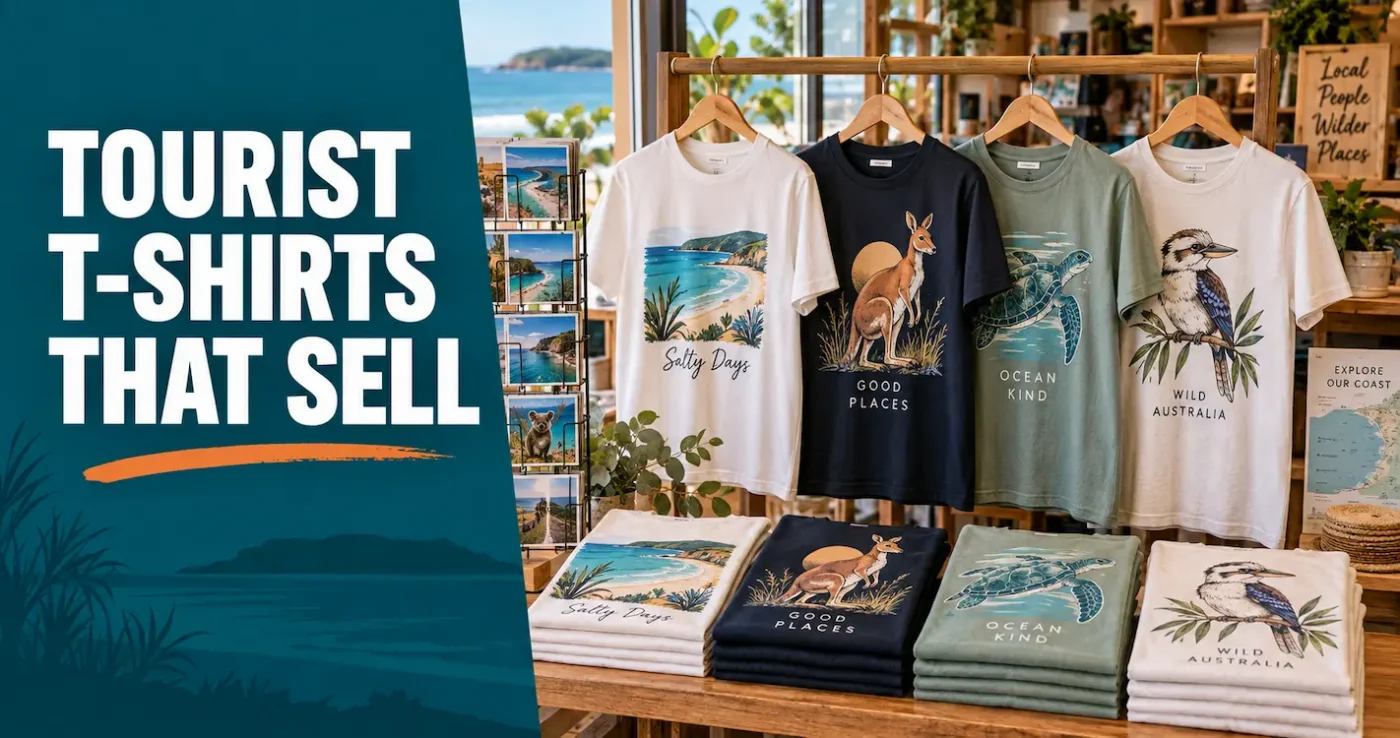
Short answer: Custom T-shirts can be a strong souvenir product when the design captures something specific about the destination and the retailer controls stock carefully. Ready-to-press DTF transfers let a tourism business test several designs, colours and sizes without purchasing a DTF printer or committing to a large run of finished garments. The best starting point is usually a small, distinctive range, a reliable heat press and a clear system for tracking what actually sells.
Why tourist T-shirts sell
A good destination T-shirt does more than name a place. It gives the visitor a wearable reminder of an experience: the beach they visited, the trail they completed, the animal they saw, the pub they discovered or the event they attended. That emotional connection is what separates a useful souvenir from a generic shirt with a town name added to it.
T-shirts also have practical advantages for tourism retailers. They are easy for travellers to pack, available across a wide range of sizes and suitable for adults, children and groups. A distinctive shirt continues to promote the destination or business whenever it is worn after the trip.
That does not mean every design will sell. Destination merchandise still needs the right artwork, garment, price, sizing and display. The commercial opportunity comes from testing those elements without tying up too much cash in finished stock.
Which businesses can sell tourist T-shirts?
A tourist T-shirt range is not limited to traditional souvenir shops. It may suit:
- visitor attractions, wildlife parks and museums;
- tour operators, surf schools and outdoor-adventure businesses;
- caravan parks, resorts, hostels and independent accommodation;
- cafes, breweries, pubs and restaurants with a recognisable local following;
- farm gates, markets and regional gift shops;
- festivals, races, reunions and seasonal events; and
- community organisations raising funds through locally themed merchandise.
The strongest candidate is usually a business that already has foot traffic, a story customers remember and somewhere suitable to display a sample. Merchandise works best as an extension of the experience rather than an unrelated product added beside the register.
Designing a shirt people want to wear
The design should be recognisable to someone who visited the destination, but attractive enough to wear at home. A customer may enjoy a novelty souvenir in the shop and still decide not to buy it if the artwork feels too loud, too generic or difficult to coordinate with everyday clothing.
Start with what is genuinely distinctive
Build ideas around details visitors actually notice: a view, local phrase, walking track, building, activity, animal, landscape, weather pattern or part of the business’s own story. Specific details usually create a stronger connection than broad themes such as “Australia”, “beach” or “holiday”.
A compact range might include:
- a core destination design that remains relevant all year;
- an activity-based design for surfing, fishing, hiking, camping or touring;
- a restrained humorous design based on a genuine local observation;
- a children’s design with age-appropriate artwork and sizing; and
- a limited event or seasonal design that carries a year or date when that detail adds meaning.
Design for the garment, not just the screen
Fine detail, low contrast and large solid blocks may look appealing on a monitor but behave differently when printed and worn. Check the artwork at its intended print size. Keep important lettering easy to read, use enough contrast against the garment and avoid isolated details smaller than approximately 4 pixels or 1 mm.
For DTF Transfers Australia, the preferred artwork is a tightly cropped transparent PNG at 300 DPI at the intended print size, with a maximum file size of 254 MB. Files are printed as supplied, so the customer must check spelling, dates, transparency, stray pixels, orientation and colours before ordering. The DTF artwork FAQ explains the preparation requirements in more detail.
How to plan a small starting range
A common mistake is launching too many designs across too many garment colours and sizes. Even four designs offered in two colours and eight sizes create 64 possible finished products. That can consume shelf space and cash before there is any sales history.
- Define the first customer. Decide whether the range is mainly for adult holidaymakers, families, tour groups, children, locals or event participants.
- Select two or three strong designs. Give each design a distinct purpose rather than producing minor variations of the same idea.
- Limit the garment colours. One light and one dark option can be enough to test demand, provided the artwork has been prepared for both.
- Choose dependable blanks. Consider fit, fabric, available sizes, repeat supply and how the garment responds to heat—not just the cheapest unit price.
- Produce and wash-test samples. Check print appearance, placement, comfort, application and laundering before offering the product to customers.
- Create simple SKU records. Record design, garment style, colour and size so sales can guide reordering.
If you are new to apparel, our guide to starting a T-shirt business with DTF transfers covers the broader setup decisions.
Choose the right stock model
The right production model depends on daily sales, available staff, storage and how quickly customers expect to leave with the garment.
| Stock model | How it works | Main advantage | Main limitation |
|---|---|---|---|
| Pre-printed stock | Finished shirts are produced before sale. | Customers can buy and leave immediately. | More money is tied up in sizes, colours and designs. |
| Print to order | A blank garment is pressed after the customer chooses. | Lower finished-stock risk and more customer choice. | Requires equipment, trained staff and production time. |
| Hybrid | Best-selling options are pre-printed; slower combinations are made as needed. | Balances fast service with flexible stock. | Needs clear stock records and an organised pressing area. |
For many small tourism businesses, the hybrid model is a sensible starting point. Display finished samples and keep a modest quantity of common sizes ready to sell, while holding blank garments and transfers for less predictable combinations. Do not promise on-the-spot printing unless trained staff and a safe production area are consistently available.
A practical DTF production workflow
Ready-to-press DTF transfers allow a business to offer full-colour artwork without owning, maintaining or learning to operate a DTF printer. You still need a suitable heat press, accurate application settings and a repeatable quality-control process.
- Finalise and check the artwork at the exact print size.
- Group repeat designs efficiently on a DTF gang sheet where the artwork and required quantities make that practical.
- Order a small test quantity before committing to a larger range.
- Match each transfer to the correct blank garment and record the tested settings.
- Pre-press the garment until no steam remains.
- Position and press the transfer consistently.
- Inspect the edges, adhesion, placement and garment condition before the shirt reaches the display.
For standard Insta-Peel transfers, useful starting settings are 140°C for 8–10 seconds with firm pressure on cotton and suitable standard fabrics, followed by an immediate hot peel and a 10-second final press. For polyester, start at 120°C for 30 seconds with firm pressure, cold peel only, then final-press for 10 seconds at 120°C. These are starting points, not guarantees. Always test on a spare garment first — heat presses and fabrics vary. Heat presses, fabrics, coatings, dyes and garment batches vary, so test the exact combination before production and follow the current transfer fitting instructions.
DTF can work across many cotton, polyester and blended garments, but the decoration area must tolerate heat and pressure. Seams, zips, buttons, waterproof treatments, sublimated polyester and other difficult constructions may require different testing or may not be suitable.
Pricing for a sustainable margin
Do not set the retail price by adding a small amount to the blank shirt and transfer. The true cost includes labour, payment fees, wastage, packaging, rent, display space, replacement stock and the risk of sizes that sell slowly.
A simple starting calculation is:
Blank garment + transfer + application labour + packaging + expected wastage + business overhead allocation = landed product cost.
The selling price then needs to leave enough gross margin to support the business. If the product is also supplied to accommodation providers, tour operators or other retailers, calculate the wholesale price and the final retailer margin before committing to the range. Our guide to pricing printed T-shirts provides a more detailed framework.
Premium garments can support a higher selling price when customers can feel and see the difference. However, “premium” should describe a genuine improvement in fabric, construction, fit or presentation—not simply a higher price.
How to display and sell the range
Tourists may have limited time and luggage space, so make the purchase easy to understand. Display one finished sample of each design at eye level, show the available colours clearly and keep the size options simple. Folded stock should be labelled so staff do not need to unfold every garment to find a size.
A short story card can explain what inspired the artwork, who created it and why it belongs to that place. That context is more persuasive than a generic “local souvenir” sign. Staff wearing the shirts can also help customers see the garment as normal apparel rather than a novelty item.
Other practical ideas include:
- placing the range near the point where the relevant experience ends;
- showing a clear size guide;
- offering a simple adult-and-child pairing rather than a complicated bundle;
- using a QR code to a reorder page for travellers who decide later; and
- photographing the actual garment rather than relying only on a digital mock-up.
Groups, events and wholesale opportunities
Tour groups, school trips, family gatherings, tours and events can create larger orders, but they need a different workflow from walk-in souvenir sales. Set a clear order deadline, confirm sizes in writing, approve the artwork before production and collect payment or a deposit under your normal terms.
Personalisation can add value, but every variable—such as a name, date or group number—also adds artwork and production risk. Use a structured order form and require the organiser to approve the final spelling and quantities.
Local wholesale partnerships may also expand the range beyond your own premises. A cafe, caravan park or tour operator might prefer a small exclusive design rather than the same shirt sold everywhere. Agree on minimum quantities, reorder timing, who owns the artwork and whether the design is exclusive before production begins.
Copyright, culture and Australian-origin claims
A local theme does not automatically make artwork free to use. Photographs, illustrations, logos, character artwork, event branding and tourism slogans may be protected by copyright or trade marks. Create original artwork, obtain the necessary licences and keep records of permissions. IP Australia provides an Australian Trade Mark Search, and our guide explains how to reduce copyright problems in T-shirt designs. This is general information rather than legal advice.
Do not imitate Aboriginal or Torres Strait Islander art, symbols or stories to make merchandise look more “Australian”. Work with appropriately authorised First Nations artists and agree on attribution, payment, licensing and permitted uses. The Indigenous Art Code provides guidance aimed at fair, ethical and respectful trade.
Be equally careful with claims such as “Australian made”, “locally made” or “made in Queensland”. Printing or pressing an imported blank in Australia does not automatically make every origin claim appropriate. The ACCC states that country-of-origin claims must be true, accurate and based on reasonable grounds. Describe the process precisely—for example, “printed in Brisbane on an imported garment”—when that is the clearest truthful statement. Review the ACCC’s country-of-origin guidance before using origin claims on labels, signage or product pages.
Measure, reorder and improve
The first range is a test, not a permanent commitment. Review sales by design, garment colour and size rather than relying on general impressions. A popular design with poor size availability can appear weaker than it really is, while a display sample may attract attention without producing sales.
Track:
- units sold by design, size and garment colour;
- sell-through time and reorder frequency;
- customer questions and requested sizes;
- returns, faults and application failures;
- sales by season, event or tour schedule; and
- the actual gross margin after wastage and discounts.
Reorder proven combinations, reduce the choices that create slow stock and refresh one part of the range at a time. This keeps the display interesting without discarding the sales history built around your strongest design.
Frequently asked questions
How many tourist T-shirt designs should a small shop start with?
Two or three well-separated designs are often more useful than a large first collection. Keep garment colours and sizes controlled, test actual demand and expand from sales evidence. The right number depends on foot traffic, storage, seasonality and whether shirts are pre-printed or made to order.
Do I need a DTF printer to make tourist T-shirts?
No. You can order finished, cured, ready-to-press transfers and apply them with a suitable heat press. This avoids the equipment, maintenance and production knowledge required to operate a DTF printing system, although pressing and testing still need to be handled correctly.
Are DTF gang sheets suitable for repeated souvenir designs?
They can be. A gang sheet lets you arrange multiple copies or sizes of artwork on a set film area. It is most efficient when the artwork is prepared correctly and the layout uses the available space well. Compare the required quantities and artwork sizes before choosing between a gang sheet and individual sheet transfers.
Should tourist shirts be printed before sale or made to order?
Pre-print enough stock to serve customers quickly, but consider keeping transfers and blank garments for less predictable sizes or designs. A hybrid system often gives a small retailer a useful balance between immediate availability and lower inventory risk.
What fabric is best for souvenir T-shirts?
There is no single best fabric for every destination. Cotton is familiar and comfortable, while polyester and blends may suit active or warm-weather uses. Choose based on the customer, climate, garment quality and tested compatibility with the transfer and heat-press settings. See our guide to different T-shirt fabrics for a broader comparison.
Can I use AI-generated artwork on tourist merchandise?
AI can help explore concepts, but the business remains responsible for the final design. Check for copied or confusingly similar elements, distorted details, incorrect local features, licensing restrictions and cultural concerns. Do not assume an image is commercially safe merely because a tool generated it.
How can I reduce unsold sizes?
Start with a limited range, track every sale and use a hybrid stock model. Keep more finished stock in proven sizes and hold blanks plus transfers for slower combinations where practical. Avoid guessing a large size distribution before you have evidence from your own customers.
Turn a destination into a wearable memory
A successful tourist T-shirt range begins with a specific local story, not a large stock order. Develop a few strong designs, test them on dependable garments, price them using the full landed cost and display them as part of the visitor experience. Ready-to-press DTF transfers can make that approach more flexible by separating the printed design from the finished-garment inventory.
When your artwork is ready, review the artwork requirements and explore ready-to-press DTF transfer options for your first tested range.
