
Artwork and Files
From Viral to Wearable: How Social Media Shapes T-Shirt Trends
Jul
How Social Media Shapes T-Shirt Trends: A Practical 2026 Guide
A T-shirt trend no longer needs a fashion house, retail buyer or seasonal catalogue to get started. It can begin with one creator, one visual idea or one community joke, then move through TikTok videos, Instagram Reels, Pinterest boards, group chats and online marketplaces within days.
That speed creates an opportunity for independent artists and small apparel businesses. It also creates risk. A post can collect thousands of views without producing a single sale, while a smaller niche community may quietly support the same design for years.
The useful question is not simply, “What T-shirts are trending?” It is: which signals show real demand, which ideas fit your audience, and how can you test them without filling a storeroom with unsold shirts?
This guide looks at current 2026 platform signals, practical trend research, copyright risks and a low-inventory DTF testing workflow. The goal is to help you respond quickly without copying other creators or gambling on hype.
TL;DR: Turning Social Trends into Sellable T-Shirts
- TikTok is powerful for rapid discovery, search-led questions, creator stories and community participation.
- Instagram helps turn an idea into a visual identity through Reels, carousels, styling, process content and customer photos.
- Pinterest is useful for earlier aesthetic signals and longer planning cycles; its trends often move more slowly than viral video.
- Marketplaces can show purchase intent, while social engagement often shows attention rather than demand.
- Current 2026 signals favour authenticity, human-made texture, personality, playful design, meaningful personalisation and emotionally relevant products.
- Do not copy viral artwork, celebrity images, logos, characters, song lyrics or trademarked phrases.
- Validate a trend across more than one source and test a small run before ordering garment stock.
- Measure saves, shares, product-page visits, add-to-cart activity and completed sales—not views alone.
- DTF sheets and gang sheets make short, mixed-design tests practical, but print quality still depends on correct artwork and pressing.
- Update this article as platform behaviour changes instead of publishing a new prediction post every year.
Why T-Shirt Trends Move Differently Now
Traditional fashion cycles were organised around seasons, wholesale orders and retail release dates. Social platforms operate continuously. A design can be discovered, remixed, criticised, photographed and forgotten before a conventional production order arrives.
Three changes are especially important for a T-shirt business:
Discovery is distributed
There is no single tastemaker. A large creator can trigger attention, but so can a local sports club, niche hobby group, artist, musician, workplace joke or small community with a shared identity.
The audience participates
People no longer just observe a trend. They duet it, style it, comment on it, request variations and adapt it to their own community. The comments may become more valuable than the original post because they reveal the words, colours or products people actually want.
Production can follow demand
Digital printing and ready-to-press transfers allow a business to test several designs in small quantities. That reduces the need to predict one winner months in advance, although it does not remove the need for good artwork, garment testing and realistic fulfilment.
How Different Platforms Shape T-Shirt Trends
Social media should not be treated as one audience. Each platform reveals a different stage of interest.
| Platform or source | What it is good at revealing | Useful T-shirt action | Main caution |
|---|---|---|---|
| TikTok | Rapid discovery, language, subcultures, questions, creator stories and reactions | Watch repeated phrases, comment requests and how people describe why they care | Views can be enormous while purchase intent remains weak |
| Styling, visual identity, creator credibility, process and customer proof | Test mock-ups, process Reels, carousels, colour choices and outfit combinations | A polished image may hide whether anyone would pay for the item | |
| Planning, colour palettes, aesthetics, occasions and longer-lived inspiration | Build mood boards and identify visual themes appearing across unrelated searches | Saves may represent future inspiration rather than an immediate purchase | |
| YouTube | Longer explanations, reviews, production processes and durable search interest | Show how artwork was developed, printed, pressed, worn and washed | Production requires more time, and audience growth may be slower |
| Facebook groups and communities | Local demand, clubs, events, professions, hobbies and direct questions | Listen for recurring needs and offer relevant, permission-based designs | Group culture and promotional rules must be respected |
| Online marketplaces | Search language, gifting occasions, personalisation and stronger buying intent | Compare listing language, reviews, gaps and seasonal search behaviour | Copying bestsellers creates legal risk and offers no lasting differentiation |
The strongest opportunity usually appears across several sources. A visual theme saved on Pinterest, discussed on TikTok and searched on a marketplace is a more useful signal than one isolated viral video.
Useful T-Shirt and Consumer Signals for 2026
These are broad directions, not instructions to copy a particular artwork. Translate them through your own audience, style and original creative work.
1. Authentic process over perfect performance
TikTok’s 2026 trend reporting describes a move towards reality, curiosity and emotional value. For apparel creators, that favours real process content: sketching, rejecting weak ideas, choosing garments, testing a press and showing the actual finished print. A perfect studio advertisement may attract less trust than an honest explanation of why a design exists.
2. Human-made texture in response to digital sameness
Etsy’s 2026 seller data highlights stitched, embroidered and visibly handmade texture, including strong growth around embroidered and crochet products. A DTF print should not pretend to be embroidery, but the broader signal can inspire original hand-drawn linework, scanned marks, visible texture, patch-inspired layouts and artwork that feels intentionally made by a person.
3. Whimsy, play and joyful self-expression
Quirky characters, unexpected combinations, cheerful colour and hobby-driven graphics provide an escape from overly polished minimalism. A strong whimsical design still needs visual discipline: one clear idea, readable hierarchy and an audience that understands the joke or mood.
4. Personalisation and meaningful keepsakes
Names, dates, places, teams, milestones and private references create emotional value that a mass-market graphic cannot easily reproduce. This can work for reunions, small clubs, birthdays, trips, workplaces, memorials and community events. Personalisation is not automatically good design; the information still needs careful spacing, spelling and approval.
5. Nostalgia remixed rather than copied
Pinterest’s 2026 forecast includes renewed Art Deco, romantic, analogue and glitch-influenced aesthetics. The opportunity is to learn from colour, geometry, composition and mood—not to reproduce a vintage advertisement, band logo, game character or another artist’s work.
6. Community identity and useful belonging
TikTok reports that community interaction and genuine recommendations increasingly influence trial and repeat purchase. T-shirts that express a real shared identity can outperform generic “viral” graphics: a local team, trade, hobby, cause or in-joke already has a reason to exist and a group of people who understand it.
7. Colour and finish as the content hook
A metallic flash, glow reveal, reflective reaction, neon accent or pearl colour shift can create the before-and-after moment needed for short-form video. The effect should support the design rather than replace it. Review our speciality DTF transfer overview before planning content, because these finishes are cold peel, supplied as sheets only and need testing.
Is It a Real Trend, a Short Fad or Meaningless Engagement?
A trend has enough breadth or depth to support repeated interest. A fad may sell briefly but collapse quickly. Meaningless engagement looks impressive on-screen but produces no useful action.
| Question | Stronger signal | Warning sign |
|---|---|---|
| Does it appear in more than one place? | Repeated across social search, comments, saves and marketplace language | One viral post copied by accounts chasing reach |
| Does it fit your audience? | Existing customers recognise the idea and request relevant variations | It is popular with people who never buy from your category |
| Is there intent? | People ask about price, sizes, colours, shipping or availability | Comments only repeat the joke or tag friends |
| Can you make an original version? | The theme inspires your own artwork and point of view | The appeal depends on copying a protected character, logo or exact phrase |
| Does the product work physically? | The artwork, transfer, garment and price can be tested profitably | The mock-up looks good but the real print is uncomfortable or unreliable |
| Can demand last long enough? | The idea connects to an ongoing identity, occasion or aesthetic | Its meaning disappears as soon as one meme leaves the feed |
A short fad can still be commercially useful, but only when you can design, test, sell and fulfil it before interest fades—and when you own or have permission to use the artwork.
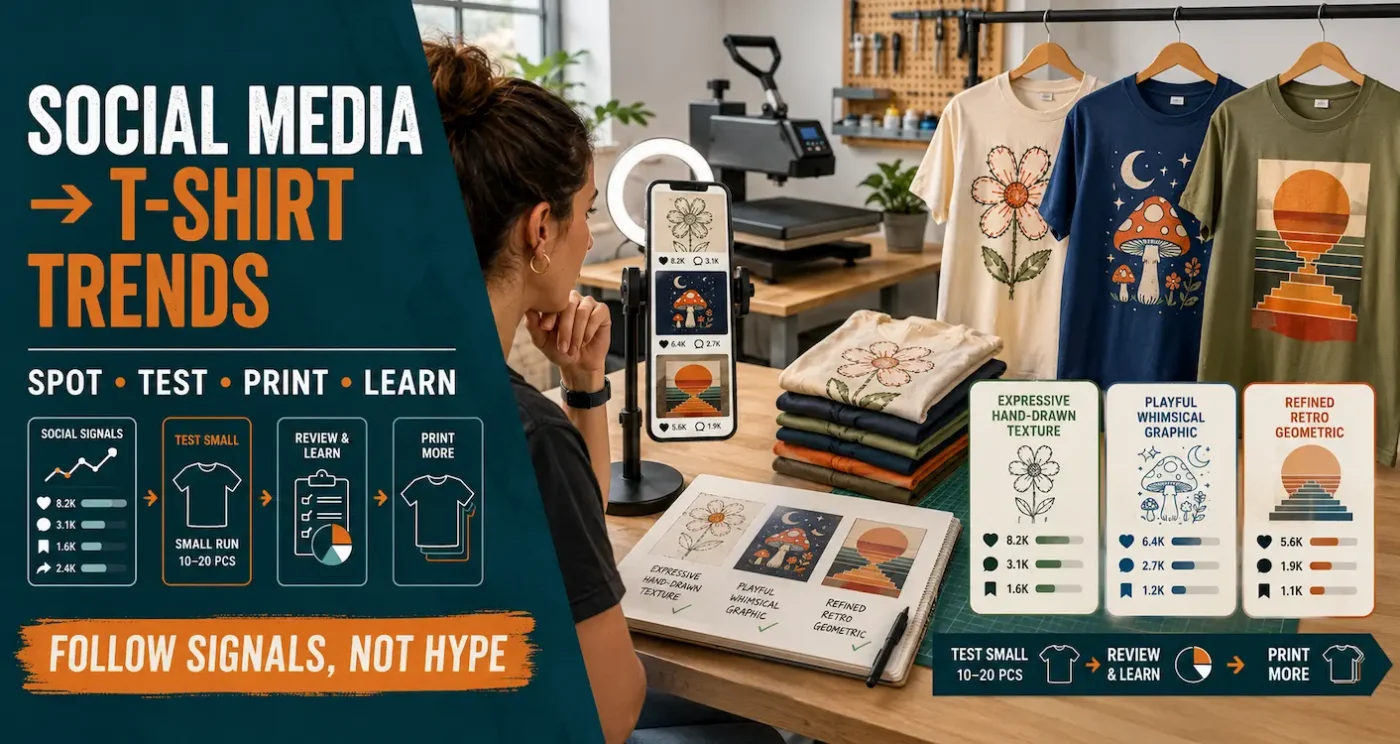
A Spot, Test, Print and Learn Workflow
Step 1: Spot repeated signals
Keep a simple record of phrases, colours, visual structures, questions and communities that appear repeatedly. Separate evidence from personal taste. Record where and when the signal appeared so you can see whether it is spreading or merely being reposted.
Step 2: Check audience and rights
Ask who would wear the design and why. Search for existing trademarks, copyrighted artwork and obvious ownership problems before investing design time. A trend involving a celebrity, sports team, film, game, song or brand is not automatically available for commercial use.
Step 3: Create an original concept
Translate the underlying mood into your own artwork. Build around your audience’s language and values instead of tracing the most visible example. Prepare a clear hero design and, if justified, one or two controlled colour variants.
Step 4: Test the message before the stock
Show realistic mock-ups, a sketch-to-print video or a choice between two versions. Ask a specific question such as “Which colour would you wear?” rather than “Do you like this?” A poll is evidence of preference, not a purchase order, so keep the next step small.
Step 5: Print a small physical run
Order a test transfer, press it onto the intended garment and inspect the real colour, scale and feel. Photograph and film the actual product. If you proceed, begin with a small run, preorder or made-to-order approach that matches your handling capacity.
Step 6: Measure useful actions
Track product-page visits, email sign-ups, size requests, add-to-cart activity and paid orders. Note whether one design, shirt colour or audience segment is driving the result.
Step 7: Scale, revise or retire
Print more only when sales justify it. Revise artwork when customers understand the concept but the product is not converting. Retire a weak idea quickly and record what you learnt rather than discounting a large pile of stock.
Designing T-Shirts for Social Discovery and Real Printing
A shirt has to work twice: as a physical garment and as a small image on a phone. Optimising only one can damage the other.
- Make the idea readable quickly: use a clear focal point and avoid forcing every detail into one print.
- Check the thumbnail: reduce the mock-up to phone-feed size. If the concept disappears, strengthen the hierarchy.
- Show scale honestly: unrealistic oversized mock-ups create disappointed customers.
- Use garment colour intentionally: the shirt can provide background, outline and negative space.
- Design for movement: speciality finishes and reflective effects may need a short video or changing light to communicate.
- Prepare production artwork separately: the social mock-up is not necessarily the print-ready file.
- Keep text accurate: check spelling, dates, personalisation and punctuation before accepting orders.
For production, supply transparent PNG artwork at the intended size and preferably 300 DPI. Crop it tightly and avoid isolated elements narrower than approximately 1 mm or four pixels at print size. Our Photopea artwork guide explains how to prepare a print-ready file using free software.
Why DTF Transfers Suit Trend Testing
DTF does not make a weak trend profitable, but it can reduce the production risk involved in testing one.
- No minimum order is required for the current DTF range.
- Several test designs can be placed efficiently on a custom DTF gang sheet.
- Transfers can be ordered before committing them to a particular garment size.
- The same artwork can be tested on different compatible shirt colours and fabrics.
- Short runs, preorders and made-to-order production reduce finished-stock risk.
- Full-colour artwork avoids separate screens or vinyl layers for each colour.
Ready-to-press DTF still requires a suitable heat press, correct artwork and testing. We print the file supplied and do not routinely perform design, spelling or trend checks as part of our budget service. Read our DTF artwork and application tips before ordering.
Copyright, Trademarks and Viral Content
Visibility is not permission. A design appearing in thousands of posts does not place it in the public domain.
- Do not print celebrity photographs without appropriate rights.
- Do not copy sports logos, fashion brands, game characters, film artwork or music merchandise.
- Song lyrics, catchphrases and slogans may be copyrighted or trademarked.
- Do not trace another creator’s viral artwork or make only superficial changes.
- Check commercial-use terms for fonts, stock elements, templates and AI tools.
- Keep licences, permissions and source files with the job records.
The customer supplying artwork is responsible for having the right to reproduce it. If ownership is uncertain, create something genuinely original or obtain written permission before ordering.
What Should You Measure After Launch?
Follower count and views can be useful context, but business decisions require behaviour closer to a sale.
| Signal | What it may tell you | How much weight to give it |
|---|---|---|
| Views and reach | The platform distributed the content | Low without stronger actions |
| Likes | The content created a quick positive reaction | Low to moderate |
| Saves and shares | The idea may have lasting value or social relevance | Moderate |
| Specific comments | People want a colour, size, variation or explanation | Moderate to strong |
| Product-page visits | Interest moved beyond the social post | Strong when measured against reach |
| Add-to-cart activity | The product and price reached serious consideration | Strong, but investigate checkout drop-off |
| Paid orders | The design, product, price and trust combined successfully | Strongest |
| Repeat orders and referrals | The idea may have value beyond its first wave of attention | Strongest long-term signal |
Common Social-Trend Mistakes
- Chasing every viral post: constant reaction produces an incoherent range and exhausted customers.
- Ordering stock before testing: attention can disappear before production is ready.
- Copying instead of interpreting: this creates legal risk and leaves no reason to choose your version.
- Treating mock-ups as proof: a digital image cannot confirm print colour, size, feel or durability.
- Reading views as sales: entertainment and purchase behaviour are not the same.
- Ignoring the audience: a global trend may have no relevance to your local customers.
- Overproducing variants: too many colours and garments divide limited demand.
- Responding too slowly: some ideas should be rejected because their useful selling window has already closed.
- Forgetting fulfilment: a viral result can still damage a business if orders cannot be produced and dispatched accurately.
Frequently Asked Questions
What T-shirt designs are trending in 2026?
Broad signals include expressive hand-made texture, playful whimsy, meaningful personalisation, community identity and remixed nostalgic aesthetics. These are starting points, not guaranteed bestsellers. Validate them with your own audience.
Which social platform is best for finding T-shirt trends?
No single platform is sufficient. TikTok is strong for rapid discovery and community language, Instagram for styling and proof, Pinterest for visual planning and longer-lived aesthetics, and marketplaces for stronger buying-intent signals.
How do I know whether a trend will sell?
You cannot know with certainty. Look for repeated signals across several sources, specific customer questions and movement from social posts to product pages or preorders. Then test a small physical run.
How many shirts should I print for a trend test?
There is no universal quantity. Base it on confirmed interest, audience size, garment availability and your ability to use leftover stock. A preorder, made-to-order offer or very small run is safer than guessing.
Can I print a meme or viral image?
Only if you own the relevant rights or have permission. Viral distribution does not remove copyright, trademark, publicity or licensing restrictions.
Can I use a celebrity image or song lyric?
Do not assume so. Celebrity photographs, names, likenesses, logos and lyrics can involve several separate rights. Obtain appropriate permission or use original subject matter.
Are likes a good way to choose a design?
Likes are a weak signal on their own. Saves, shares, specific buying questions, product-page visits, add-to-cart activity and paid orders are progressively more useful.
Why are DTF gang sheets useful for testing?
Several original designs or sizes can share one sheet, reducing the need to order a long run of one unproven graphic. You can press only the transfers needed after testing the exact garment.
Should I create a new article every year?
No. Update this retained article as platforms, design signals and customer behaviour change. That keeps its history, internal links and search value in one useful resource.
Current Trend Sources
This update draws on TikTok’s Next Report 2026, Pinterest Business’s Pinterest Predicts 2026 and Etsy’s Spring and Summer 2026 Seller Trend Report. Platform reports are useful evidence of behaviour within those platforms, but they are not guarantees that a specific T-shirt will sell.
